







Question: An important problem in satellite dynamics is to determine the position of an object given the geometric parameters of its orbit. A particular parameter
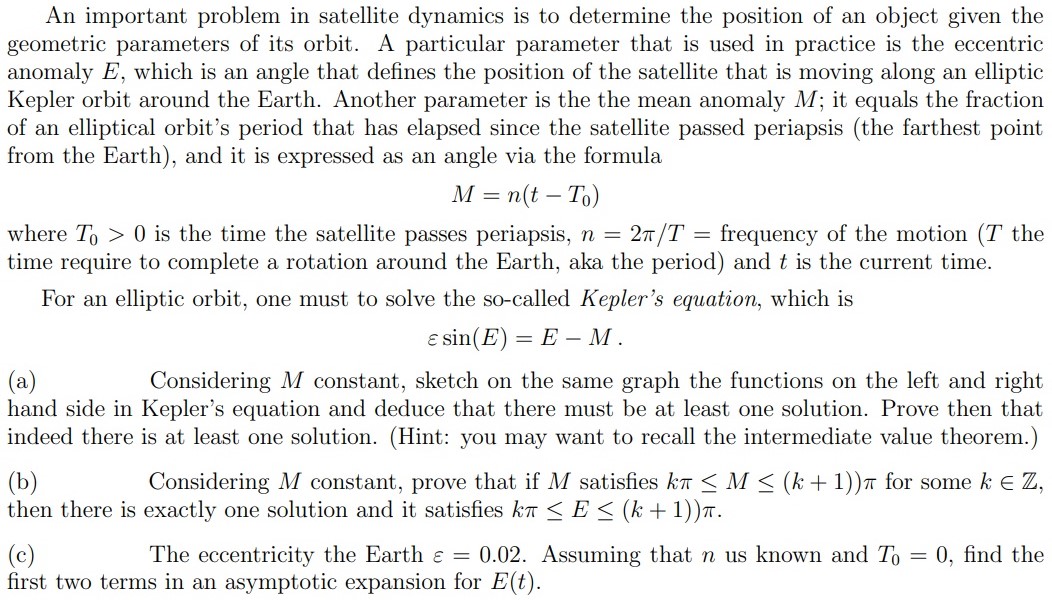
An important problem in satellite dynamics is to determine the position of an object given the geometric parameters of its orbit. A particular parameter that is used in practice is the eccentric anomaly E, which is an angle that defines the position of the satellite that is moving along an elliptic Kepler orbit around the Earth. Another parameter is the the mean anomaly M; it equals the fraction of an elliptical orbit's period that has elapsed since the satellite passed periapsis (the farthest point from the Earth), and it is expressed as an angle via the formula M = n(t - To) = where To 0 is the time the satellite passes periapsis, n = 2/T frequency of the motion (T the time require to complete a rotation around the Earth, aka the period) and t is the current time. For an elliptic orbit, one must to solve the so-called Kepler's equation, which is (a) E sin(E) E-M. = Considering M constant, sketch on the same graph the functions on the left and right hand side in Kepler's equation and deduce that there must be at least one solution. Prove then that indeed there is at least one solution. (Hint: you may want to recall the intermediate value theorem.) (b) Considering M constant, prove that if M satisfies k M (k+1)) for some k Z, then there is exactly one solution and it satisfies k E (k+1)). (c) The eccentricity the Earth = 0.02. Assuming that n us known and To first two terms in an asymptotic expansion for E(t). = 0, find the
Step by Step Solution
There are 3 Steps involved in it

Get step-by-step solutions from verified subject matter experts
 Study Help