



Question: An important unit consists of two components placed in par- allel. The unit performs satisfactorily if one of the two components is operating. Therefore, only
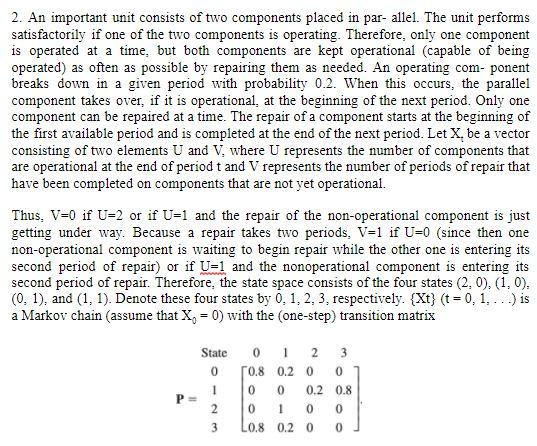
An important unit consists of two components placed in par- allel. The unit performs satisfactorily if one of the two components is operating. Therefore, only one component is operated at a time, but both components are kept operational (capable of being operated) as often as possible by repairing them as needed. An operating com- ponent breaks down in a given period with probability 0.2. When this occurs, the parallel component takes over, if it is operational, at the beginning of the next period. Only one component can be repaired at a time. The repair of a component starts at the beginning of the first available period and is completed at the end of the next period. Let Xt be a vector consisting of two elements U and V, where U represents the number of components that are operational at the end of period t and V represents the number of periods of repair that have been completed on components that are not yet operational.
Thus, V=0 if U=2 or if U=1 and the repair of the non-operational component is just getting under way. Because a repair takes two periods, V=1 if U=0 (since then one non-operational component is waiting to begin repair while the other one is entering its second period of repair) or if U=1 and the nonoperational component is entering its second period of repair. Therefore, the state space consists of the four states (2, 0), (1, 0), (0, 1), and (1, 1). Denote these four states by 0, 1, 2, 3, respectively. {Xt} (t = 0, 1, . . .) is a Markov chain (assume that X0 = 0) with the (one-step) transition matrix.
Compute for the long-term or steady-state probability of each state. show solution
2. An important unit consists of two components placed in par- allel. The unit performs satisfactorily if one of the two components is operating. Therefore, only one component is operated at a time, but both components are kept operational (capable of being operated) as often as possible by repairing them as needed. An operating com- ponent breaks down in a given period with probability 0.2. When this occurs, the parallel component takes over, if it is operational, at the beginning of the next period. Only one component can be repaired at a time. The repair of a component starts at the beginning of the first available period and is completed at the end of the next period. Let X. be a vector consisting of two elements U and V, where U represents the number of components that are operational at the end of period t and V represents the number of periods of repair that have been completed on components that are not yet operational. Thus, V=0 if U=2 or if U=1 and the repair of the non-operational component is just getting under way. Because a repair takes two periods. V=1 if U=0 (since then one non-operational component is waiting to begin repair while the other one is entering its second period of repair) or if U=1 and the nonoperational component is entering its second period of repair. Therefore, the state space consists of the four states (2.0), (1, 0). (0.1), and (1, 1). Denote these four states by 0. 1, 2, 3, respectively. {Xt} (t = 0, 1, ...) is a Markov chain (assume that X, = 0) with the one-step) transition matrix State 0 0 1 2 3 [0.8 0.2 0 0 0 0 0.2 0.8 1 P= 2 0 1 0 0 3 L0.8 0.20 0
Step by Step Solution
There are 3 Steps involved in it

Get step-by-step solutions from verified subject matter experts