



Question: An individual cell such as an egg cell ( an ovum, produced in the ovaries ) is commonly organized spatially, as manifested in part by
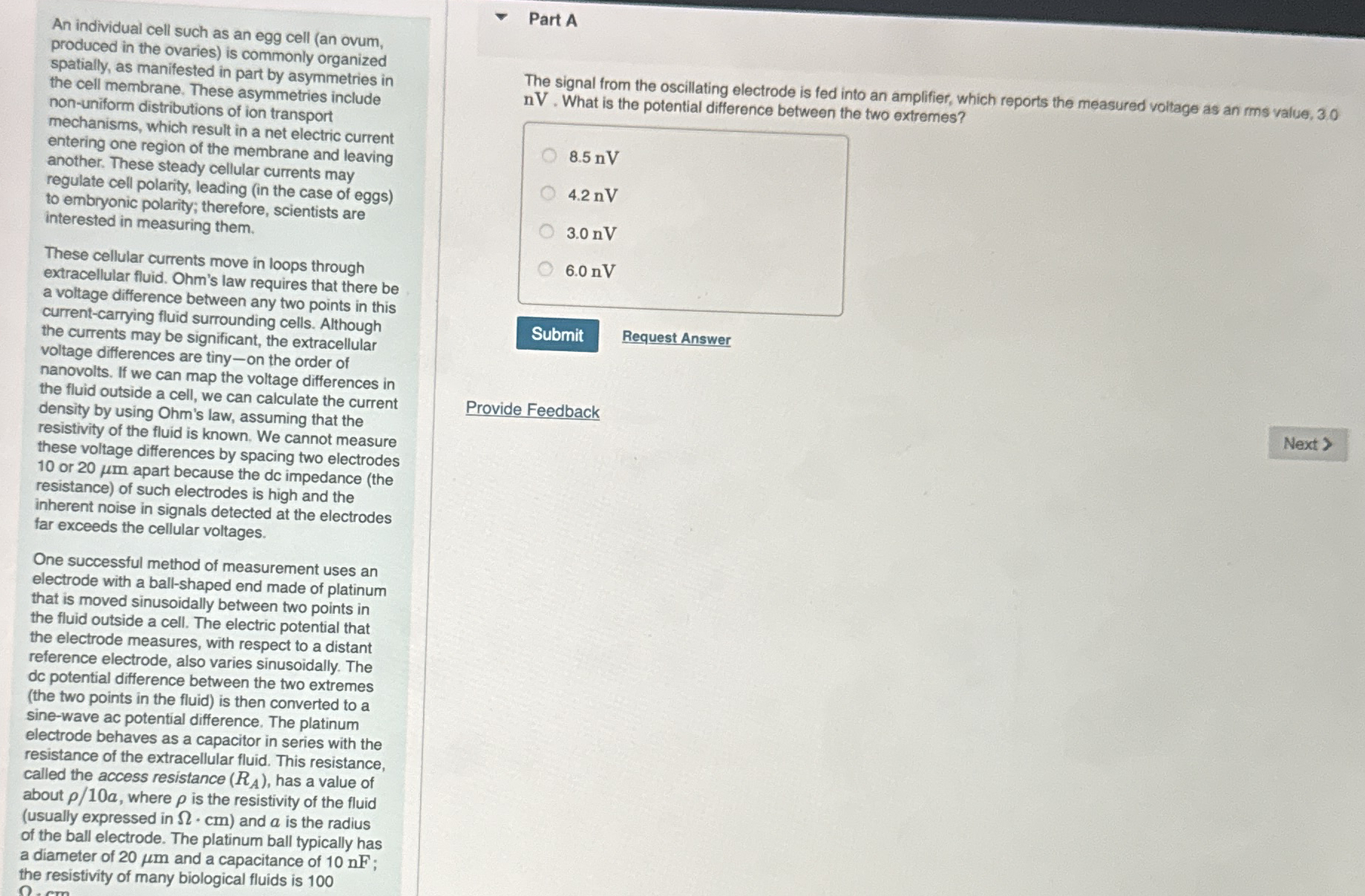
An individual cell such as an egg cell an ovum, produced in the ovaries is commonly organized spatially, as manifested in part by asymmetries in the cell membrane. These asymmetries include nonuniform distributions of ion transport mechanisms, which result in a net electric current entering one region of the membrane and leaving another. These steady cellular currents may regulate cell polarity, leading in the case of eggs to embryonic polarity; therefore, scientists are interested in measuring them.
These cellular currents move in loops through extracellular fluid. Ohm's law requires that there be a voltage difference between any two points in this currentcarrying fluid surrounding cells. Although the currents may be significant, the extracellular voltage differences are tinyon the order of nanovolts. If we can map the voltage differences in the fluid outside a cell, we can calculate the current density by using Ohm's law, assuming that the resistivity of the fluid is known. We cannot measure these voltage differences by spacing two electrodes or apart because the dc impedance the resistance of such electrodes is high and the inherent noise in signals detected at the electrodes far exceeds the cellular voltages.
One successful method of measurement uses an electrode with a ballshaped end made of platinum that is moved sinusoidally between two points in the fluid outside a cell. The electric potential that the electrode measures, with respect to a distant reference electrode, also varies sinusoidally The dc potential difference between the two extremes the two points in the fluid is then converted to a sinewave ac potential difference. The platinum electrode behaves as a capacitor in series with the resistance of the extracellular fluid. This resistance, called the access resistance has a value of about where is the resistivity of the fluid usually expressed in and is the radius of the ball electrode. The platinum ball typically has a diameter of and a capacitance of nF ; the resistivity of many biological fluids is
Part A
The signal from the oscillating electrode is fed into an amplifier, which reports the measured voltage as an rms value, nV What is the potential difference between the two extremes?
nV
nV
nV
nV
Request Answer
Provide Feedback
Step by Step Solution
There are 3 Steps involved in it
1 Expert Approved Answer
Step: 1 Unlock

Question Has Been Solved by an Expert!
Get step-by-step solutions from verified subject matter experts
Step: 2 Unlock
Step: 3 Unlock