





Question: AN INVENTORY MANAGEMENT PROBLEM In the following problem, find the best ordering policies: JA company that sells a single product would like to decide how

AN INVENTORY MANAGEMENT PROBLEM
AN INVENTORY MANAGEMENT PROBLEM In the following

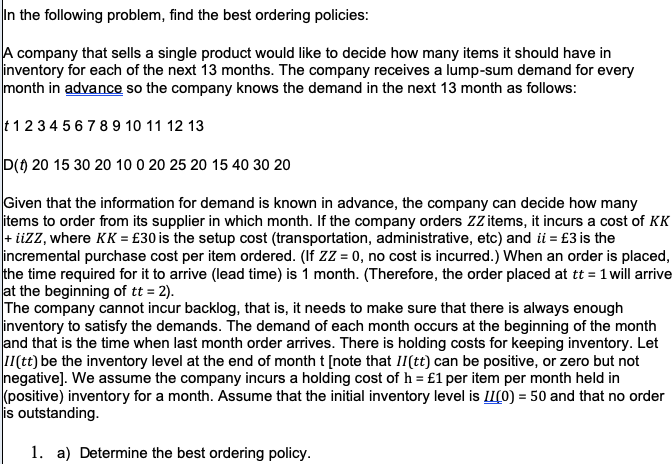
In the following problem, find the best ordering policies: JA company that sells a single product would like to decide how many items it should have in inventory for each of the next 13 months. The company receives a lump-sum demand for every month in advance so the company knows the demand in the next 13 month as follows: t 1 2 3 4 5 6 7 8 9 10 11 12 13 D(1) 20 15 30 20 10 0 20 25 20 15 40 30 20 Given that the information for demand is known in advance, the company can decide how many Jitems to order from its supplier in which month. If the company orders ZZ items, it incurs a cost of KK + iiZz, where KK = 30 is the setup cost (transportation, administrative, etc) and ii = 3 is the incremental purchase cost per item ordered. (If ZZ = 0, no cost is incurred.) When an order is placed, the time required for it to arrive (lead time) is 1 month. (Therefore, the order placed at tt = 1 will arrive at the beginning of tt = 2). The company cannot incur backlog, that is, it needs to make sure that there is always enough inventory to satisfy the demands. The demand of each month occurs at the beginning of the month Jand that is the time when last month order arrives. There is holding costs for keeping inventory. Let JI(tt) be the inventory level at the end of month t [note that Il(tt) can be positive, or zero but not negative). We assume the company incurs a holding cost of h = 1 per item per month held in (positive) inventory for a month. Assume that the initial inventory level is LICO) = 50 and that no order is outstanding. 1. a) Determine the best ordering policy

Step by Step Solution

There are 3 Steps involved in it

1 Expert Approved Answer
Step: 1 Unlock blur-text-image

Question Has Been Solved by an Expert!

Get step-by-step solutions from verified subject matter experts

Step: 2 Unlock
Step: 3 Unlock

Students Have Also Explored These Related General Management Questions!