







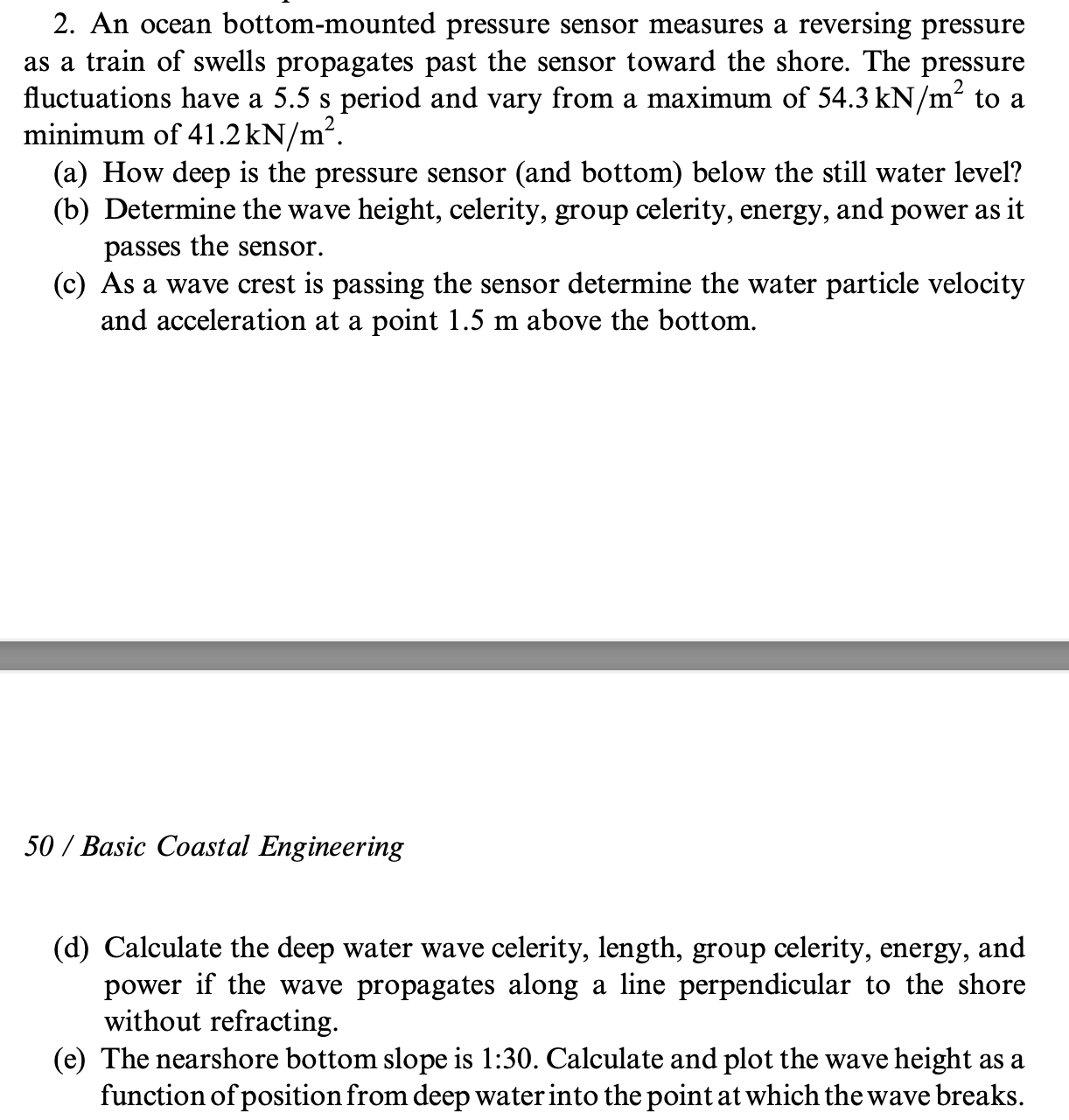
Question: An ocean bottom - mounted pressure sensor measures a reversing pressure as a train of swells propagates past the sensor toward the shore. The pressure
An ocean bottommounted pressure sensor measures a reversing pressure
as a train of swells propagates past the sensor toward the shore. The pressure
fluctuations have a period and vary from a maximum of to a
minimum of
a How deep is the pressure sensor and bottom below the still water level?
b Determine the wave height, celerity, group celerity, energy, and power as it
passes the sensor
c As a wave crest is passing the sensor determine the water particle velocity
and acceleration at a point above the bottom.
Basic Coastal Engineering
d Calculate the deep water wave celerity, length, group celerity, energy, and
power if the wave propagates along a line perpendicular to the shore
without refracting.
e The nearshore bottom slope is : Calculate and plot the wave height as a
function of position from deep water into the point at which the wave breaks.
Step by Step Solution
There are 3 Steps involved in it
1 Expert Approved Answer
Step: 1 Unlock

Question Has Been Solved by an Expert!
Get step-by-step solutions from verified subject matter experts
Step: 2 Unlock
Step: 3 Unlock
 Study Help