







Question: These problems are (mostly) simplified versions of real-world problems. Because of this, you may need use critical thinking to make occasional assumptions about some of
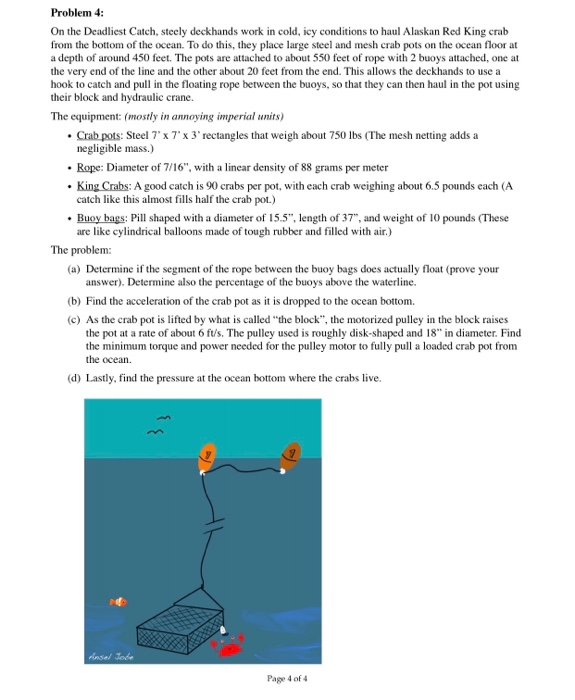
Problem 4: On the Deadliest Catch, steely deckhands work in cold, icy conditions to haul Alaskan Red King crab from the bottom of the ocean. To do this, they place large steel and mesh crab pots on the ocean floor at a depth of around 450 feet. The pots are attached to about 550 feet of rope with 2 buoys attached, one at the very end of the line and the other about 20 feet from the end. This allows the deckhands to use a hook to catch and pull in the floating rope between the buoys, so that they can then haul in the pot using their block and hydraulic crane. The equipment: (mostly in annoying imperial units) Crab pots: Steel 7" x 7" x 3" rectangles that weigh about 750 lbs (The mesh netting adds a negligible mass.) Rope: Diameter of 7/16", with a linear density of 88 grams per meter King Crabs: A good catch is 90 crabs per pot, with each crab weighing about 6.5 pounds each (A catch like this almost fills half the crab pot.) Buoy bags: Pill shaped with a diameter of 15.5", length of 37", and weight of 10 pounds (These are like cylindrical balloons made of tough rubber and filled with air.) The problem: (a) Determine if the segment of the rope between the buoy bags does actually float (prove your answer). Determine also the percentage of the buoys above the waterline. (b) Find the acceleration of the crab pot as it is dropped to the ocean bottom. (c) As the crab pot is lifted by what is called "the block", the motorized pulley in the block raises the pot at a rate of about 6 fts. The pulley used is roughly disk-shaped and 18" in diameter. Find the minimum torque and power needed for the pulley motor to fully pull a loaded crab pot from the ocean. (d) Lastly, find the pressure at the ocean bottom where the crabs live. Ansel Tote Page 4 of 4 Problem 4: On the Deadliest Catch, steely deckhands work in cold, icy conditions to haul Alaskan Red King crab from the bottom of the ocean. To do this, they place large steel and mesh crab pots on the ocean floor at a depth of around 450 feet. The pots are attached to about 550 feet of rope with 2 buoys attached, one at the very end of the line and the other about 20 feet from the end. This allows the deckhands to use a hook to catch and pull in the floating rope between the buoys, so that they can then haul in the pot using their block and hydraulic crane. The equipment: (mostly in annoying imperial units) Crab pots: Steel 7" x 7" x 3" rectangles that weigh about 750 lbs (The mesh netting adds a negligible mass.) Rope: Diameter of 7/16", with a linear density of 88 grams per meter King Crabs: A good catch is 90 crabs per pot, with each crab weighing about 6.5 pounds each (A catch like this almost fills half the crab pot.) Buoy bags: Pill shaped with a diameter of 15.5", length of 37", and weight of 10 pounds (These are like cylindrical balloons made of tough rubber and filled with air.) The problem: (a) Determine if the segment of the rope between the buoy bags does actually float (prove your answer). Determine also the percentage of the buoys above the waterline. (b) Find the acceleration of the crab pot as it is dropped to the ocean bottom. (c) As the crab pot is lifted by what is called "the block", the motorized pulley in the block raises the pot at a rate of about 6 fts. The pulley used is roughly disk-shaped and 18" in diameter. Find the minimum torque and power needed for the pulley motor to fully pull a loaded crab pot from the ocean. (d) Lastly, find the pressure at the ocean bottom where the crabs live. Ansel Tote Page 4 of 4
Step by Step Solution
There are 3 Steps involved in it

Get step-by-step solutions from verified subject matter experts
 Study Help