







Question: An organization uses application whitelisting to help prevent zero-day attacks. Malware was recently identified on one client, which was able to run despite the organization's
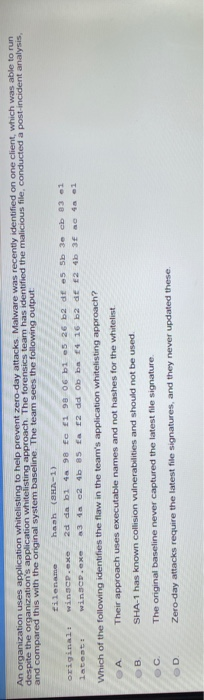
An organization uses application whitelisting to help prevent zero-day attacks. Malware was recently identified on one client, which was able to run despite the organization's application whitelisting approach. The forensics team has identified the malicious file, conducted a post-incident analysis, and compared this with the original system baseline. The team sees the following output filename haah (BHA-1) original: winCP.exe 2d da bi 4a 98 fe 1 98 OG bi e5 26 b2 af os 5b 30 cb 03 -1 latest: winBCP.exe -3 da c2 tb es ta 12 dd ob ba 14 16 b2 de 12 45 3 as ta ei Which of the following identifies the flaw in the team's application whitelisting approach? OA Their approach uses executable names and not hashes for the whitelist SHA-1 has known collision vulnerabilities and should not be used The original baseline never captured the latest file signature Zero-day attacks require the latest file signatures, and they never updated these. D
Step by Step Solution
There are 3 Steps involved in it

Get step-by-step solutions from verified subject matter experts
 Study Help