







Question: Analysis and Conclusion PART 2: For this second part, you'll make quantitative calculations. Click ON all three show velocity vector, show acceleration vector, and Ruler
Analysis and Conclusion
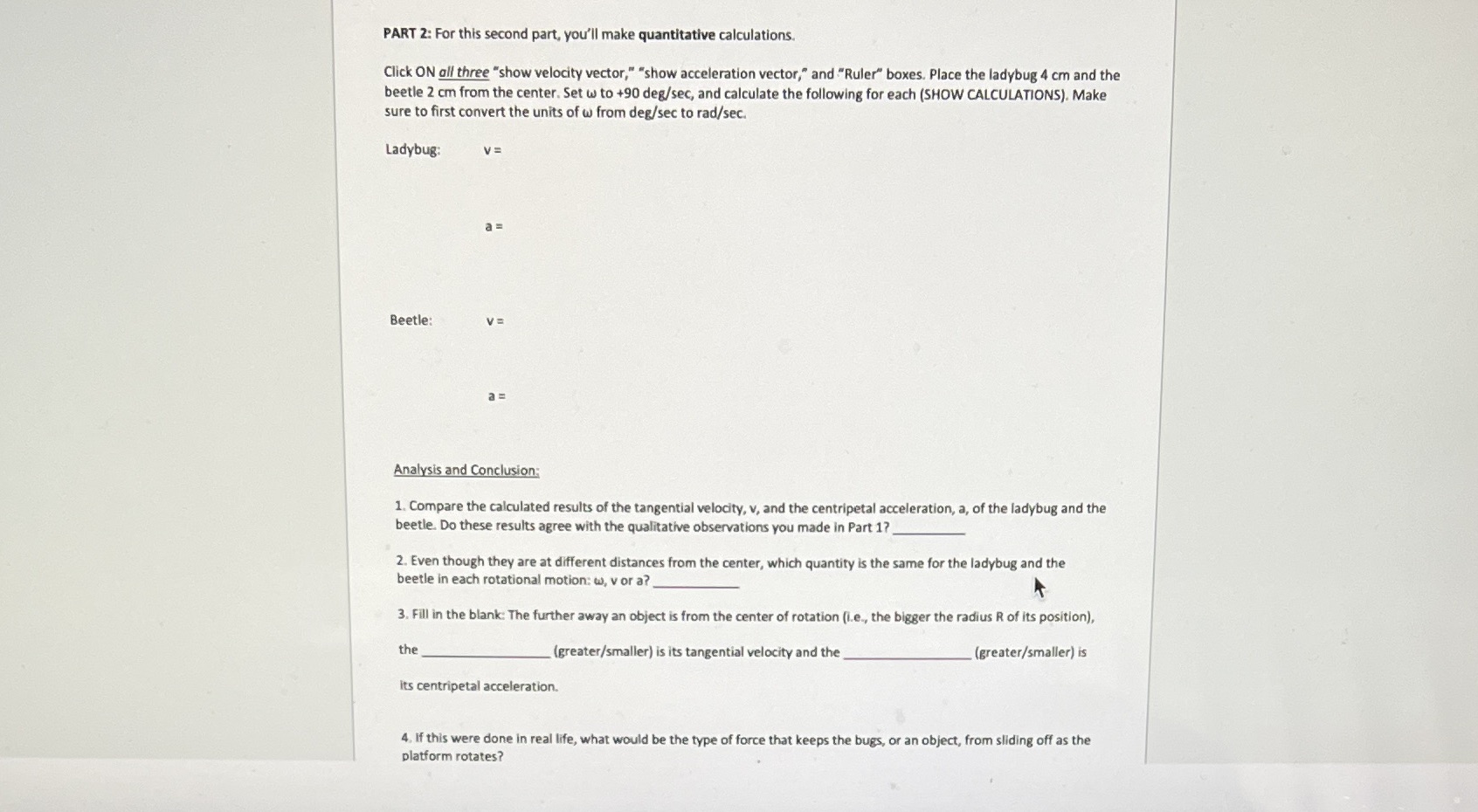
PART 2: For this second part, you'll make quantitative calculations. Click ON all three "show velocity vector," "show acceleration vector," and "Ruler" boxes. Place the ladybug 4 cm and the beetle 2 cm from the center. Set w to +90 deg/sec, and calculate the following for each (SHOW CALCULATIONS). Make sure to first convert the units of w from deg/sec to rad/sec. Ladybug: V= a= Beetle: V= a= Analysis and Conclusion: 1. Compare the calculated results of the tangential velocity, v, and the centripetal acceleration, a, of the ladybug and the beetle. Do these results agree with the qualitative observations you made in Part 1? 2. Even though they are at different distances from the center, which quantity is the same for the ladybug and the beetle in each rotational motion: w, v or a? 3. Fill in the blank: The further away an object is from the center of rotation (i.e., the bigger the radius R of its position), the (greater/smaller) is its tangential velocity and the (greater/smaller) is its centripetal acceleration. 4. If this were done in real life, what would be the type of force that keeps the bugs, or an object, from sliding off as the platform rotates
Step by Step Solution
There are 3 Steps involved in it

Get step-by-step solutions from verified subject matter experts
 Study Help