







Question: Analysis of Algorithm Given a sequence A = {a_1, ..., a_n, } of points on the real line. The task is to determine the smallest
Analysis of Algorithm
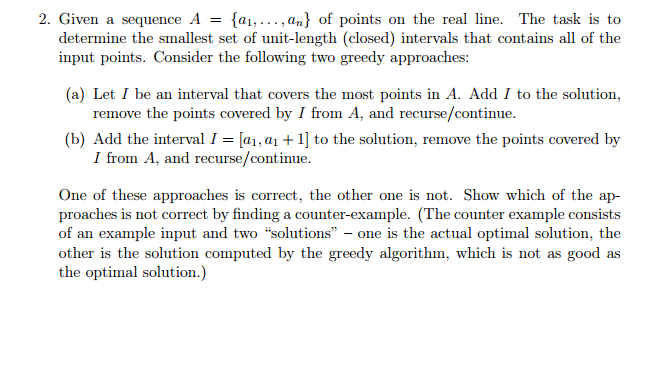
Given a sequence A = {a_1, ..., a_n, } of points on the real line. The task is to determine the smallest set of unit-length (closed) intervals that contains all of the input points. Consider the following two greedy approaches: (a) Let I be an interval that covers the most points in A. Add I to the solution, remove the points covered by I from A, and recourse/continue. (b) Add the interval I = [a_1, a_1 + 1] to the solution, remove the points covered by I from A, and recourse/continue. One of these approaches is correct, the other one is not. Show which of the approaches is not correct by finding a counter-example. (The counter example consists of an example input and two "solutions" - one is the actual optimal solution, the other is the solution computed by the greedy algorithm, which is not as good as the optimal solution.) Given a sequence A = {a_1, ..., a_n, } of points on the real line. The task is to determine the smallest set of unit-length (closed) intervals that contains all of the input points. Consider the following two greedy approaches: (a) Let I be an interval that covers the most points in A. Add I to the solution, remove the points covered by I from A, and recourse/continue. (b) Add the interval I = [a_1, a_1 + 1] to the solution, remove the points covered by I from A, and recourse/continue. One of these approaches is correct, the other one is not. Show which of the approaches is not correct by finding a counter-example. (The counter example consists of an example input and two "solutions" - one is the actual optimal solution, the other is the solution computed by the greedy algorithm, which is not as good as the optimal solution.)
Step by Step Solution
There are 3 Steps involved in it

Get step-by-step solutions from verified subject matter experts
 Study Help