







Question: analyze a performance problem Using the Mager & Pipe model to remedy a performance problem This assignment is worth 6% of the course grade. The
analyze a performance problem 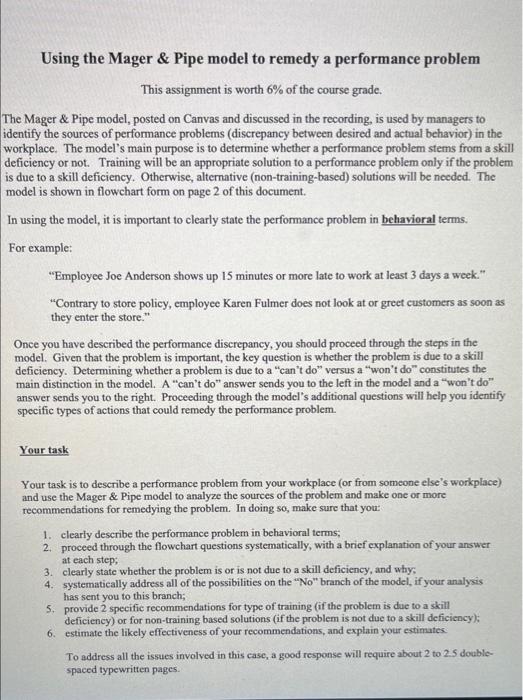
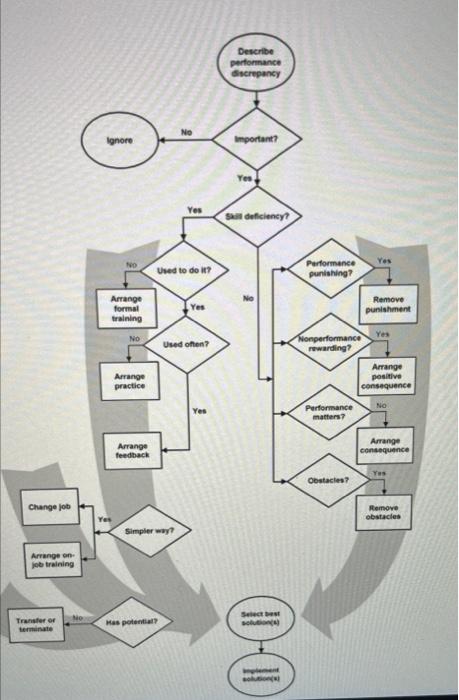
Using the Mager & Pipe model to remedy a performance problem This assignment is worth 6% of the course grade. The Mager & Pipe model, posted on Canvas and discussed in the recording, is used by managers to identify the sources of performance problems (discrepancy between desired and actual behavior) in the workplace. The model's main purpose is to determine whether a performance problem stems from a skill deficiency or not. Training will be an appropriate solution to a performance problem only if the problem is due to a skill deficiency. Otherwise, alternative (non-training-based) solutions will be needed. The model is shown in flowchart form on page 2 of this document. In using the model, it is important to clearly state the performance problem in behavioral terms. For example: "Employee Joe Anderson shows up 15 minutes or more late to work at least 3 days a week." "Contrary to store policy, employee Karen Fulmer does not look at or greet customers as soon as they enter the store." Once you have described the performance discrepancy, you should proceed through the steps in the model. Given that the problem is important, the key question is whether the problem is due to a skill deficiency. Determining whether a problem is due to a "can't do" versus a "won't do" constitutes the main distinction in the model. A "can't do" answer sends you to the left in the model and a "won't do" answer sends you to the right. Proceeding through the model's additional questions will help you identify specific types of actions that could remedy the performance problem. Your task Your task is to describe a performance problem from your workplace (or from someone else's workplace) and use the Mager & Pipe model to analyze the sources of the problem and make one or more recommendations for remedying the problem. In doing so, make sure that you: 1. clearly describe the performance problem in behavioral terms; 2. proceed through the flowchart questions systematically, with a brief explanation of your answer at each step; 3. clearly state whether the problem is or is not due to a skill deficiency, and why; 4. systematically address all of the possibilities on the "No" branch of the model, if your analysis has sent you to this branch; 5. provide 2 specific recommendations for type of training (if the problem is due to a skill deficiency) or for non-training based solutions (if the problem is not due to a skill deficiency); 6. estimate the likely effectiveness of your recommendations, and explain your estimates. To address all the issues involved in this case, a good response will require about 2 to 2.5 double- spaced typewritten pages. Change job Arrange on job training Transfer or terminate Ignore Arrange formal training No Arrange practice Arrange feedback Yes Used to do it? Yes Used often? Yes Simpler way? Has potential? Describe performance discrepancy Important? Yes Skill deficiency? Select best solution(s) solution(s) Yes Remove punishment Yes Arrange positive consequence No Arrange consequence Yes Remove obstacles Performance punishing? Nonperformance rewarding? Performance matters? Obstacles Step by Step Solution
There are 3 Steps involved in it
1 Expert Approved Answer
Step: 1 Unlock

Question Has Been Solved by an Expert!
Get step-by-step solutions from verified subject matter experts
Step: 2 Unlock
Step: 3 Unlock
 Study Help