







Question: Analyze the current inventory management practices ( i . e . , order quantity and frequency, reorder point and safety stock, etc. ) at Kaffee
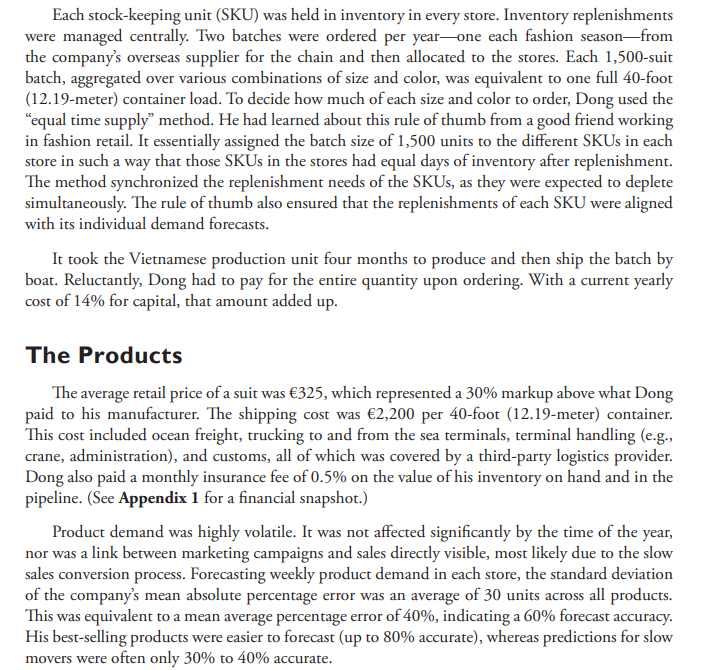
Analyze the current inventory management practices ie order quantity and frequency, reorder point and safety stock, etc. at Kaffee Kostuum. Each stockkeeping unit SKU was held in inventory in every store. Inventory replenishments were managed centrally. Two batches were ordered per yearone each fashion seasonfrom the company's overseas supplier for the chain and then allocated to the stores. Each suit batch, aggregated over various combinations of size and color, was equivalent to one full foot meter container load. To decide how much of each size and color to order, Dong used the "equal time supply" method. He had learned about this rule of thumb from a good friend working in fashion retail. It essentially assigned the batch size of units to the different SKUs in each store in such a way that those SKUs in the stores had equal days of inventory after replenishment. The method synchronized the replenishment needs of the SKUs, as they were expected to deplete simultaneously. The rule of thumb also ensured that the replenishments of each SKU were aligned with its individual demand forecasts.
It took the Vietnamese production unit four months to produce and then ship the batch by boat. Reluctantly, Dong had to pay for the entire quantity upon ordering. With a current yearly cost of for capital, that amount added up
The Products
The average retail price of a suit was which represented a markup above what Dong paid to his manufacturer. The shipping cost was per foot meter container. This cost included ocean freight, trucking to and from the sea terminals, terminal handling eg crane, administration and customs, all of which was covered by a thirdparty logistics provider. Dong also paid a monthly insurance fee of on the value of his inventory on hand and in the pipeline. See Appendix for a financial snapshot.
Product demand was highly volatile. It was not affected significantly by the time of the year, nor was a link between marketing campaigns and sales directly visible, most likely due to the slow sales conversion process. Forecasting weekly product demand in each store, the standard deviation of the company's mean absolute percentage error was an average of units across all products. This was equivalent to a mean average percentage error of indicating a forecast accuracy. His bestselling products were easier to forecast up to accurate whereas predictions for slow movers were often only to accurate. Dong asked a team of MBA students from the Kellogg School of Management to fulfill a summer internship project by advising him on how to improve his financials in the short term. They came up with the following recommendations.
Reduction of the variety. Limiting the number of SKUs would make it easier to predict weekly product demand. Using historical numbers, the students calculated that when demands for similar colors could be aggregated, a reduction of the variety would increase overall forecast accuracy to As variety had always been part of the value proposition, however, Dong wondered whether recent evolutions in machinelearning techniques alternatively could be used to obtain the same forecast accuracy improvements.
Give more ownership to stores to order individually. Unsold stock bothered Dong. Some SKUs had not sold during the past two years, but they were not the same from store to store. If each store were given more ownership, each could place its orders individually, presumably with a closer matching to its markets.
Carry only showroom stock in stores and quickly deliver suits from Frankfurt to buyers. This way, all inventory could be stocked centrally in Frankfurt, and only a few sizecolor combinations would be needed in the stores for fitting purposes. With its central location in Germany, suits could be delivered from Frankfurt within one day at a fee of See Appendix for a map of Europe showing Kaffee Kostuum store locations.
Source from Romania. The students found a production unit in Bucharest that could produce at on average per suit. Although this exceeded the current purchase price, shipping costs would be cut by half. Moreover, with lead times of only four weeks, capital tied up in transit stock could be substantially reduced.
Dong wondered how to assess this report's strategic and financial impact before moving Appendix I: Snapshot Income Statement
Step by Step Solution
There are 3 Steps involved in it
1 Expert Approved Answer
Step: 1 Unlock

Question Has Been Solved by an Expert!
Get step-by-step solutions from verified subject matter experts
Step: 2 Unlock
Step: 3 Unlock
 Study Help