Question: Analyze the following code: Double[] array = {1, 2, 3}; ArrayList list = new ArrayListo(Arrays.asList(array)); System.out.println (list); The code is correct and displays (1.0, 2.0,
![Analyze the following code: Double[] array = {1, 2, 3}; ArrayList](https://s3.amazonaws.com/si.experts.images/answers/2024/08/66d328b0cdfb3_54466d328b054438.jpg)
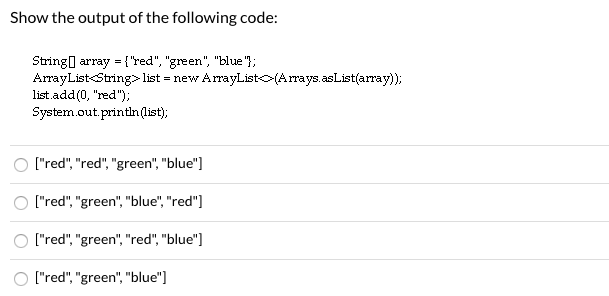
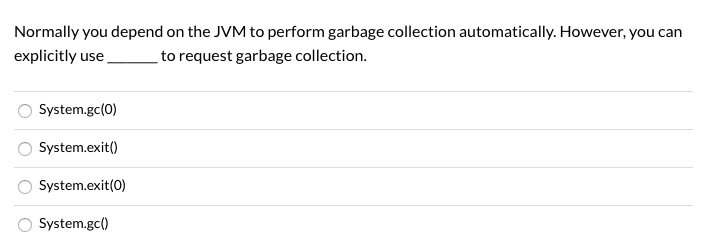
Analyze the following code: Double[] array = {1, 2, 3}; ArrayList list = new ArrayListo(Arrays.asList(array)); System.out.println (list); The code is correct and displays (1.0, 2.0, 3.0). The code has a compile error because an integer such as 1 is automatically converted into an Integer object, but the array element type is Double. The code has a compile error because asList(array) requires that the array elements are objects. The code is correct and displays (1, 2, 3]. Show the output of the following code: String array = {"red", "green", "blue"}; ArrayList list = new ArrayListo(Arrays.asList(array)); list.add(0, "red"); System.out.println(list); O ["red", "red", "green", "blue"] ["red", "green", "blue", "red"] O ["red", "green", "red", "blue"] O ["red", "green", "blue"] Normally you depend on the JVM to perform garbage collection automatically. However, you can explicitly use to request garbage collection. System.gc(0) System.exit() System.exit(0) System.gc()









 Study Help