



Question: Angular displacement A plywood disc is set up with a set of 4 blinkies attached to it . The blinkies are all attached to the
Angular displacement
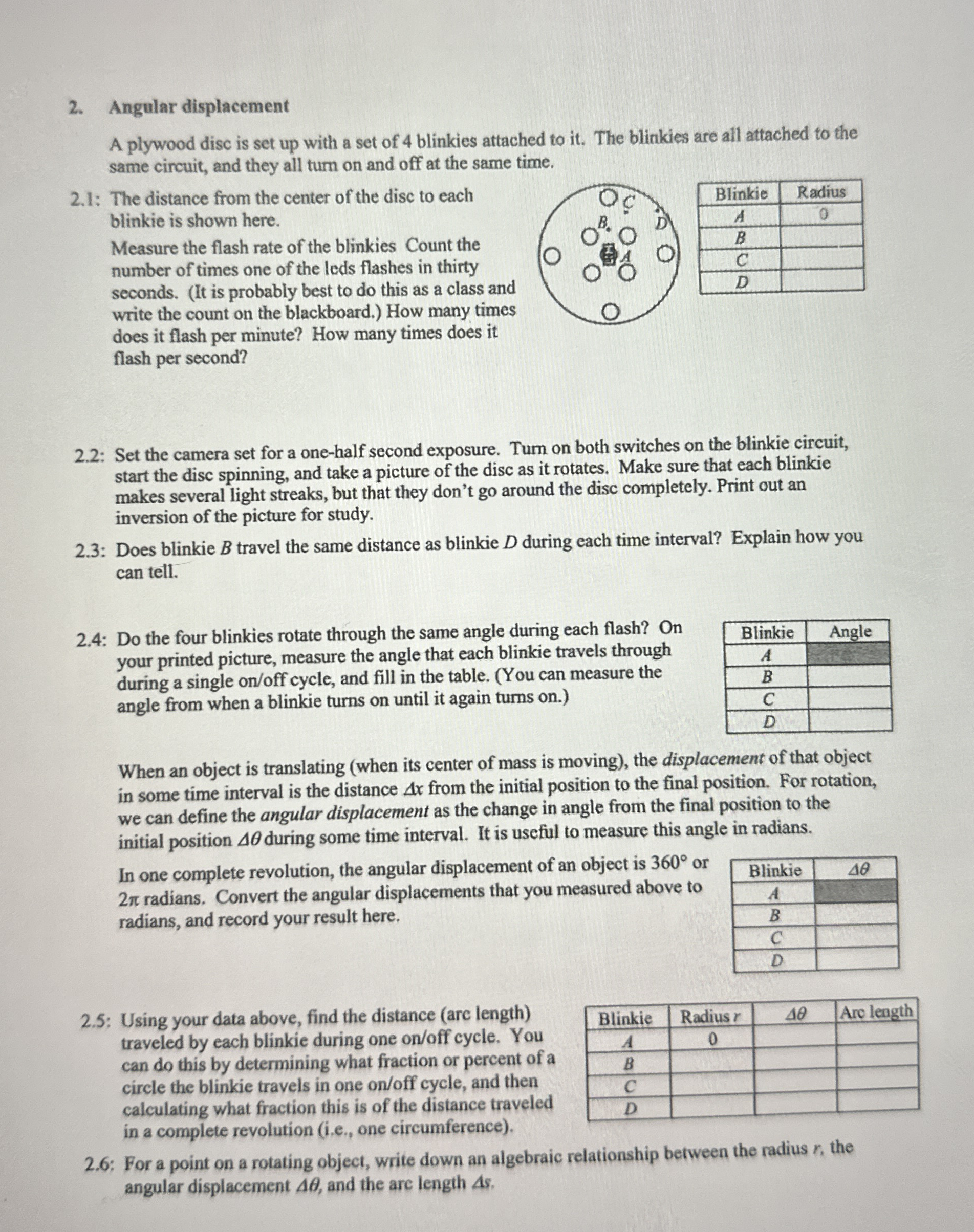
A plywood disc is set up with a set of blinkies attached to it The blinkies are all attached to the same circuit, and they all turn on and off at the same time.
: The distance from the center of the disc to each blinkie is shown here.
Measure the flash rate of the blinkies Count the number of times one of the leds flashes in thirty seconds. It is probably best to do this as a class and write the count on the blackboard. How many times does it flash per minute? How many times does it
tableBlinkieRadius
flash per second?
: Set the camera set for a onehalf second exposure. Turn on both switches on the blinkie circuit, start the disc spinning, and take a picture of the disc as it rotates. Make sure that each blinkie makes several light streaks, but that they don't go around the disc completely. Print out an inversion of the picture for study.
: Does blinkie travel the same distance as blinkie during each time interval? Explain how you can tell.
: Do the four blinkies rotate through the same angle during each flash? On your printed picture, measure the angle that each blinkie travels through during a single onoff cycle, and fill in the table. You can measure the angle from when a blinkie turns on until it again turns on
tableBlinkieAngle
When an object is translating when its center of mass is moving the displacement of that object in some time interval is the distance from the initial position to the final position. For rotation, we can define the angular displacement as the change in angle from the final position to the initial position during some time interval. It is useful to measure this angle in radians.
In one complete revolution, the angular displacement of an object is or radians. Convert the angular displacements that you measured above to radians, and record your result here.
tableBlinkie
Step by Step Solution
There are 3 Steps involved in it
1 Expert Approved Answer
Step: 1 Unlock

Question Has Been Solved by an Expert!
Get step-by-step solutions from verified subject matter experts
Step: 2 Unlock
Step: 3 Unlock