



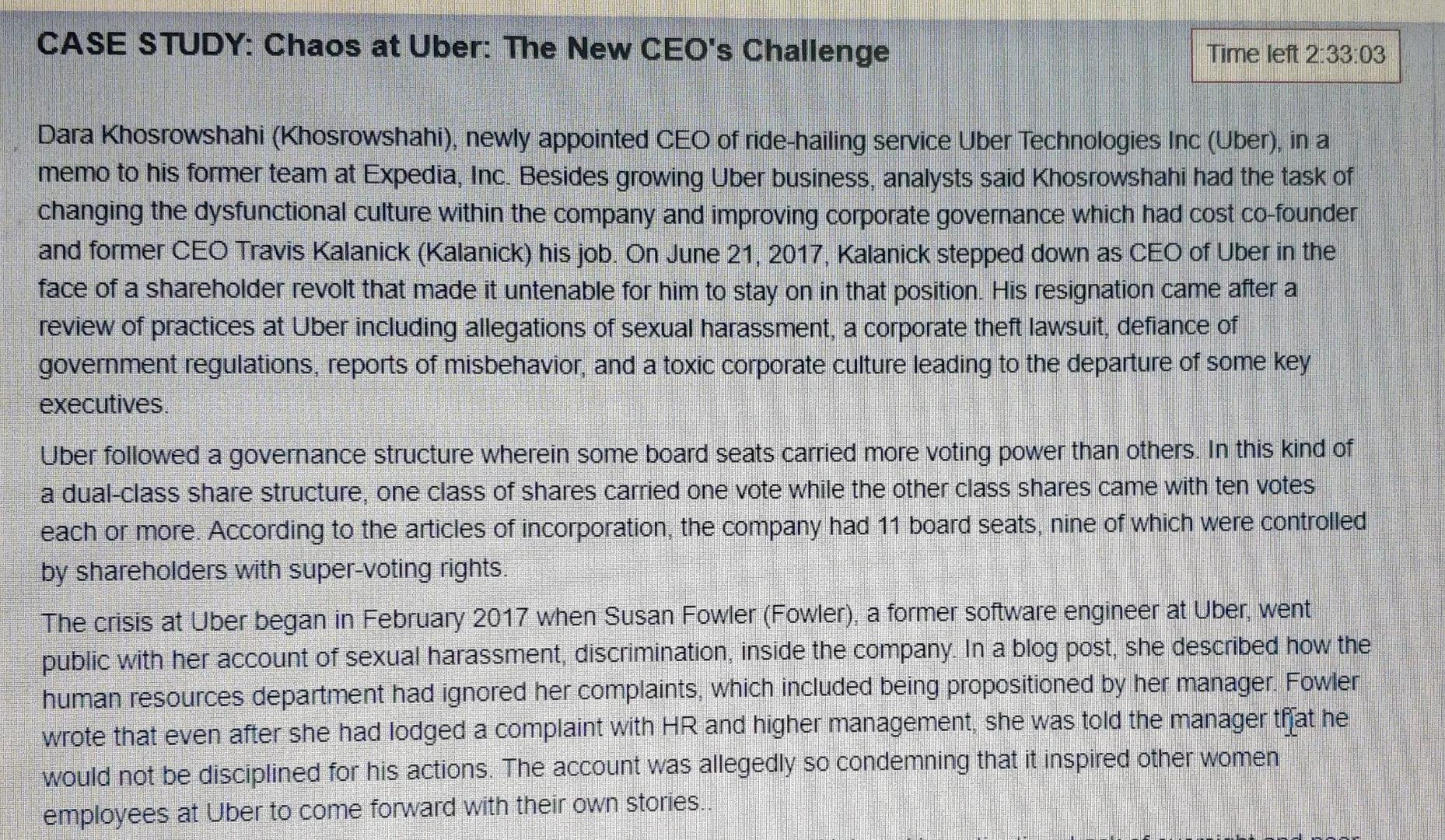
Question: Ans this immediately CASE STUDY: Chaos at Uber: The New CEO's Challenge Time left 2:33:03 Dara Khosrowshahi (Khosrowshahi), newly appointed CEO of ride-hailing service Uber
Ans this immediately
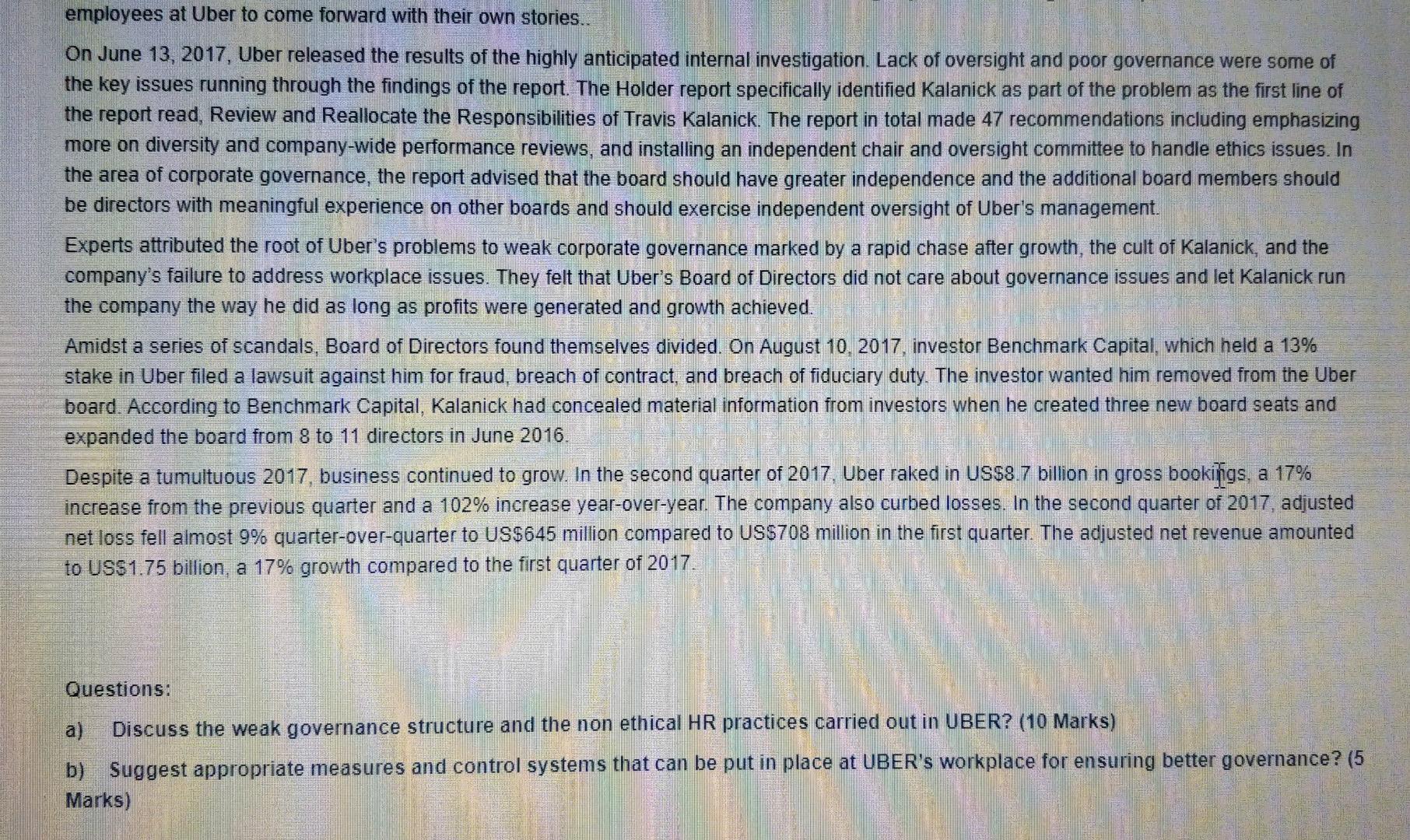
CASE STUDY: Chaos at Uber: The New CEO's Challenge Time left 2:33:03 Dara Khosrowshahi (Khosrowshahi), newly appointed CEO of ride-hailing service Uber Technologies Inc (Uber), in a memo to his former team at Expedia, Inc. Besides growing Uber business, analysts said Khosrowshahi had the task of changing the dysfunctional culture within the company and improving corporate governance which had cost co-founder and former CEO Travis Kalanick (Kalanick) his job. On June 21, 2017, Kalanick stepped down as CEO of Uber in the face of a shareholder revolt that made it untenable for him to stay on in that position. His resignation came after a review of practices at Uber including allegations of sexual harassment, a corporate theft lawsuit, defiance of government regulations, reports of misbehavior, and a toxic corporate culture leading to the departure of some key executives. Uber followed a governance structure wherein some board seats carried more voting power than others. In this kind of a dual-class share structure, one class of shares carried one vote while the other class shares came with ten votes each or more. According to the articles of incorporation, the company had 11 board seats, nine of which were controlled by shareholders with super-voting rights. The crisis at Uber began in February 2017 when Susan Fowler (Fowler), a former software engineer at Uber, went public with her account of sexual harassment, discrimination, inside the company. In a blog post, she described how the human resources department had ignored her complaints, which included being propositioned by her manager. Fowler wrote that even after she had lodged a complaint with HR and higher management, she was told the manager tffat he would not be disciplined for his actions. The account was allegedly so condemning that it inspired other women employees at Uber to come forward with their own stories.. employees at Uber to come forward with their own stories.. On June 13, 2017, Uber released the results of the highly anticipated internal investigation. Lack of oversight and poor governance were some of the key issues running through the findings of the report. The Holder report specifically identified Kalanick as part of the problem as the first line of the report read, Review and Reallocate the Responsibilities of Travis Kalanick. The report in total made 47 recommendations including emphasizing more on diversity and company-wide performance reviews, and installing an independent chair and oversight committee to handle ethics issues. In the area of corporate governance, the report advised that the board should have greater independence and the additional board members should be directors with meaningful experience on other boards and should exercise independent oversight of Uber's management. Experts attributed the root of Uber's problems to weak corporate governance marked by a rapid chase after growth, the cult of Kalanick, and the company's failure to address workplace issues. They felt that Uber's Board of Directors did not care about governance issues and let Kalanick run the company the way he did as long as profits were generated and growth achieved. Amidst a series of scandals, Board of Directors found themselves divided. On August 10, 2017, investor Benchmark Capital, which held a 13% stake in Uber filed a lawsuit against him for fraud, breach of contract, and breach of fiduciary duty. The investor wanted him removed from the Uber board. According to Benchmark Capital, Kalanick had concealed material information from investors when he created three new board seats and expanded the board from 8 to 11 directors in June 2016. Despite a tumultuous 2017, business continued to grow. In the second quarter of 2017. Uber raked in US$8.7 billion in gross bookings, a 17% increase from the previous quarter and a 102% increase year-over-year. The company also curbed losses. In the second quarter of 2017, adjusted net loss fell almost 9% quarter-over-quarter to US$645 million compared to US$708 million in the first quarter. The adjusted net revenue amounted to US$1.75 billion, a 17% growth compared to the first quarter of 2017. Questions: a) Discuss the weak governance structure and the non ethical HR practices carried out in UBER? (10 Marks) b) Suggest appropriate measures and control systems that can be put in place at UBER's workplace for ensuring better governance
Step by Step Solution
There are 3 Steps involved in it

Get step-by-step solutions from verified subject matter experts