





Question: Answer 10:28 AM D : LIVE ,Ill .| 1.09 76 50 Activity 6.4 Sediment from Source to Sink Name: Course/Section: Date: Learning GOAL You will

Answer
Answer 10:28 AM D : LIVE ,Ill .| 1.09 76 50
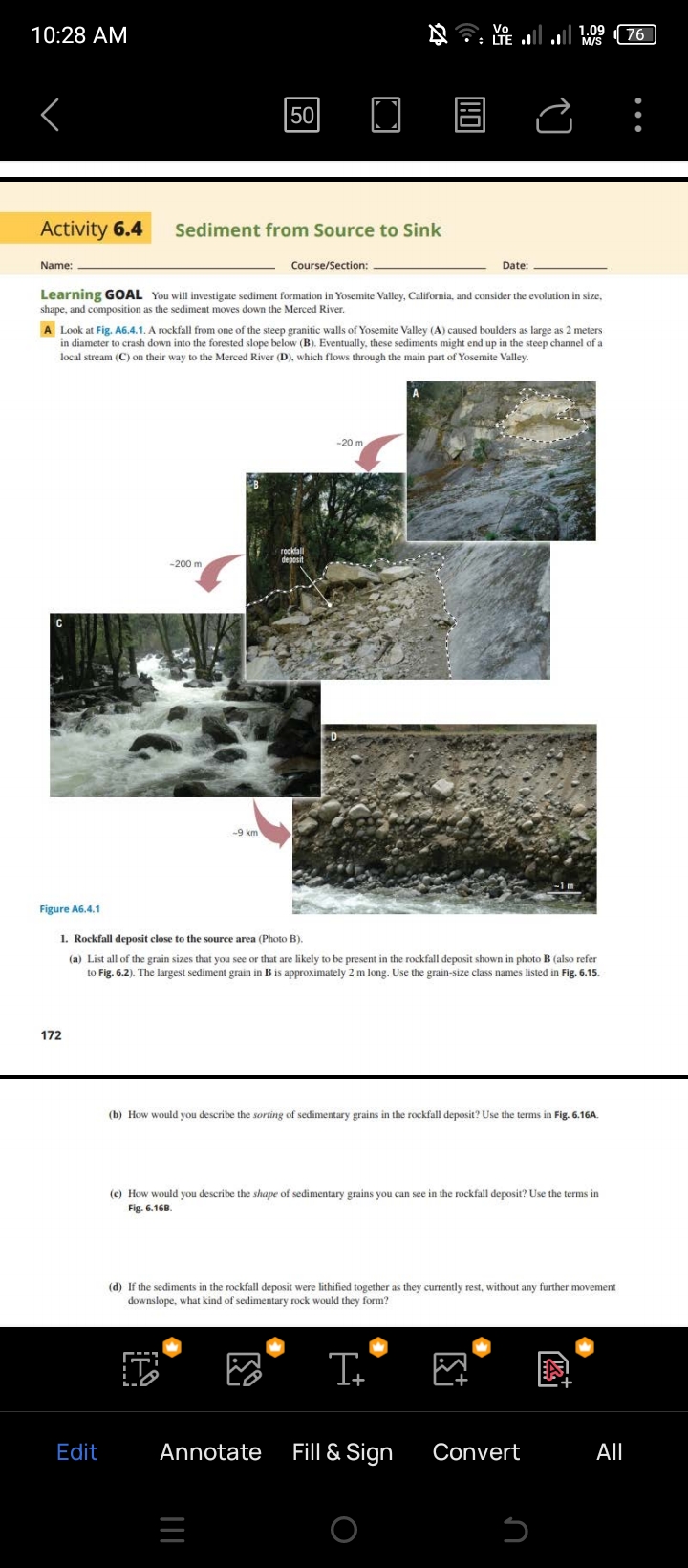
10:28 AM D : LIVE ,Ill .| 1.09 76 50 Activity 6.4 Sediment from Source to Sink Name: Course/Section: Date: Learning GOAL You will investigate sediment formation in Yosemite Valley, California, and consider the evolution in size, shape, and composition as the sediment moves down the Merced River. A Look at Fig. A6.4.1. A rockfall from one of the steep granitic walls of Yosemite Valley (A) caused boulders as large as 2 meters in diameter to crash down into the forested slope below (B). Eventually, these sediments might end up in the steep channel of a local stream (C) on their way to the Merced River (D), which flows through the main part of Yosemite Valley. -20 m -200 m -9 km Figure A6.4.1 1. Rockfall deposit close to the source area (Photo B). (a) List all of the grain sizes that you see or that are likely to be present in the rockfall deposit shown in photo B (also refer to Fig. 6.2). The largest sediment grain in B is approximately 2 m long. Use the grain-size class names listed in Fig. 6.15. 172 (b) How would you describe the sorting of sedimentary grains in the rockfall deposit? Use the terms in Fig. 6.16A. (e) How would you describe the shape of sedimentary grains you can see in the rockfall deposit? Use the terms in Fig. 6.168. (d) If the sediments in the rockfall deposit were lithified together as they currently rest, without any further movement downslope, what kind of sedimentary rock would they form? E EAST Edit Annotate Fill & Sign Convert All O

Step by Step Solution

There are 3 Steps involved in it

1 Expert Approved Answer
Step: 1 Unlock blur-text-image

Question Has Been Solved by an Expert!

Get step-by-step solutions from verified subject matter experts

Step: 2 Unlock
Step: 3 Unlock

Students Have Also Explored These Related Business Writing Questions!