Question: answer 11-11 and 11-12 based on case 11 CASE STUDY 11 Case 1 443 Automating Labor On May 24, 2016, former McDonald's CEO d lensi
answer 11-11 and 11-12 based on case 11
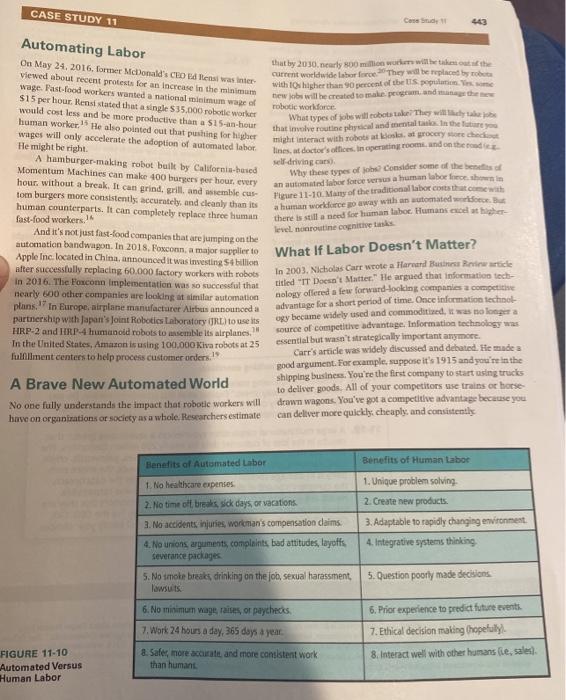
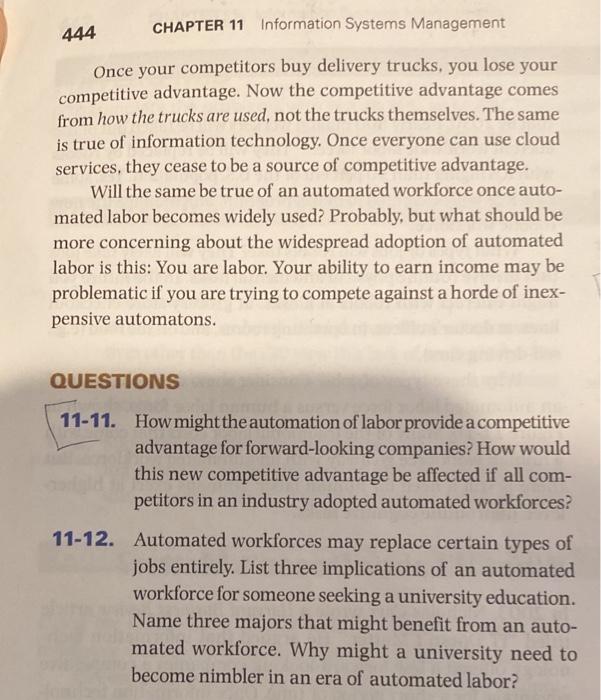
CASE STUDY 11 Case 1 443 Automating Labor On May 24, 2016, former McDonald's CEO d lensi was inter viewed about recent protest for an increase in the minimum wape. Past-lood workers wanted a national minimum wage of $15 per hour. Rens stated that a single $35.000 robotic worker would cost less and be more productive than a 15-an-hour human worker. He also pointed out that pushing for her wages will only accelerate the adoption of automated labor, He might be right A hamburger making robot built by California-based Momentum Machines can make 400 burgers per hour every hour, without a break. It can grind grill, and assemble cur tom burgers more consistently accurately and cleanly than its human counterparts. It can completely replace three human fast-food workers. And it's not just fast-food companies that are jumping on the automation bandwagon. In 2018. Foxconn a major supplier to Apple Inc. located in China, announced it was investing St billion after successfully replacing 60,000 factory workers with robots In 2016. The Foxconn Implementation was so successful that nearly 600 other companies are looking at similar automation plans. In Europe.airplane manufacturer Airbus announced a partnership with Japan's Joint Robotics Laboratory RL to use is HRP-2 and HIRP-4 humanoid robots to semble its airplanes, In the United States, Amazon is using 100,000 Kiva robots at 25 luillment centers to help process customer orders that by 2030. nearly 800 million wou will be taken out the current worldwide labor force. They will be replaced by the with 1s higher than 90 percent of the propose tiews will be created to make progeum and manage the robotic workforce What types of jobs will robots take they will y take that move routine physical and mental and in the future might interact with robots at least grocery store dhe lines, ut doctor's offices in operating rooms and on the condiz self-driving cars) Why these types of Job Consider some of the bene an automated labor force ser a human labor een in Figure 11-10. Many of the traditional labor costs that come with a human workforce po away with an automated there is still a need for human laboe. Humans excel at higher level no routine cognitive What If Labor Doesn't Matter? In 2003. Nicholas Carr wrote a Harvard Business wide titled "IT Doesn't Matter." He argued that information tects nology offered a few forward-looking companies .competiche advantage for a short period of time. Once information technol- ogy became widely used and commoditied, it was no longer a source of competitive advantage. Information technology w essential but wasn't strategically important anymore Carr's article was widely discussed and debated. He made a good argument. For example, suppose it's 1915 and you're in the shipping business. You're the first company to start using trucks to deliver goods. All of your competitors use trains or horse drawn wagons. You've got a competitive advantage because you can deliver more quickly cheaply and consistently A Brave New Automated World No one fully understands the impact that robotic workers will have on organisations or society as a whole. Researchers estimate Benefits of Automated Labor Benefits of Human Labor 1. Unique problem solving 2. Create new products. 3. Adaptable to rapidly changing environment 4. Integrative systems thinking 1. No healthcare expenses 2. No time of breaks, sick days or vacations 3. No accidents injuries, workman's compensation daims 4. No unions arguments complaints bad attitudes, layoffs severance packages 5. No smoke breaks, drinking on the job, sexual harassment lawsuits 6. No minimum wage, raises, or paychecks 7. Work 24 hours a day, 365 days a year & Safer more accurate and more consistent work than humans 5. Question poorly made decisions 6. Prior experience to predict future events. 7. Ethical decision making thopefully 8. Interact well with other humans (ie, sales) FIGURE 11-10 Automated Versus Human Labor 444 CHAPTER 11 Information Systems Management Once your competitors buy delivery trucks, you lose your competitive advantage. Now the competitive advantage comes from how the trucks are used, not the trucks themselves. The same is true of information technology. Once everyone can use cloud services, they cease to be a source of competitive advantage. Will the same be true of an automated workforce once auto- mated labor becomes widely used? Probably, but what should be more concerning about the widespread adoption of automated labor is this: You are labor. Your ability to earn income may be problematic if you are trying to compete against a horde of inex- pensive automatons. QUESTIONS 11-11. How might the automation of labor provide a competitive advantage for forward-looking companies? How would this new competitive advantage be affected if all com- petitors in an industry adopted automated workforces? 11-12. Automated workforces may replace certain types of jobs entirely. List three implications of an automated workforce for someone seeking a university education. Name three majors that might benefit from an auto- mated workforce. Why might a university need to become nimbler in an era of automated labor









 Study Help