







Question: Answer 2 question at the end (minimum 150-words per question) I posted these text in image formats too The Data Warehouse at the Isle of
Answer 2 question at the end (minimum 150-words per question)
I posted these text in image formats too
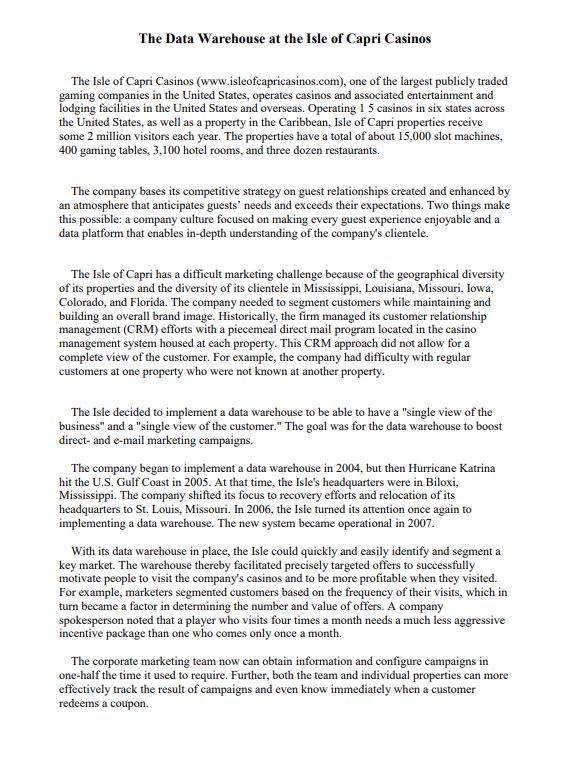
The Data Warehouse at the Isle of Capri Casinos
The Isle of Capri Casinos (www.isleofcapricasinos.com), one of the largest publicly traded gaming companies in the United States, operates casinos and associated entertainment and lodging facilities in the United States and overseas. Operating 1 5 casinos in six states across the United States, as well as a property in the Caribbean, Isle of Capri properties receive some 2 million visitors each year. The properties have a total of about 15,000 slot machines, 400 gaming tables, 3,100 hotel rooms, and three dozen restaurants.
The company bases its competitive strategy on guest relationships created and enhanced by an atmosphere that anticipates guests needs and exceeds their expectations. Two things make this possible: a company culture focused on making every guest experience enjoyable and a data platform that enables in-depth understanding of the company's clientele.
The Isle of Capri has a difficult marketing challenge because of the geographical diversity of its properties and the diversity of its clientele in Mississippi, Louisiana, Missouri, Iowa, Colorado, and Florida. The company needed to segment customers while maintaining and building an overall brand image. Historically, the firm managed its customer relationship management (CRM) efforts with a piecemeal direct mail program located in the casino management system housed at each property. This CRM approach did not allow for a complete view of the customer. For example, the company had difficulty with regular customers at one property who were not known at another property.
The Isle decided to implement a data warehouse to be able to have a "single view of the business" and a "single view of the customer." The goal was for the data warehouse to boost direct- and e-mail marketing campaigns.
The company began to implement a data warehouse in 2004, but then Hurricane Katrina hit the U.S. Gulf Coast in 2005. At that time, the Isle's headquarters were in Biloxi, Mississippi. The company shifted its focus to recovery efforts and relocation of its headquarters to St. Louis, Missouri. In 2006, the Isle turned its attention once again to implementing a data warehouse. The new system became operational in 2007.
With its data warehouse in place, the Isle could quickly and easily identify and segment a key market. The warehouse thereby facilitated precisely targeted offers to successfully motivate people to visit the company's casinos and to be more profitable when they visited. For example, marketers segmented customers based on the frequency of their visits, which in turn became a factor in determining the number and value of offers. A company spokesperson noted that a player who visits four times a month needs a much less aggressive incentive package than one who comes only once a month.
The corporate marketing team now can obtain information and configure campaigns in one-half the time it used to require. Further, both the team and individual properties can more effectively track the result of campaigns and even know immediately when a customer redeems a coupon.
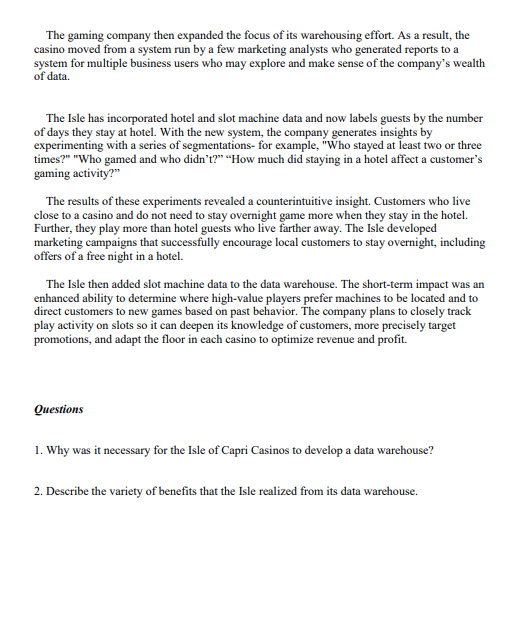
The gaming company then expanded the focus of its warehousing effort. As a result, the casino moved from a system run by a few marketing analysts who generated reports to a system for multiple business users who may explore and make sense of the companys wealth of data.
The Isle has incorporated hotel and slot machine data and now labels guests by the number of days they stay at hotel. With the new system, the company generates insights by experimenting with a series of segmentations- for example, "Who stayed at least two or three times?" "Who gamed and who didnt? How much did staying in a hotel affect a customers gaming activity?
The results of these experiments revealed a counterintuitive insight. Customers who live close to a casino and do not need to stay overnight game more when they stay in the hotel. Further, they play more than hotel guests who live farther away. The Isle developed marketing campaigns that successfully encourage local customers to stay overnight, including offers of a free night in a hotel.
The Isle then added slot machine data to the data warehouse. The short-term impact was an enhanced ability to determine where high-value players prefer machines to be located and to direct customers to new games based on past behavior. The company plans to closely track play activity on slots so it can deepen its knowledge of customers, more precisely target promotions, and adapt the floor in each casino to optimize revenue and profit.
Questions
1. Why was it necessary for the Isle of Capri Casinos to develop a data warehouse?
2. Describe the variety of benefits that the Isle realized from its data warehouse.
The Data Warehouse at the Isle of Capri Casinos The Isle of Capri Casinos (www.isleofcapricasinos.com), one of the largest publicly traded gaming companies in the United States, operates casinos and associated entertainment and lodging facilities in the United States and overseas. Operating 15 casinos in six states across the United States, as well as a property in the Caribbean, Isle of Capri properties receive some 2 million visitors each year. The properties have a total of about 15,000 slot machines, 400 gaming tables, 3,100 hotel rooms, and three dozen restaurants. The company bases its competitive strategy on guest relationships created and enhanced by an atmosphere that anticipates guests' needs and exceeds their expectations. Two things make this possible: a company culture focused on making every guest experience enjoyable and a data platform that enables in-depth understanding of the company's clientele. The Isle of Capri has a difficult marketing challenge because of the geographical diversity of its properties and the diversity of its clientele in Mississippi, Louisiana, Missouri, Iowa, Colorado, and Florida. The company needed to segment customers while maintaining and building an overall brand image. Historically, the firm managed its customer relationship management (CRM) efforts with a piecemeal direct mail program located in the casino management system housed at each property. This CRM approach did not allow for a complete view of the customer. For example, the company had difficulty with regular customers at one property who were not known at another property. The Isle decided to implement a data warehouse to be able to have a "single view of the business" and a "single view of the customer." The goal was for the data warehouse to boost direct- and e-mail marketing campaigns. The company began to implement a data warehouse in 2004, but then Hurricane Katrina hit the U.S. Gulf Coast in 2005. At that time, the Isle's headquarters were in Biloxi, Mississippi. The company shifted its focus to recovery efforts and relocation of its headquarters to St. Louis, Missouri. In 2006, the Isle turned its attention once again to implementing a data warehouse. The new system became operational in 2007. With its data warehouse in place, the Isle could quickly and easily identify and segment a key market. The warehouse thereby facilitated precisely targeted offers to successfully motivate people to visit the company's casinos and to be more profitable when they visited. For example, marketers segmented customers based on the frequency of their visits, which in turn became a factor in determining the number and value of offers. A company spokesperson noted that a player who visits four times a month needs a much less aggressive incentive package than one who comes only once a month. The corporate marketing team now can obtain information and configure campaigns in one-half the time it used to require. Further, both the team and individual properties can more effectively track the result of campaigns and even know immediately when a customer redeems a coupon The gaming company then expanded the focus of its warehousing effort. As a result, the casino moved from a system run by a few marketing analysts who generated reports to a system for multiple business users who may explore and make sense of the company's wealth of data. The Isle has incorporated hotel and slot machine data and now labels guests by the number of days they stay at hotel. With the new system, the company generates insights by experimenting with a series of segmentations-for example, "Who stayed at least two or three times?" "Who gamed and who didn't? How much did staying in a hotel affect a customer's gaming activity?" The results of these experiments revealed a counterintuitive insight. Customers who live close to a casino and do not need to stay overnight game more when they stay in the hotel. Further, they play more than hotel guests who live farther away. The Isle developed marketing campaigns that successfully encourage local customers to stay overnight, including offers of a free night in a hotel. The Isle then added slot machine data to the data warehouse. The short-term impact was an enhanced ability to determine where high-value players prefer machines to be located and to direct customers to new games based on past behavior. The company plans to closely track play activity on slots so it can deepen its knowledge of customers, more precisely target promotions, and adapt the floor in each casino to optimize revenue and profit. Questions 1. Why was it necessary for the Isle of Capri Casinos to develop a data warehouse? 2. Describe the variety of benefits that the Isle realized from its data warehouseStep by Step Solution
There are 3 Steps involved in it

Get step-by-step solutions from verified subject matter experts
 Study Help