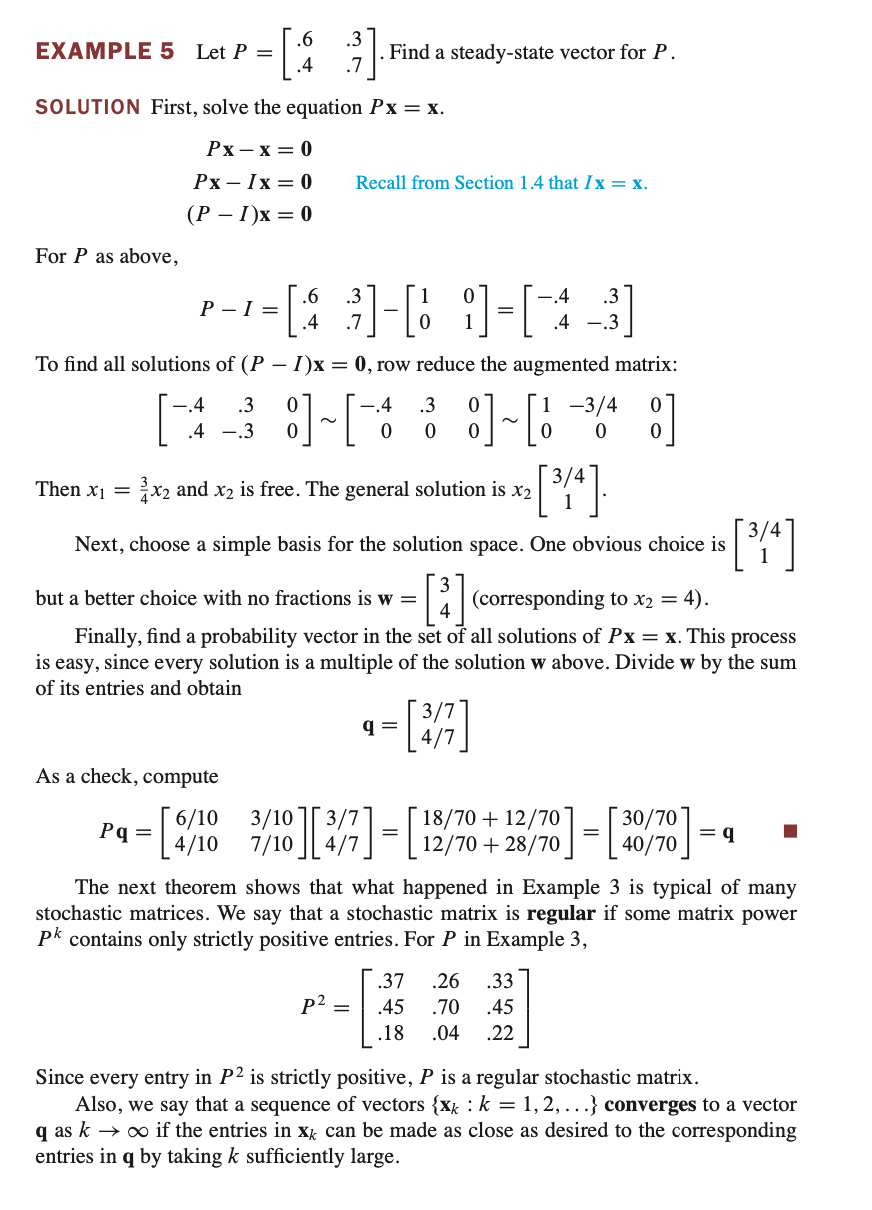
Question: Answer 2&3 please EXAMPLE 5 Let P = :4 7. Find a steady-state vector for P. SOLUTION First, solve the equation PX = X. Px-
Answer 2&3 please
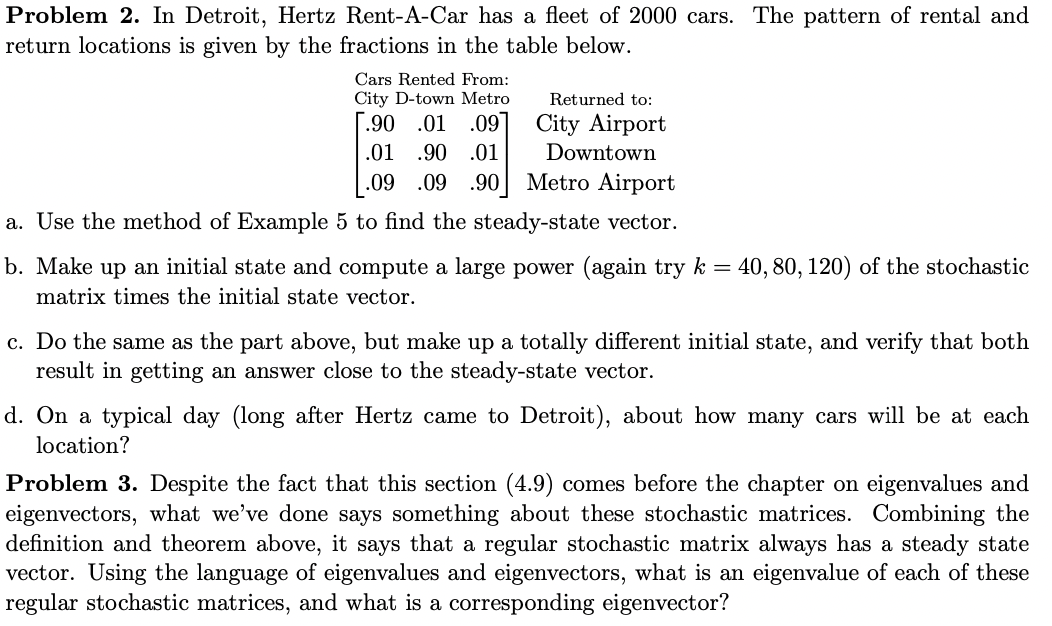
EXAMPLE 5 Let P = :4 7. Find a steady-state vector for P. SOLUTION First, solve the equation PX = X. Px- x=0 Px- Ix =0 Recall from Section 1.4 that Ix = X. (P - I)X = 0 For P as above, P-1=[:4 3]-[6 0]-[4-3] To find all solutions of (P - I)x = 0, row reduce the augmented matrix: [4 3 0]~[ 8 8 8]~[6 304 8] Then x1 = x2 and x2 is free. The general solution is X2 [314]. Next, choose a simple basis for the solution space. One obvious choice is 3 / 4 but a better choice with no fractions is w : (corresponding to x2 = 4). Finally, find a probability vector in the set of all solutions of Px = x. This process is easy, since every solution is a multiple of the solution w above. Divide w by the sum of its entries and obtain 9 = 4/7] As a check, compute 6/10 Pq = 4/10 9/8 1971-12/70 +28/70=40/70 =9 The next theorem shows that what happened in Example 3 is typical of many stochastic matrices. We say that a stochastic matrix is regular if some matrix power Pk contains only strictly positive entries. For P in Example 3, .37 .26 .33 p2 .45 .70 .45 .18 .04 .22 Since every entry in P2 is strictly positive, P is a regular stochastic matrix. Also, we say that a sequence of vectors {Xk : k = 1, 2, ...} converges to a vector q as k - co if the entries in xk can be made as close as desired to the corresponding entries in q by taking k sufficiently large.Problem 2. In Detroit, Hertz Rent-ACar has a eet of 2000 cars. The pattern of rental and return locations is given by the fractions in the table below. Cars Rented From: City D-town Metro Returned to: .90 .01 .09 City Airport .01 .90 .01 Downtown .09 .09 .90 Metro Airport a. Use the method of Example 5 to nd the steady-state vector. b. Make up an initial state and compute a large power (again try k: : 40, 80, 120) of the stochastic matrix times the initial state vector. c. Do the same as the part above, but make up a totally different initial state, and verify that both result in getting an answer close to the steady-state vector. (1. On a typical day (long after Hertz came to Detroit), about how many cars will be at each location? Problem 3. Despite the fact that this section (4.9) comes before the chapter on eigenvalues and eigenvectors, what we've done says something about these stochastic matrices. Combining the denition and theorem above, it says that a regular stochastic matrix always has a steady state vector. Using the language of eigenvalues and eigenvectors, what is an eigenvalue of each of these regular stochastic matrices, and what is a corresponding eigenvector









 Study Help