







Question: Answer 3 i give thumbs up As per one report, the global ERP software market size is expected to surpass $115 billion by 2030 .

Answer 3 i give thumbs up
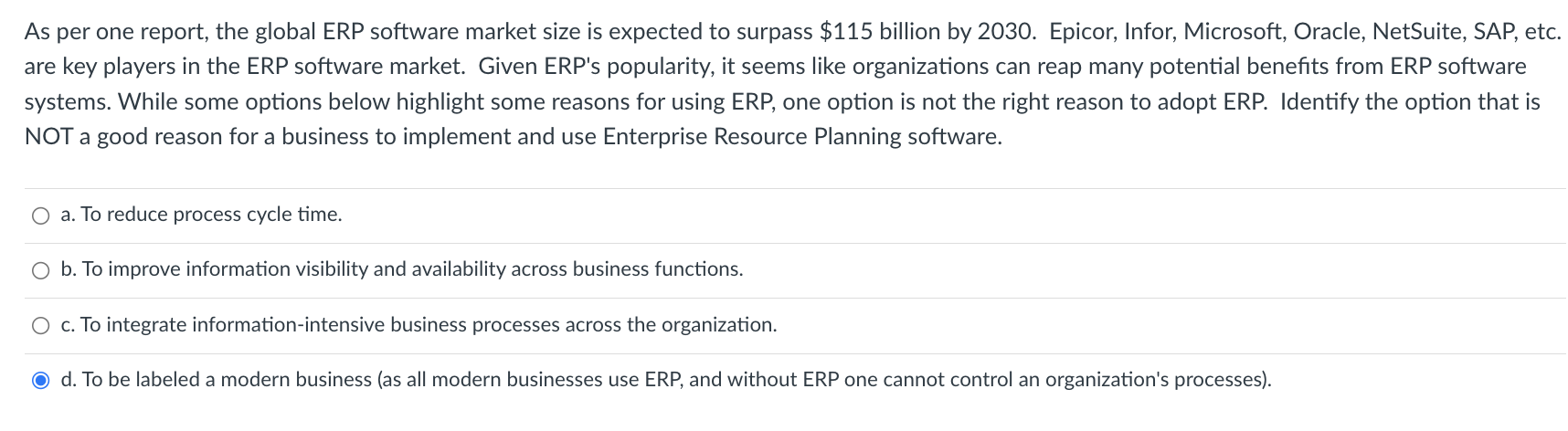
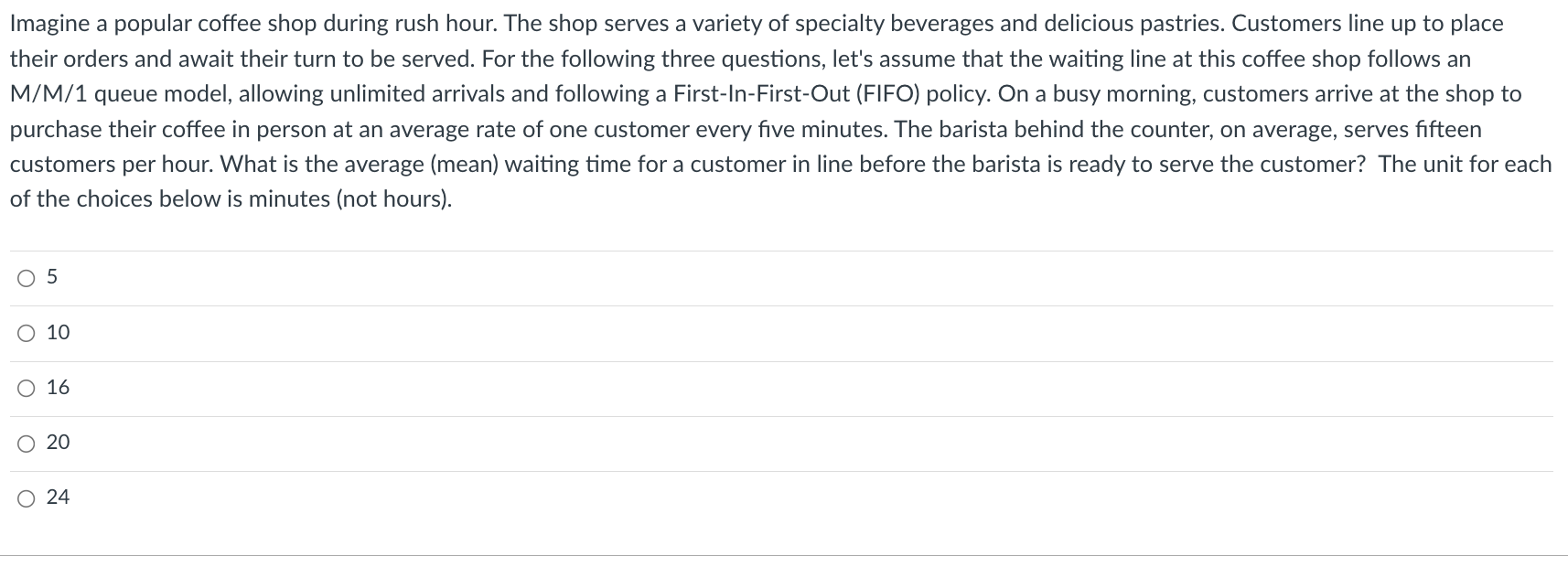
As per one report, the global ERP software market size is expected to surpass $115 billion by 2030 . Epicor, Infor, Microsoft, Oracle, NetSuite, SAP, etc. are key players in the ERP software market. Given ERP's popularity, it seems like organizations can reap many potential benefits from ERP software systems. While some options below highlight some reasons for using ERP, one option is not the right reason to adopt ERP. Identify the option that is NOT a good reason for a business to implement and use Enterprise Resource Planning software. a. To reduce process cycle time. b. To improve information visibility and availability across business functions. c. To integrate information-intensive business processes across the organization. d. To be labeled a modern business (as all modern businesses use ERP, and without ERP one cannot control an organization's processes). Pick the best choice regarding the Clark-Fisher (CF) model. a. The CF model accurately foretells the rise of advancements in the fields of Augmented Reality, Virtual Reality, and Artificial Intelligence. b. The CF model explicitly warns humanity against the implementation of mechanization, modernization, and robotic/AI automation. c. The CF model predicts that the workforce shifts from high productivity sectors (e.g., agriculture or manufacturing) to low productivity sectors (e.g., services). d. The CF model predicts the shift of the labor force from low productivity to high productivity sectors. Imagine a popular coffee shop during rush hour. The shop serves a variety of specialty beverages and delicious pastries. Customers line up to place their orders and await their turn to be served. For the following three questions, let's assume that the waiting line at this coffee shop follows an M/M/1 queue model, allowing unlimited arrivals and following a First-In-First-Out (FIFO) policy. On a busy morning, customers arrive at the shop to purchase their coffee in person at an average rate of one customer every five minutes. The barista behind the counter, on average, serves fifteen customers per hour. What is the average (mean) waiting time for a customer in line before the barista is ready to serve the customer? The unit for each of the choices below is minutes (not hours). 5 10 16 20 24
Step by Step Solution
There are 3 Steps involved in it

Get step-by-step solutions from verified subject matter experts
 Study Help