







Question: Answer 7.15, 7.16, 7.17, and 7.18 case application Saving mates for saving lives Mates in Construction (MIC) is using Australia's strong tradi- tion of 'mateship'
Answer 7.15, 7.16, 7.17, and 7.18
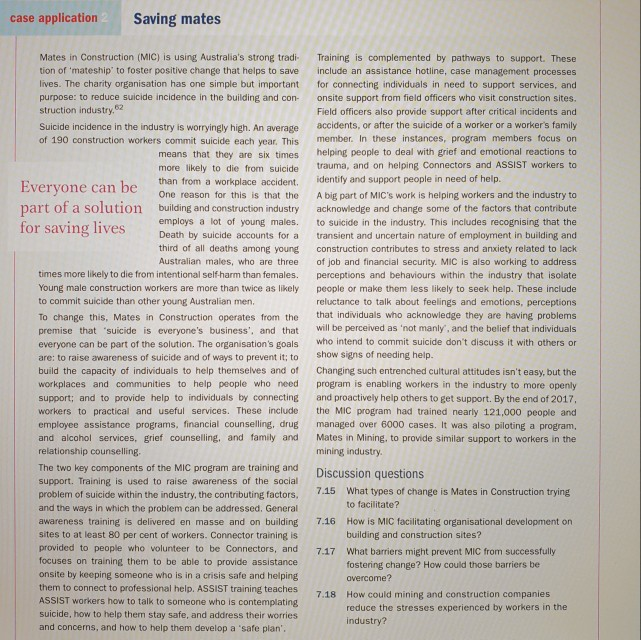
case application Saving mates for saving lives Mates in Construction (MIC) is using Australia's strong tradi- tion of 'mateship' to foster positive change that helps to save lives. The charity organisation has one simple but important purpose: to reduce suicide incidence in the building and con- struction industry62 Suicide incidence in the industry is worryingly high. An average of 190 construction workers commit suicide each year. This means that they are six times more likely to die from suicide than from a workplace accident. Everyone can be One reason for this is that the employs a lot of young males. Death by suicide accounts for a third of all deaths among young Australian males, who are three times more likely to die from intentional self-harm than females. Young male construction workers are more than twice as likely to commit suicide than other young Australian men. To change this, Mates in Construction operates from the premise that suicide is everyone's business', and that everyone can be part of the solution. The organisation's goals are: to raise awareness of suicide and of ways to prevent it; to build the capacity of individuals to help themselves and of workplaces and communities to help people who need support; and to provide help to individuals by connecting workers to practical and useful services. These include employee assistance programs, financial counselling, drug and alcohol services, grief counselling, and family and relationship counselling. The two key components of the MIC program are training and support. Training is used to raise awareness of the social problem of suicide within the industry, the contributing factors, and the ways in which the problem can be addressed. General awareness training is delivered en masse and on building sites to at least 80 per cent of workers. Connector training is provided to people who volunteer to be Connectors, and focuses on training them to be able to provide assistance onsite by keeping someone who is in a crisis safe and helping them to connect to professional help. ASSIST training teaches ASSIST workers how to talk to someone who is contemplating suicide, how to help them stay safe, and address their worries and concerns, and how to help them develop a 'safe plan Training is complemented by pathways to support. These include an assistance hotline, case management processes for connecting individuals in need to support services, and onsite support from field officers who visit construction sites. Field officers also provide support after critical incidents and accidents, or after the suicide of a worker or a worker's family member. In these instances, program members focus on helping people to deal with grief and emotional reactions to trauma, and on helping Connectors and ASSIST workers to identify and support people in need of help. A big part of MIC's work is helping workers and the industry to acknowledge and change some of the factors that contribute to suicide in the industry. This includes recognising that the transient and uncertain nature of employment in building and construction contributes to stress and anxiety related to lack of job and financial security. MIC is also working to address perceptions and behaviours within the industry that isolate people or make them less likely to seek help. These include reluctance to talk about feelings and emotions, perceptions that individuals who acknowledge they are having problems will be perceived as 'not manly, and the belief that individuals who intend to commit suicide don't discuss it with others or show signs of needing help. Changing such entrenched cultural attitudes isn't easy, but the program is enabling workers in the industry to more openly and proactively help others to get support. By the end of 2017, the MIC program had trained nearly 121,000 people and managed over 6000 cases. It was also piloting a program, Mates in Mining, to provide similar support to workers in the mining industry. Discussion questions 7.15 What types of change is Mates in Construction trying to facilitate? 7.16 How is MIC facilitating organisational development on building and construction sites? 7.17 What barriers might prevent MIC from successfully fostering change? How could those barriers be overcome? 7.18 How could mining and construction companies reduce the stresses experienced by workers in the industry
Step by Step Solution
There are 3 Steps involved in it
1 Expert Approved Answer
Step: 1 Unlock

Question Has Been Solved by an Expert!
Get step-by-step solutions from verified subject matter experts
Step: 2 Unlock
Step: 3 Unlock
 Study Help