







Question: ANSWER 7-24 PLEASE EXAMPLE 6-10 AW and Repeatability: Perfect Together! Three products will be manufactured in a new facility at the Apex Manufacturing Company. They
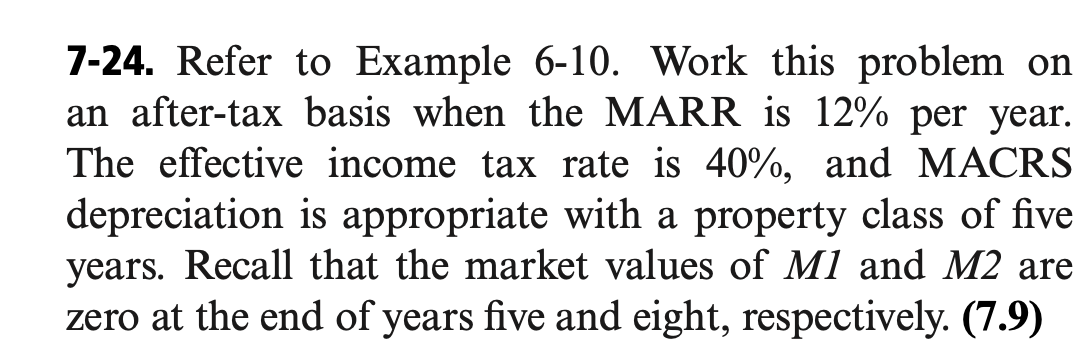
ANSWER 7-24 PLEASE
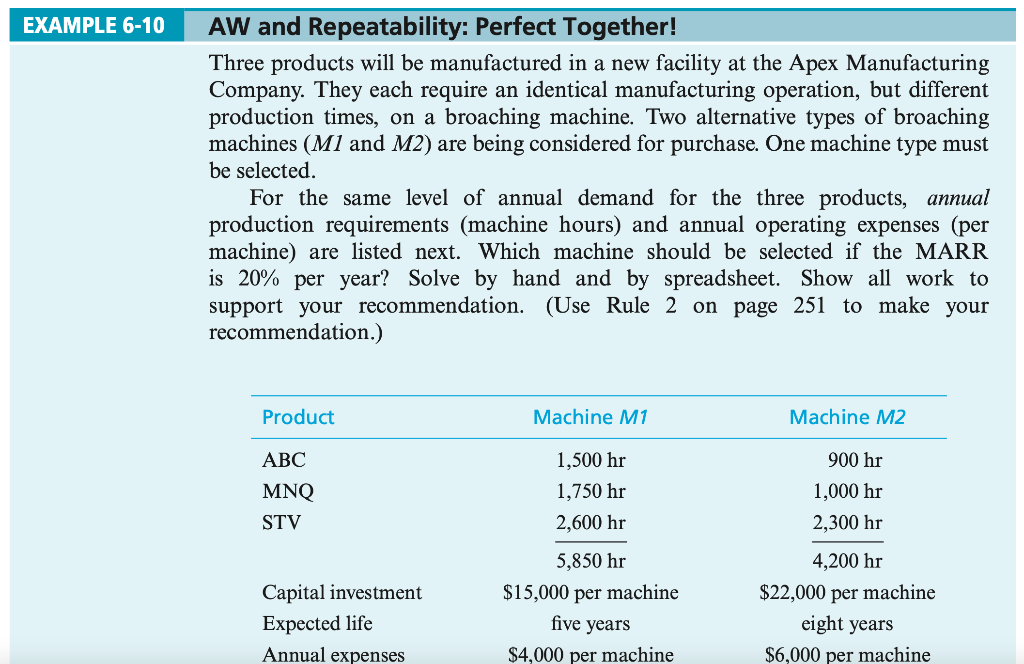
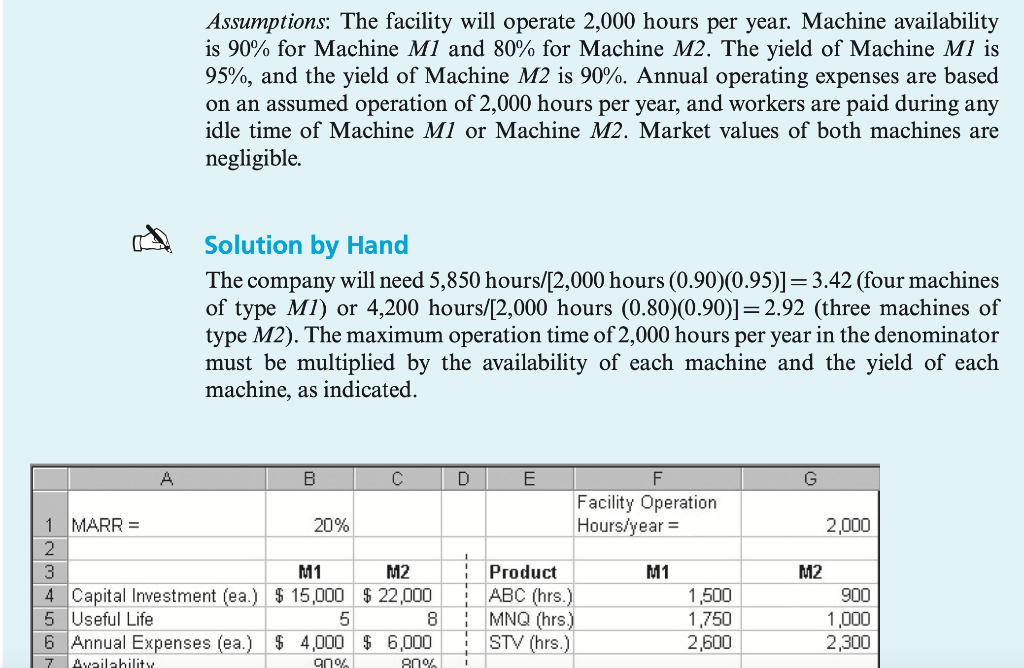
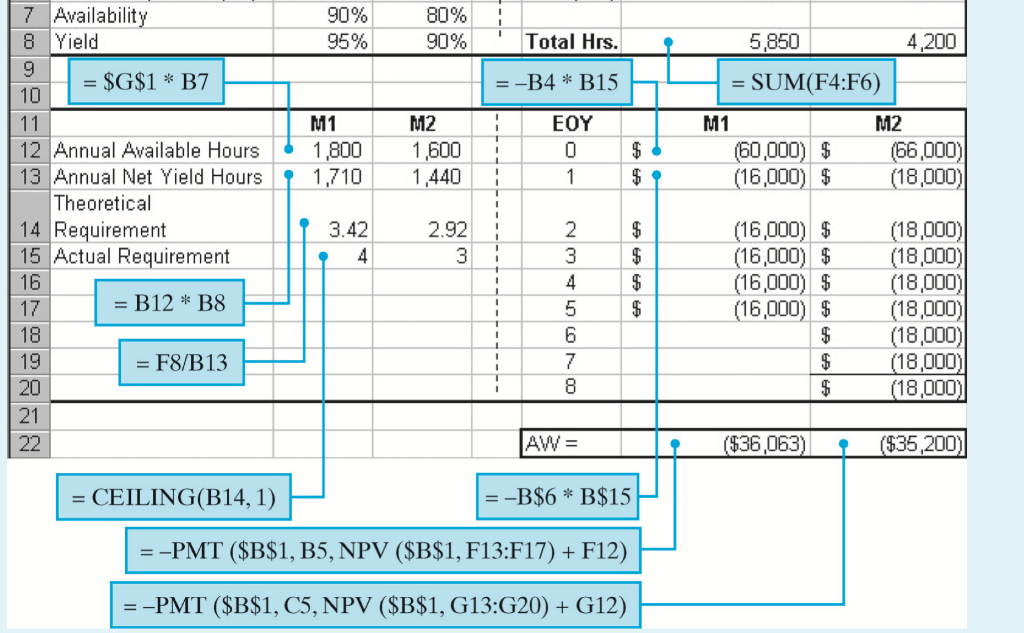
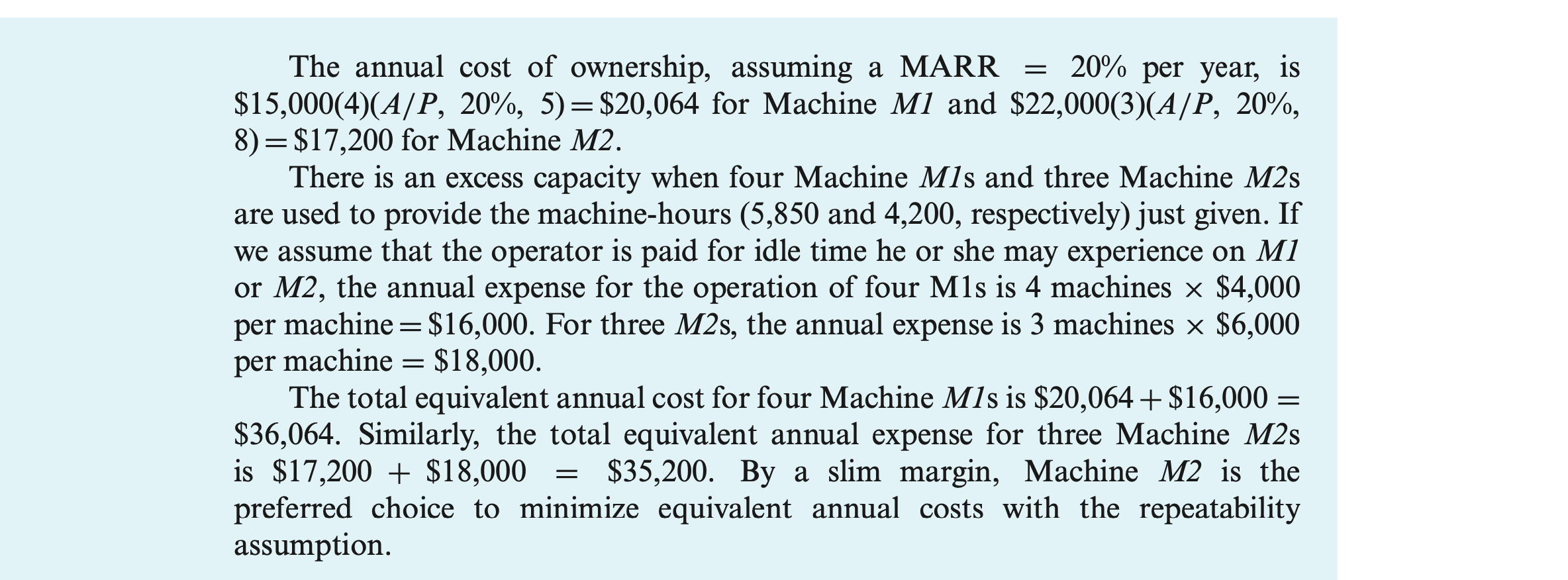
EXAMPLE 6-10 AW and Repeatability: Perfect Together! Three products will be manufactured in a new facility at the Apex Manufacturing Company. They each require an identical manufacturing operation, but different production times, on a broaching machine. Two alternative types of broaching machines (M1 and M2) are being considered for purchase. One machine type must be selected. For the same level of annual demand for the three products, annual production requirements (machine hours) and annual operating expenses (per machine) are listed next. Which machine should be selected if the MARR is 20% per year? Solve by hand and by spreadsheet. Show all work to support your recommendation. (Use Rule 2 on page 251 to make your recommendation.) Product Machine M1 Machine M2 ABC MNQ STV 1,500 hr 1,750 hr 2,600 hr 900 hr 1,000 hr 2,300 hr 5,850 hr $15,000 per machine Capital investment Expected life Annual expenses 4,200 hr $22,000 per machine eight years $6,000 per machine five years $4,000 per machine Assumptions: The facility will operate 2,000 hours per year. Machine availability is 90% for Machine M1 and 80% for Machine M2. The yield of Machine Ml is 95%, and the yield of Machine M2 is 90%. Annual operating expenses are based on an assumed operation of 2,000 hours per year, and workers are paid during any idle time of Machine M1 or Machine M2. Market values of both machines are negligible. Solution by Hand The company will need 5,850 hours/[2,000 hours (0.90)(0.95)]= 3.42 (four machines of type MI) or 4,200 hours/[2,000 hours (0.80)(0.90)]=2.92 (three machines of type M2). The maximum operation time of 2,000 hours per year in the denominator must be multiplied by the availability of each machine and the yield of each machine, as indicated. A B C D E G F Facility Operation Hours/year= 2,000 M1 1 MARR = 20% 2 3 M1 M2 4 Capital Investment (ea.) $ 15,000 $ 22,000 5 Useful Life 5 8 6 Annual Expenses (ea.) $ 4,000 $ 6,000 80% Product ABC (hrs.) MNQ (hrs. STV (hrs.) 1,500 1,750 2,600 M2 900 1,000 2,300 Availability ano The annual cost of ownership, assuming a MARR = 20% per year, is $15,000(4)(A/P, 20%, 5)= $20,064 for Machine M1 and $22,000(3)(A/P, 20%, 8)=$17,200 for Machine M2. There is an excess capacity when four Machine Mls and three Machine M2s are used to provide the machine-hours (5,850 and 4,200, respectively) just given. If we assume that the operator is paid for idle time he or she may experience on Mi or M2, the annual expense for the operation of four Mls is 4 machines x $4,000 per machine = $16,000. For three M2s, the annual expense is 3 machines x $6,000 per machine = $18,000. The total equivalent annual cost for four Machine Mls is $20,064 +$16,000 = $36,064. Similarly, the total equivalent annual expense for three Machine M2s is $17,200 + $18,000 $35,200. By a slim margin, Machine M2 is the preferred choice to minimize equivalent annual costs with the repeatability assumption. - = = 7-24. Refer to Example 6-10. Work this problem on an after-tax basis when the MARR is 12% per year. The effective income tax rate is 40%, and MACRS depreciation is appropriate with a property class of five years. Recall that the market values of M1 and M2 are zero at the end of years five and eight, respectively. (7.9) EXAMPLE 6-10 AW and Repeatability: Perfect Together! Three products will be manufactured in a new facility at the Apex Manufacturing Company. They each require an identical manufacturing operation, but different production times, on a broaching machine. Two alternative types of broaching machines (M1 and M2) are being considered for purchase. One machine type must be selected. For the same level of annual demand for the three products, annual production requirements (machine hours) and annual operating expenses (per machine) are listed next. Which machine should be selected if the MARR is 20% per year? Solve by hand and by spreadsheet. Show all work to support your recommendation. (Use Rule 2 on page 251 to make your recommendation.) Product Machine M1 Machine M2 ABC MNQ STV 1,500 hr 1,750 hr 2,600 hr 900 hr 1,000 hr 2,300 hr 5,850 hr $15,000 per machine Capital investment Expected life Annual expenses 4,200 hr $22,000 per machine eight years $6,000 per machine five years $4,000 per machine Assumptions: The facility will operate 2,000 hours per year. Machine availability is 90% for Machine M1 and 80% for Machine M2. The yield of Machine Ml is 95%, and the yield of Machine M2 is 90%. Annual operating expenses are based on an assumed operation of 2,000 hours per year, and workers are paid during any idle time of Machine M1 or Machine M2. Market values of both machines are negligible. Solution by Hand The company will need 5,850 hours/[2,000 hours (0.90)(0.95)]= 3.42 (four machines of type MI) or 4,200 hours/[2,000 hours (0.80)(0.90)]=2.92 (three machines of type M2). The maximum operation time of 2,000 hours per year in the denominator must be multiplied by the availability of each machine and the yield of each machine, as indicated. A B C D E G F Facility Operation Hours/year= 2,000 M1 1 MARR = 20% 2 3 M1 M2 4 Capital Investment (ea.) $ 15,000 $ 22,000 5 Useful Life 5 8 6 Annual Expenses (ea.) $ 4,000 $ 6,000 80% Product ABC (hrs.) MNQ (hrs. STV (hrs.) 1,500 1,750 2,600 M2 900 1,000 2,300 Availability ano The annual cost of ownership, assuming a MARR = 20% per year, is $15,000(4)(A/P, 20%, 5)= $20,064 for Machine M1 and $22,000(3)(A/P, 20%, 8)=$17,200 for Machine M2. There is an excess capacity when four Machine Mls and three Machine M2s are used to provide the machine-hours (5,850 and 4,200, respectively) just given. If we assume that the operator is paid for idle time he or she may experience on Mi or M2, the annual expense for the operation of four Mls is 4 machines x $4,000 per machine = $16,000. For three M2s, the annual expense is 3 machines x $6,000 per machine = $18,000. The total equivalent annual cost for four Machine Mls is $20,064 +$16,000 = $36,064. Similarly, the total equivalent annual expense for three Machine M2s is $17,200 + $18,000 $35,200. By a slim margin, Machine M2 is the preferred choice to minimize equivalent annual costs with the repeatability assumption. - = = 7-24. Refer to Example 6-10. Work this problem on an after-tax basis when the MARR is 12% per year. The effective income tax rate is 40%, and MACRS depreciation is appropriate with a property class of five years. Recall that the market values of M1 and M2 are zero at the end of years five and eight, respectively. (7.9)
Step by Step Solution
There are 3 Steps involved in it

Get step-by-step solutions from verified subject matter experts
 Study Help