







Question: answer a, b, and c Consider two bonds, a 3-year bond paying annual coupons at 5% and a 10 -year bond also paying annual coupons
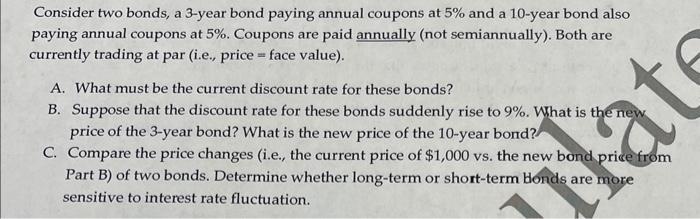
Consider two bonds, a 3-year bond paying annual coupons at 5% and a 10 -year bond also paying annual coupons at 5%. Coupons are paid annually (not semiannually). Both are currently trading at par (i.e., price = face value). A. What must be the current discount rate for these bonds? B. Suppose that the discount rate for these bonds suddenly rise to 9%. What is the new price of the 3-year bond? What is the new price of the 10-year bond? C. Compare the price changes (i.e., the current price of $1,000 vs. the new bond price from Part B) of two bonds. Determine whether long-term or short-term bonds are more sensitive to interest rate fluctuation
Step by Step Solution
There are 3 Steps involved in it

Get step-by-step solutions from verified subject matter experts
 Study Help