







Question: answer a,b,c,d 2. Below is a plot for the binding of a ligand to the surface of a cell in the absence (solid line) and
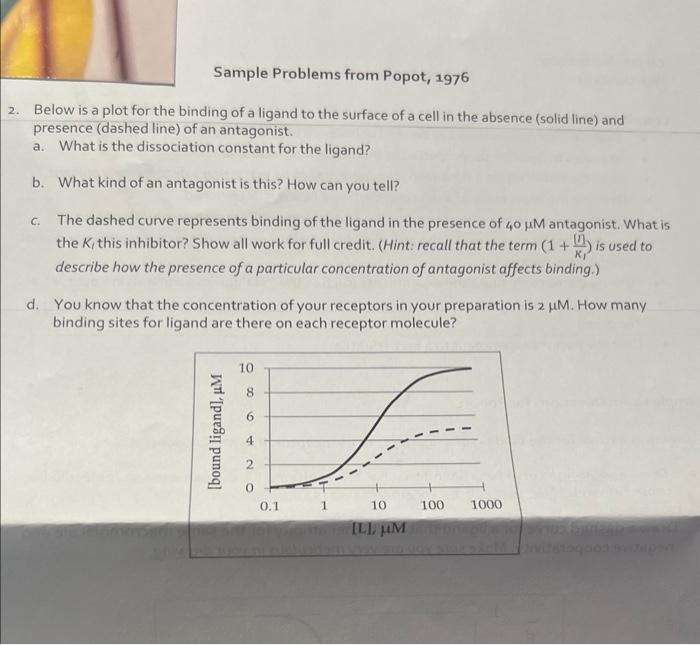
2. Below is a plot for the binding of a ligand to the surface of a cell in the absence (solid line) and presence (dashed line) of an antagonist. a. What is the dissociation constant for the ligand? b. What kind of an antagonist is this? How can you tell? c. The dashed curve represents binding of the ligand in the presence of 40M antagonist. What is the K1 this inhibitor? Show all work for full credit. (Hint: recall that the term (1+K1(I)) is used to describe how the presence of a particular concentration of antagonist affects binding.) d. You know that the concentration of your receptors in your preparation is 2M. How many binding sites for ligand are there on each receptor molecule
Step by Step Solution
There are 3 Steps involved in it

Get step-by-step solutions from verified subject matter experts
 Study Help