







Question: 1. Which has maximum internal energy at 298 K? a) helium gas c) ozone gas d) equal b) oxygen gas For a gas having
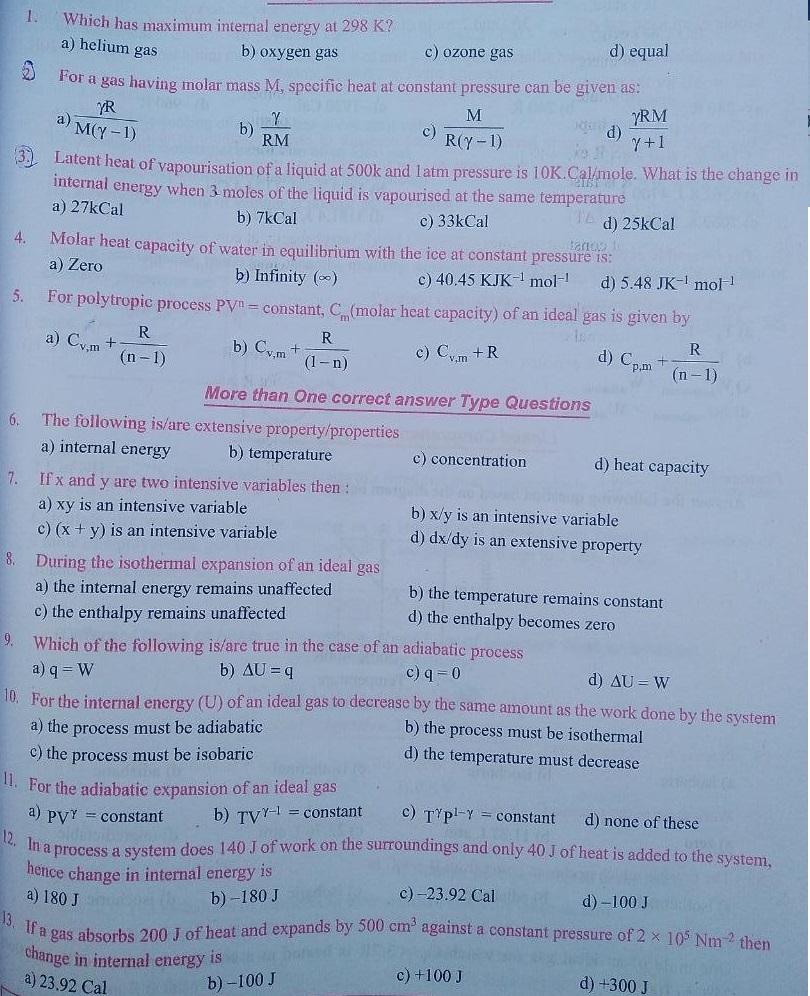
1. Which has maximum internal energy at 298 K? a) helium gas c) ozone gas d) equal b) oxygen gas For a gas having molar mass M, specific heat at constant pressure can be given as: YR a) M(Y-1) YRM a d) Y+1 M b) RM c) R(y-1) 31 Latent heat of vapourisation of a liquid at 500k and latm pressure is 10K.Cal/mole. What is the change in internal energy when 3 moles of the liquid is vapourised at the same temperature a) 27kCal b) 7kCal ) 33KCal TE d) 25kCal 4. Molar heat capacity of water in equilibrium with the ice at constant pressure is: a) Zero b) Infinity () c) 40.45 KJK mol- d) 5.48 JK- mol 5. For polytropic process PV = constant, C (molar heat capacity) of an ideal gas is given by R a) Cv,m R b) Cm + c) C,m +R Cp.m d) (n -1) (1-n) (n- 1) More than One correct answer Type Questions The following is/are extensive property/properties a) internal energy 6. b) temperature c) concentration d) heat capacity 7. If x and y are two intensive variables then : b) x/y is an intensive variable d) dx/dy is an extensive property a) xy is an intensive variable c) (x + y) is an intensive variable 8. During the isothermal expansion of an ideal gas a) the internal energy remains unaffected c) the enthalpy remains unaffected b) the temperature remains constant d) the enthalpy becomes zero 9. Which of the following is/are true in the case of an adiabatic process a) q = W b) AU = q 0 = b () d) AU = W 10. For the internal energy (U) of an ideal gas to decrease by the same amount as the work done by the system b) the process must be isothermal a) the process must be adiabatic d) the temperature must decrease ) the process must be isobaric . For the adiabatic expansion of an ideal gas b) TVY-1 = constant c) T'pl-Y = constant d) none of these a) pyY = constant 12. In a process a system does 140 J of work on the surrouindings and only 40 J of heat is added to the system hence change in internal energy is a) 180 J c) -23.92 Cal d) -100 J b) -180 J gas absorbs 200 J of heat and expands by S00 cm" against a constant pressure of 2 x 10⁵ Nm 2 4kan 13. If a Change in internal energy is a a) 23.92 Cal c) +100 J d) +300 J b) -100 J
Step by Step Solution
3.37 Rating (147 Votes )
There are 3 Steps involved in it

Get step-by-step solutions from verified subject matter experts
 Study Help