



Question: Answer all and i will give thumbs up please Lease or Sell Astro Company owns a equipment with a cost of $365,300 and accumulated depreciation
 Answer all and i will give thumbs up please
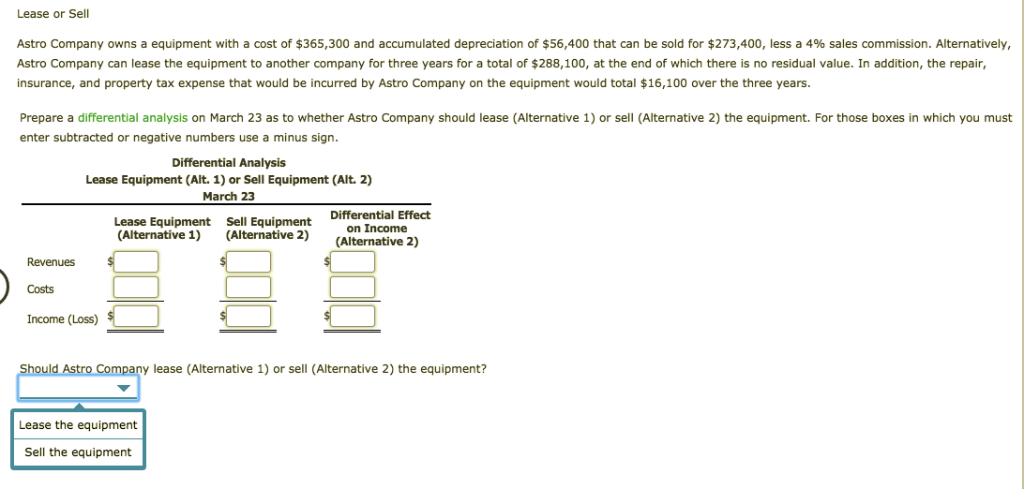
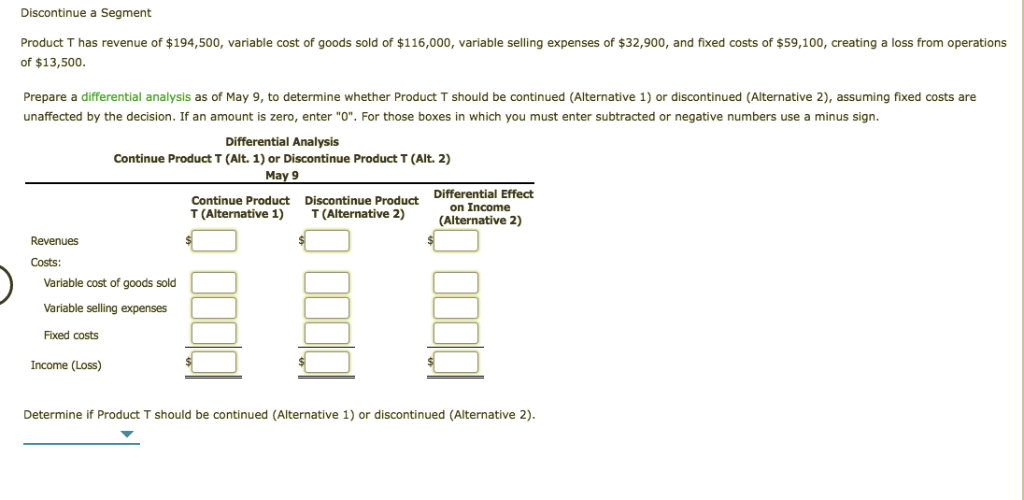
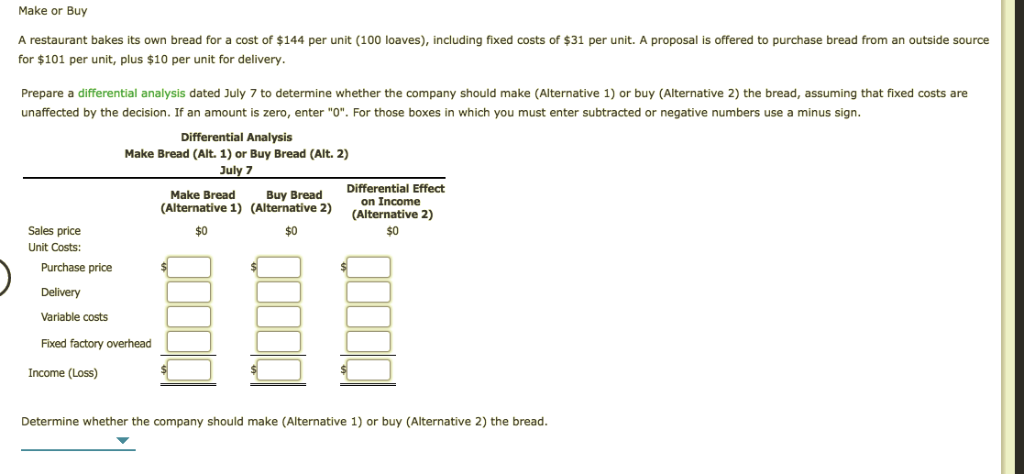
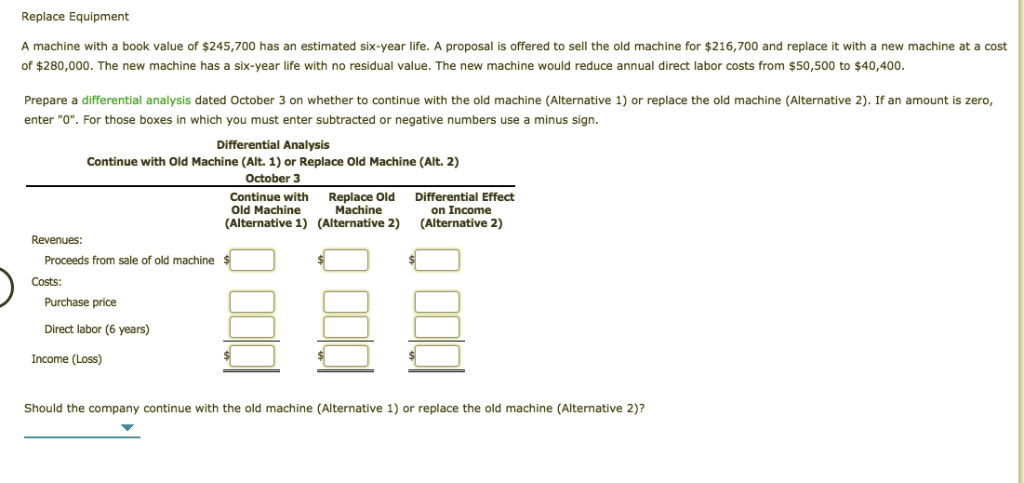
Lease or Sell Astro Company owns a equipment with a cost of $365,300 and accumulated depreciation of $56,400 that can be sold for $273,400, less a 4% sales commission. Alternatively, Astro Company can lease the equipment to another company for three years for a total of $288,100, at the end of which there is no residual value. In addition, the repair, insurance, and property tax expense that would be incurred by Astro Company on the equipment would total $16,100 over the three years. Prepare a differential analysis on March 23 as to whether Astro Company should lease (Alternative 1) or sell (Alternative 2) the equipment. For those boxes in which you must enter subtracted or negative numbers use a minus sign. Differential Analysis Lease Equipment (Alt. 1) or Sell Equipment (Alt. 2) March 23 Lease Equipment Sell Equipment Differential Effect (Alternative 1) (Alternative 2) on Income (Alternative 2) Revenues Costs Income (Loss) Should Astro Company lease (Alternative 1) or sell (Alternative 2) the equipment? Lease the equipment Sell the equipment Discontinue a Segment Product T has revenue of $194,500, variable cost of goods sold of $116,000, variable selling expenses of $32,900, and fixed costs of $59,100, creating a loss from operations of $13,500. Prepare a differential analysis as of May 9, to determine whether Product T should be continued (Alternative 1) or discontinued (Alternative 2), assuming fixed costs are unaffected by the decision. If an amount is zero, enter "0". For those boxes in which you must enter subtracted or negative numbers use a minus sign Differential Analysis Continue Product T (Alt. 1) or Discontinue Product T (Alt. 2) May 9 Continue Product Discontinue Product Differential Effect on Income T(Alternative 1) T(Alternative 2) (Alternative 2) Revenues Costs: Variable cost of goods sold Variable selling expenses Fixed costs Income (Loss) Determine if Product T should be continued (Alternative 1) or discontinued (Alternative 2). Make or Buy A restaurant bakes its own bread for a cost of $144 per unit (100 loaves), including fixed costs of $31 per unit. A proposal is offered to purchase bread from an outside source for $101 per unit, plus $10 per unit for delivery. Prepare a differential analysis dated July 7 to determine whether the company should make (Alternative 1) or buy (Alternative 2) the bread, assuming that fixed costs are unaffected by the decision. If an amount is zero, enter "0". For those boxes in which you must enter subtracted or negative numbers use a minus sign. Differential Analysis Make Bread (Alt. 1) or Buy Bread (Alt. 2) July 7 Make Bread Buy Bread Differential Effect (Alternative 1) (Alternative 2) on Income (Alternative 2) $0 $0 Sales price Unit Costs: Purchase price Delivery Variable costs Fixed factory overhead Income (Loss) Determine whether the company should make (Alternative 1) or buy (Alternative 2) the bread. Replace Equipment A machine with a book value of $245,700 has an estimated six-year life. A proposal is offered to sell the old machine for $216,700 and replace it with a new machine at a cost of $280,000. The new machine has a six-year life with no residual value. The new machine would reduce annual direct labor costs from $50,500 to $40,400. Prepare a differential analysis dated October 3 on whether to continue with the old machine (Alternative 1) or replace the old machine (Alternative 2). If an amount is zero, enter "0". For those boxes in which you must enter subtracted or negative numbers use a minus sign. Differential Analysis Continue with Old Machine (Alt. 1) or Replace Old Machine (Alt. 2) October 3 Continue with Replace Old Differential Effect Old Machine Machine on Income (Alternative 1) (Alternative 2) (Alternative 2) Revenues: Proceeds from sale of old machine $ Costs: Purchase price Direct labor (6 years) Income (Loss) Should the company continue with the old machine (Alternative 1) or replace the old machine (Alternative 2)
Step by Step Solution
There are 3 Steps involved in it

Get step-by-step solutions from verified subject matter experts