







Question: answer all and show work please Table 1. Standard state enthalpies of atom 10. Based on the dara in Table 1, what is H for
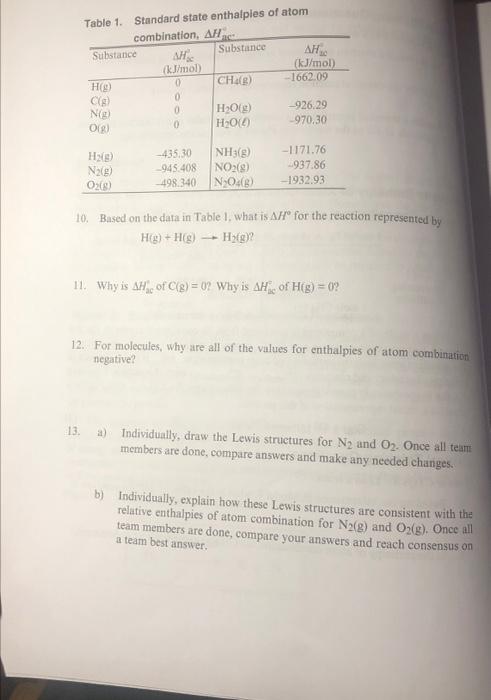
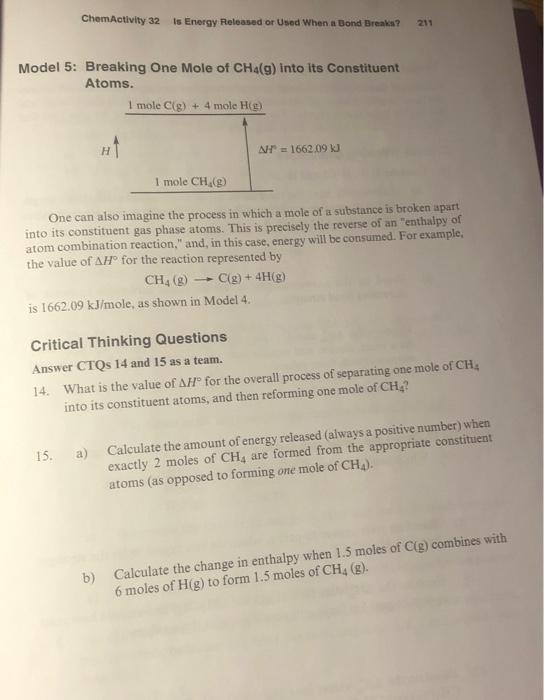
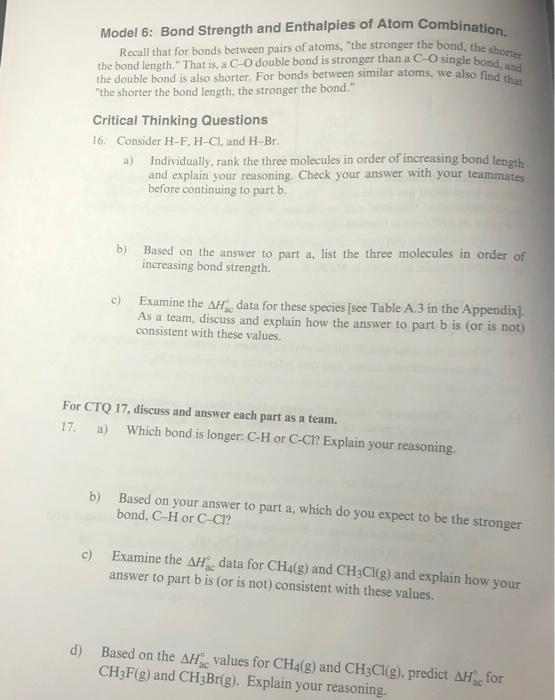
Table 1. Standard state enthalpies of atom 10. Based on the dara in Table 1, what is H for the reaction represented by H(g)+H(g)H2(g)? 11. Why is Hac of C(g)=0 ? Why is Hac2 of H(g)=0 ? 12. For molecules, why are all of the values for enthalpies of atom combination negative? 13. a) Individually, draw the Lewis structures for N2 and O2. Once all team members are done, compare answers and make any needed changes. b) Individually, explain how these Lewis structures are consistent with the relative cnthalpies of atom combination for N2(g) and O2(g). Once all team members are done, compare your answers and reach consensus on a team best answer. ChemActivity 32 Is Energy Released or Used When a Bond Breaks? 211 Model 5: Breaking One Mole of CH4(g) into its Constituent Atoms. One can also imagine the process in which a mole of a substance is broken apart into its constituent gas phase atoms. This is precisely the reverse of an "enthalpy of atom combination reaction," and, in this case, energy will be consumed. For example, the value of H for the reaction represented by CH4(g)C(g)+4H(g) is 1662.09kJ/mole, as shown in Model 4. Critical Thinking Questions Answer CTQs 14 and 15 as a team. 14. What is the value of H for the overall process of separating one mole of CH4 into its constituent atoms, and then reforming one mole of CH4 ? 15. a) Calculate the amount of energy released (always a positive number) when exactly 2 moles of CH4 are formed from the appropriate constituent atoms (as opposed to forming one mole of CH4 ). b) Calculate the change in enthalpy when 1.5 moles of C(g) combines with 6 moles of H(g) to form 1.5 moles of CH4(g). For CTQ 17, discuss and answer each part as a team. 17. a) Which bond is longer: CH or CCl ? Explain your reasoning. b) Based on your answer to part a, which do you expect to be the stronger bond, C-H or CCl ? c) Examine the Hac data for CH4(g) and CH3Cl(g) and explain how your answer to part b is (or is not) consistent with these values. d) Based on the Hac values for CH4(g) and CH3Cl(g), predict Hac for CH3F(g) and CH3Br(g). Explain your reasoning
Step by Step Solution
There are 3 Steps involved in it

Get step-by-step solutions from verified subject matter experts
 Study Help