Question: ANSWER ALL BLANKS, EVEN THOSE MARKED WRONG WITH RED Fig. The following table details the tasks required for Indiana-based Frank Pianki Industries to manufacture a

ANSWER ALL BLANKS, EVEN THOSE MARKED WRONG WITH REDANSWER ALL BLANKS, EVEN THOSE MARKED WRONG WITHANSWER ALL BLANKS, EVEN THOSE MARKED WRONG WITHANSWER ALL BLANKS, EVEN THOSE MARKED WRONG WITHANSWER ALL BLANKS, EVEN THOSE MARKED WRONG WITHANSWER ALL BLANKS, EVEN THOSE MARKED WRONG WITH
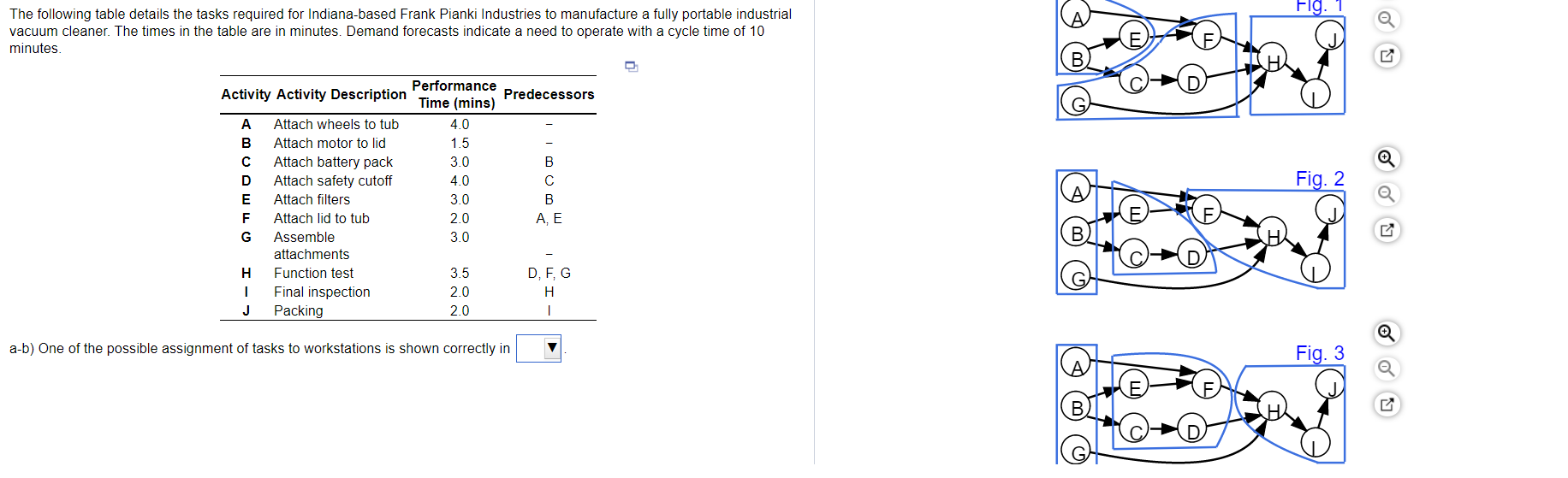
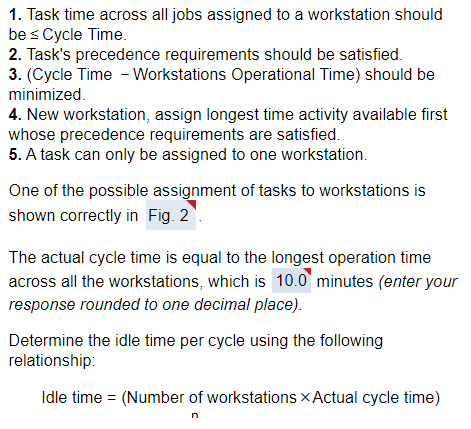
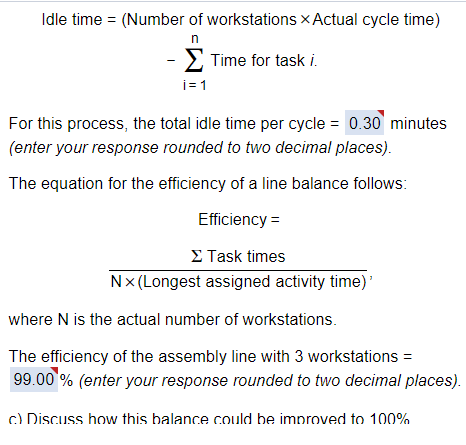
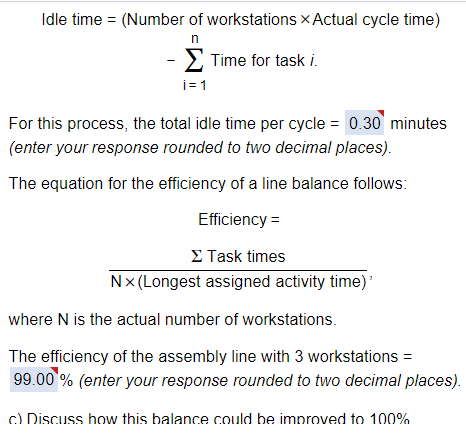
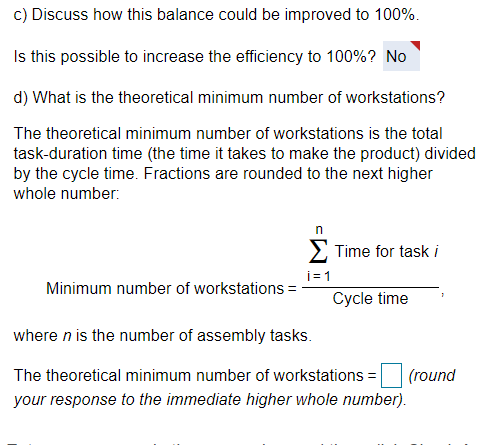
Fig. The following table details the tasks required for Indiana-based Frank Pianki Industries to manufacture a fully portable industrial vacuum cleaner. The times in the table are in minutes. Demand forecasts indicate a need to operate with a cycle time of 10 minutes. O Predecessors 4.0 Performance Activity Activity Description Time (mins) A Attach wheels to tub B Attach motor to lid 1.5 Attach battery pack 3.0 D Attach safety cutoff 4.0 E Attach filters 3.0 F Attach lid to tub 2.0 G Assemble 3.0 attachments . Function test 3.5 1 Final inspection 2.0 J Packing 2.0 B B A, E Fig. D, F, G H | a-b) One of the possible assignment of tasks to workstations is shown correctly in Fig. 3 1. Task time across all jobs assigned to a workstation should be s Cycle Time. 2. Task's precedence requirements should be satisfied. 3. (Cycle Time - Workstations Operational Time) should be minimized 4. New workstation, assign longest time activity available first whose precedence requirements are satisfied. 5. A task can only be assigned to one workstation. One of the possible assignment of tasks to workstations is shown correctly in Fig. 2. The actual cycle time is equal to the longest operation time across all the workstations, which is 10.0 minutes (enter your response rounded to one decimal place). Determine the idle time per cycle using the following relationship: Idle time = (Number of workstations x Actual cycle time) n n Idle time = (Number of workstations x Actual cycle time) - ime for taski. i = 1 For this process, the total idle time per cycle = 0.30 minutes (enter your response rounded to two decimal places). The equation for the efficiency of a line balance follows: Efficiency = Task times Nx(Longest assigned activity time)' where N is the actual number of workstations. The efficiency of the assembly line with 3 workstations = 99.00 % (enter your response rounded to two decimal places). c) Discuss how this balance could be improved to 100% n Idle time = (Number of workstations x Actual cycle time) - ime for taski. i = 1 For this process, the total idle time per cycle = 0.30 minutes (enter your response rounded to two decimal places). The equation for the efficiency of a line balance follows: Efficiency = Task times Nx(Longest assigned activity time)' where N is the actual number of workstations. The efficiency of the assembly line with 3 workstations = 99.00 % (enter your response rounded to two decimal places). c) Discuss how this balance could be improved to 100% c) Discuss how this balance could be improved to 100%. Is this possible to increase the efficiency to 100%? No d) What is the theoretical minimum number of workstations? The theoretical minimum number of workstations is the total task-duration time (the time it takes to make the product) divided by the cycle time. Fractions are rounded to the next higher whole number: n Time for task i i = 1 Minimum number of workstations Cycle time where n is the number of assembly tasks. The theoretical minimum number of workstations = (round your response to the immediate higher whole number)

Step by Step Solution

There are 3 Steps involved in it

1 Expert Approved Answer
Step: 1 Unlock blur-text-image

Question Has Been Solved by an Expert!

Get step-by-step solutions from verified subject matter experts

Step: 2 Unlock
Step: 3 Unlock

Students Have Also Explored These Related General Management Questions!