


Question: answer all parts please 2. Let G = SL(2, Z), let p be a prime number, and consider the set U of 2 x 2

answer all parts please
answer all parts please 2. Let G = SL(2, Z), let
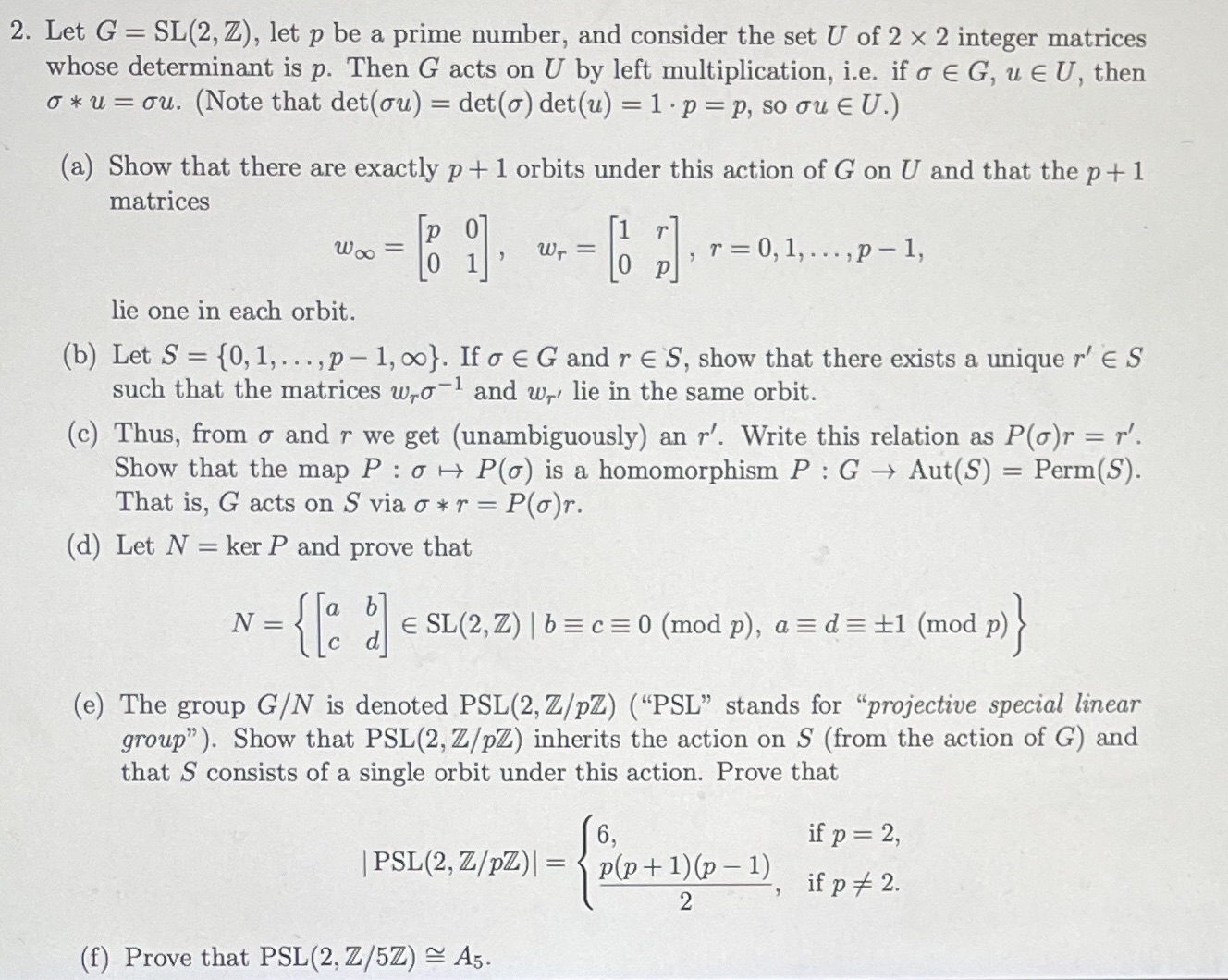
2. Let G = SL(2, Z), let p be a prime number, and consider the set U of 2 x 2 integer matrices whose determinant is p. Then G acts on U by left multiplication, i.e. if o E G, u E U, then o * u = ou. (Note that det(ou) = det(o) det(u) = 1 . p = p, so ou E U.) (a) Show that there are exactly p + 1 orbits under this action of G on U and that the p + 1 matrices WOO P , T = 0 , 1 , . .., p - 1 , lie one in each orbit. (b) Let S = {0, 1, ..., p- 1, co}. If o E G and r E 'S, show that there exists a unique r' E S such that the matrices wro- and w, lie in the same orbit. (c) Thus, from o and r we get (unambiguously) an r'. Write this relation as P(o) r = r'. Show that the map P : o > P(o) is a homomorphism P : G - Aut(S) = Perm(S). That is, G acts on S via o * r = P(o)r. (d) Let N = ker P and prove that N = ESL(2, Z) | b= c= 0 (mod p), a = d= tl (mod p) (e) The group G/N is denoted PSL(2, Z/pZ) ("PSL" stands for "projective special linear group"). Show that PSL(2, Z/pZ) inherits the action on S (from the action of G) and that S consists of a single orbit under this action. Prove that 6, if p = 2, |PSL(2, Z/pZ)| = P(p + 1)(p -1) if p # 2. 2 (f) Prove that PSL(2, Z/5Z) ~ A5

Step by Step Solution

There are 3 Steps involved in it

1 Expert Approved Answer
Step: 1 Unlock blur-text-image

Question Has Been Solved by an Expert!

Get step-by-step solutions from verified subject matter experts

Step: 2 Unlock
Step: 3 Unlock

Students Have Also Explored These Related Mathematics Questions!