







Question: Answer all please Chapter Four Geometric Optics: Reflection and Refraction of Light, Mirrors And Lenses Due Date 1. A converging lens with 50 cm focal
Answer all please
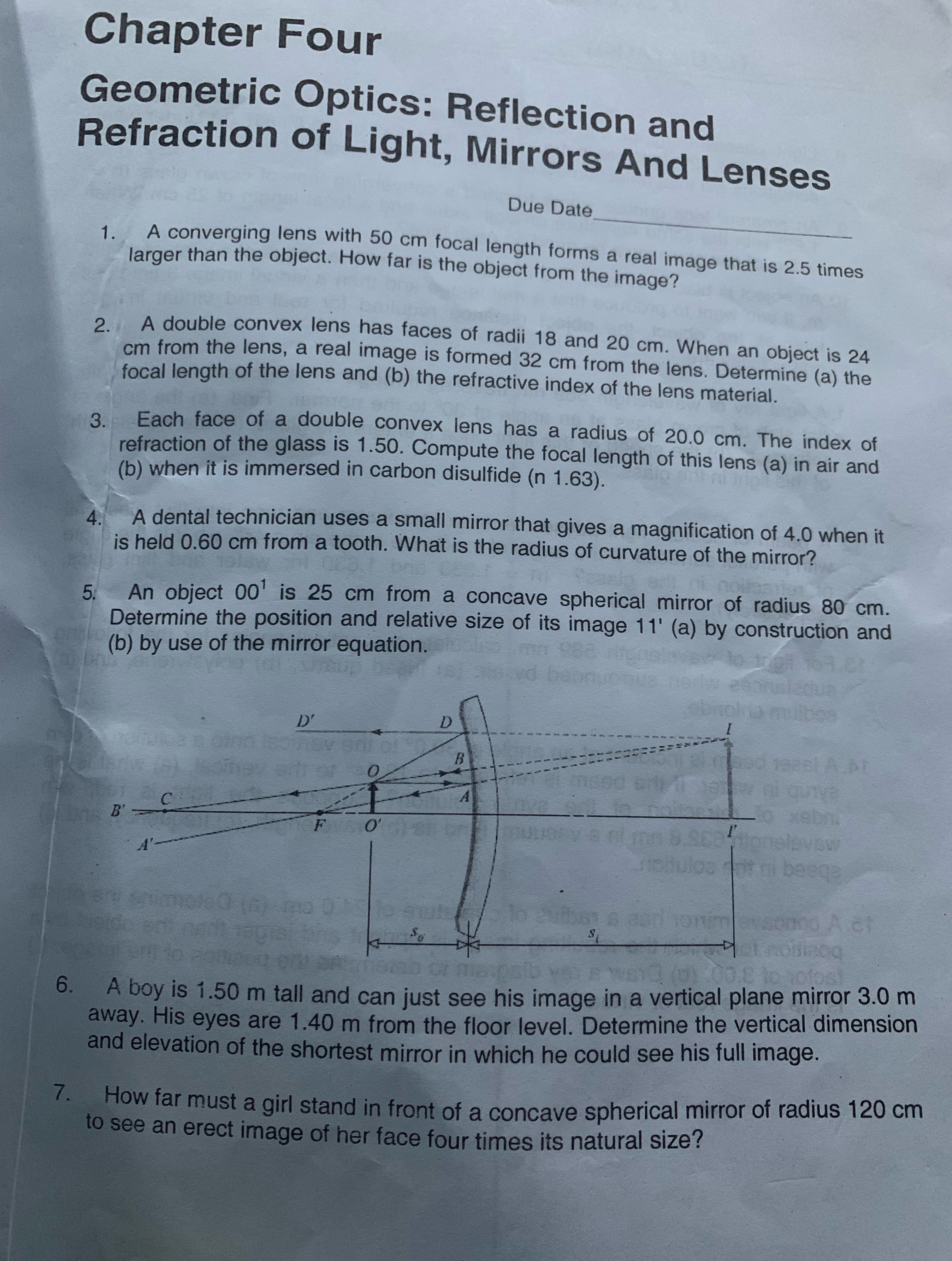
Chapter Four Geometric Optics: Reflection and Refraction of Light, Mirrors And Lenses Due Date 1. A converging lens with 50 cm focal length forms a real image that is 2.5 times larger than the object. How far is the object from the image? 2. A double convex lens has faces of radii 18 and 20 cm. When an object is 24 cm from the lens, a real image is formed 32 cm from the lens. Determine (a) the focal length of the lens and (b) the refractive index of the lens material. 3. Each face of a double convex lens has a radius of 20.0 cm. The index of refraction of the glass is 1.50. Compute the focal length of this lens (a) in air and (b) when it is immersed in carbon disulfide (n 1.63). A dental technician uses a small mirror that gives a magnification of 4.0 when it is held 0.60 cm from a tooth. What is the radius of curvature of the mirror? 5. An object 00' is 25 cm from a concave spherical mirror of radius 80 cm. Determine the position and relative size of its image 11' (a) by construction and (b) by use of the mirror equation. to mutton D' B' C tolovew Will beegs 6. A boy is 1.50 m tall and can just see his image in a vertical plane mirror 3.0 m away. His eyes are 1.40 m from the floor level. Determine the vertical dimension and elevation of the shortest mirror in which he could see his full image. 7. How far must a girl stand in front of a concave spherical mirror of radius 120 cm to see an erect image of her face four times its natural size
Step by Step Solution
There are 3 Steps involved in it

Get step-by-step solutions from verified subject matter experts
 Study Help