







Question: answer all please Question 1 Ethical systems may be defined as a system of shared beliefs and rituals that are concemed with the realm of
answer all please 








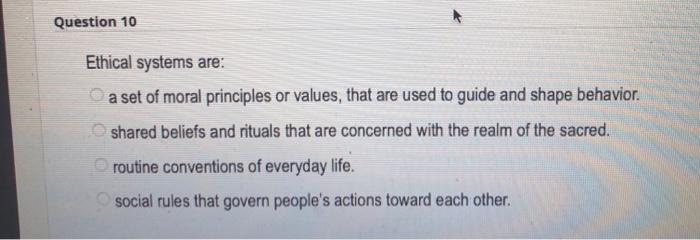
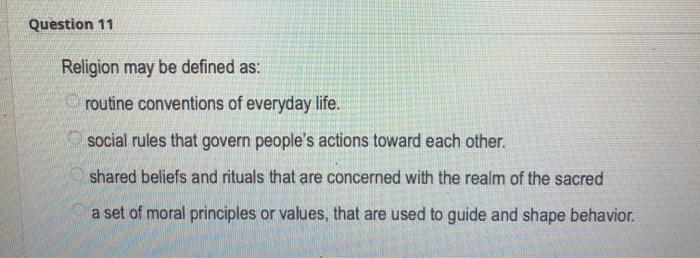
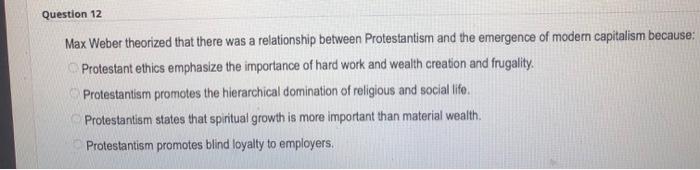
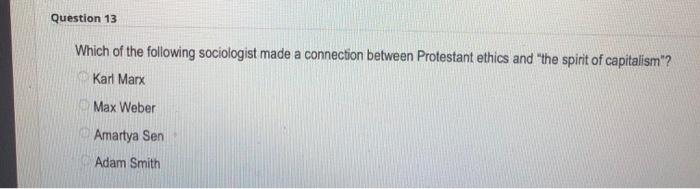
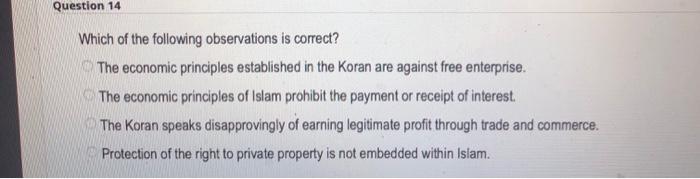
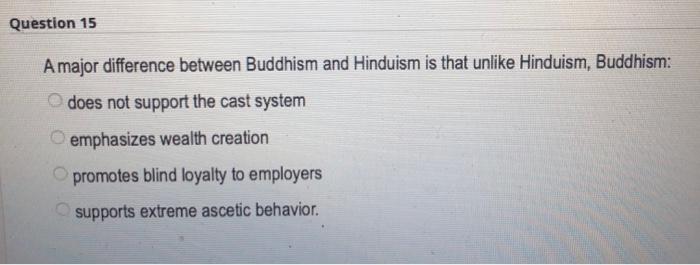
Question 1 Ethical systems may be defined as a system of shared beliefs and rituals that are concemed with the realm of the sacred. True False Question 2 2 point: According to Max Weber. Protestantism encouraged capitalism's development by emphasizing the importance of wealth creation and frugality. True False Question 3 Like Christianity and Judaism, Islam is a polytheistic religion. True False Question 4 The Koran speaks disapprovingly of free enterprise. True False Question 5 The protection of the right to private property is embedded within Islam. True False Question 6 Max Weber thought that devout Hindus would be less likely to engage in entrepreneurial activity than devout Protestants. True False Question 7 Unlike Hinduism, Buddhism supports the caste system. True False Question 8 Both Hindus and Buddhists stress the afterlife and spiritual achievement rather than involvement in this world. True False Question 9 Confucianism is a religion. True False Question 10 Ethical systems are: a set of moral principles or values, that are used to guide and shape behavior. shared beliefs and rituals that are concerned with the realm of the sacred. routine conventions of everyday life. social rules that govern people's actions toward each other. Question 11 Religion may be defined as: routine conventions of everyday life. social rules that govern people's actions toward each other. shared beliefs and rituals that are concerned with the realm of the sacred a set of moral principles or values, that are used to guide and shape behavior. Question 11 Religion may be defined as: routine conventions of everyday life. social rules that govern people's actions toward each other. shared beliefs and rituals that are concerned with the realm of the sacred a set of moral principles or values, that are used to guide and shape behavior. Question 12 Max Weber theorized that there was a relationship between Protestantism and the emergence of modern capitalism because: Protestant ethics emphasize the importance of hard work and wealth creation and frugality. Protestantism promotes the hierarchical domination of religious and social life. Protestantism states that spiritual growth is more important than material wealth Protestantism promotes blind loyalty to employers. Question 13 Which of the following sociologist made a connection between Protestant ethics and the spirit of capitalism"? Karl Marx Max Weber Amartya Sen Adam Smith Question 14 Which of the following observations is correct? The economic principles established in the Koran are against free enterprise. The economic principles of Islam prohibit the payment or receipt of interest. The Koran speaks disapprovingly of earning legitimate profit through trade and commerce. Protection of the right to private property is not embedded within Islam. Question 15 A major difference between Buddhism and Hinduism is that unlike Hinduism, Buddhism: does not support the cast system emphasizes wealth creation promotes blind loyalty to employers supports extreme ascetic behavior Step by Step Solution
There are 3 Steps involved in it
1 Expert Approved Answer
Step: 1 Unlock

Here are the answers to your questions Question 1 False Questi... View full answer
Question Has Been Solved by an Expert!
Get step-by-step solutions from verified subject matter experts
Step: 2 Unlock
Step: 3 Unlock
 Study Help