







Question: Answer all Questions from Question 1 to 4 CASE STUDY READ THE CASE STUDY AND ANSWER THE QUESTIONS THAT FOLLOW WAGE NEGOTIATION PROCESSES AND STRIKE
Answer all Questions from Question 1 to 4
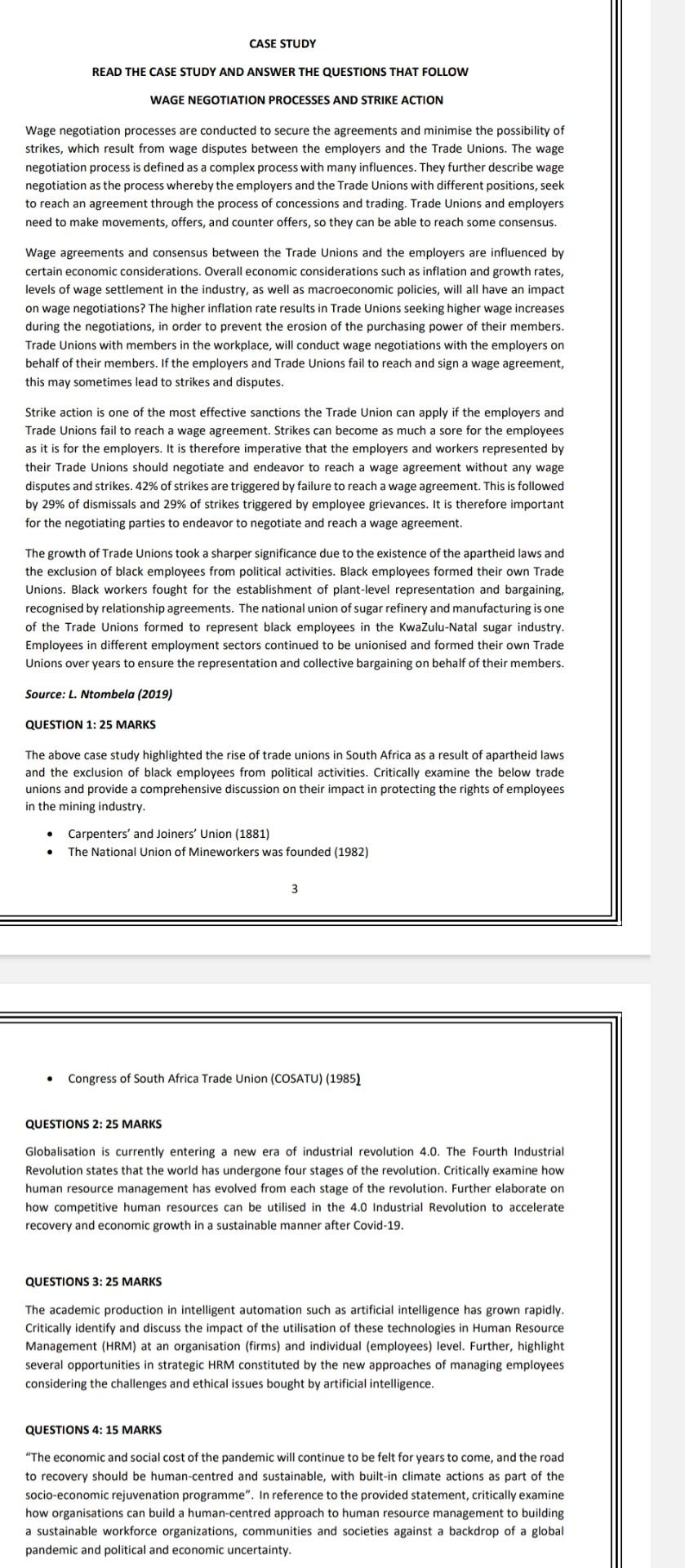
CASE STUDY READ THE CASE STUDY AND ANSWER THE QUESTIONS THAT FOLLOW WAGE NEGOTIATION PROCESSES AND STRIKE ACTION Wage negotiation processes are conducted to secure the agreements and minimise the possibility of strikes, which result from wage disputes between the employers and the Trade Unions. The wage negotiation process is defined as a complex process with many influences. They further describe wage negotiation as the process whereby the employers and the Trade Unions with different positions, seek to reach an agreement through the process of concessions and trading. Trade Unions and employers need to make movements, offers, and counter offers, so they can be able to reach some consensus. Wage agreements and consensus between the Trade Unions and the employers are influenced by certain economic considerations. Overall economic considerations such as inflation and growth rates, levels of wage settlement in the industry, as well as macroeconomic policies, will all have an impact on wage negotiations? The higher inflation rate results in Trade Unions seeking higher wage increases during the negotiations, in order to prevent the erosion of the purchasing power of their members. Trade Unions with members in the workplace, will conduct wage negotiations with the employers on behalf of their members. If the employers and Trade Unions fail to reach and sign a wage agreement, this may sometimes lead to strikes and disputes. Strike action is one of the most effective sanctions the Trade Union can apply if the employers and Trade Unions fail to reach a wage agreement. Strikes can become as much a sore for the employees as it is for the employers. It is therefore imperative that the employers and workers represented by their Trade Unions should negotiate and endeavor to reach a wage agreement without any wage disputes and strikes. 42% of strikes are triggered by failure to reach a wage agreement. This is followed by 29% of dismissals and 29% of strikes triggered by employee grievances. It is therefore important for the negotiating parties to endeavor to negotiate and reach a wage agreement. The growth of Trade Unions took a sharper significance due to the existence of the apartheid laws and the exclusion of black employees from political activities. Black employees formed their own Trade Unions. Black workers fought for the establishment of plant-level representation and bargaining, recognised by relationship agreements. The national union of sugar refinery and manufacturing is one of the Trade Unions formed to represent black employees in the KwaZulu-Natal sugar industry. Employees in different employment sectors continued to be unionised and formed their own Trade Unions over years to ensure the representation and collective bargaining on behalf of their members. Source: L. Ntombela (2019) QUESTION 1: 25 MARKS The above case study highlighted the rise of trade unions in South Africa as a result of apartheid laws and the exclusion of black employees from political activities. Critically examine the below trade unions and provide a comprehensive discussion on their impact in protecting the rights of employees in the mining industry. - Carpenters' and Joiners' Union (1881) - The National Union of Mineworkers was founded (1982) 3 - Congress of South Africa Trade Union (COSATU) (1985) QUESTIONS 2: 25 MARKS Globalisation is currently entering a new era of industrial revolution 4.0. The Fourth Industrial Revolution states that the world has undergone four stages of the revolution. Critically examine how human resource management has evolved from each stage of the revolution. Further elaborate on how competitive human resources can be utilised in the 4.0 Industrial Revolution to accelerate recovery and economic growth in a sustainable manner after Covid-19. QUESTIONS 3: 25 MARKS The academic production in intelligent automation such as artificial intelligence has grown rapidly. Critically identify and discuss the impact of the utilisation of these technologies in Human Resource Management (HRM) at an organisation (firms) and individual (employees) level. Further, highlight several opportunities in strategic HRM constituted by the new approaches of managing employees considering the challenges and ethical issues bought by artificial intelligence. QUESTIONS 4: 15 MARKS "The economic and social cost of the pandemic will continue to be felt for years to come, and the road to recovery should be human-centred and sustainable, with built-in climate actions as part of the socio-economic rejuvenation programme". In reference to the provided statement, critically examine how organisations can build a human-centred approach to human resource management to building a sustainable workforce organizations, communities and societies against a backdrop of a global
Step by Step Solution
There are 3 Steps involved in it

Get step-by-step solutions from verified subject matter experts
 Study Help