Question: answer all questions please! Ignore key points questions CASE STUDY: Who's the Boss? Leon has been head chef at the Elite Caf since it opened
answer all questions please! Ignore key points questions 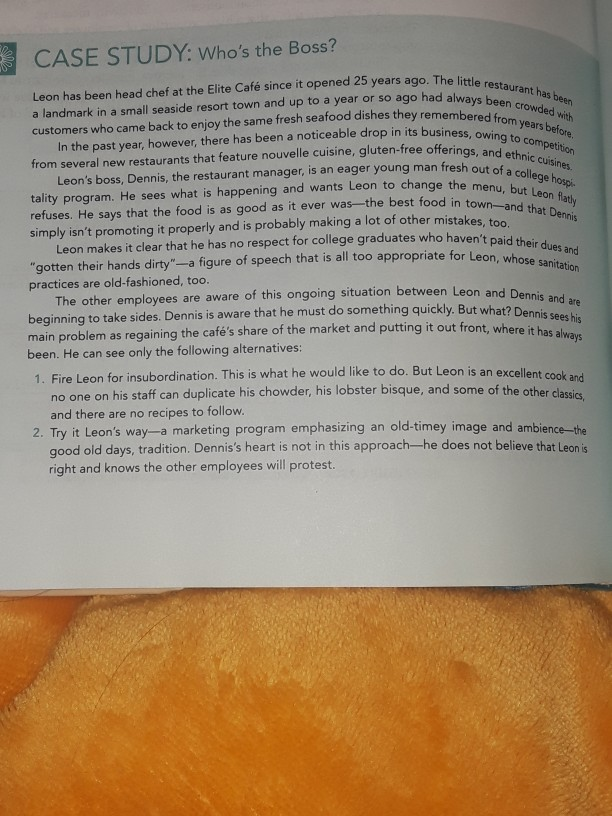
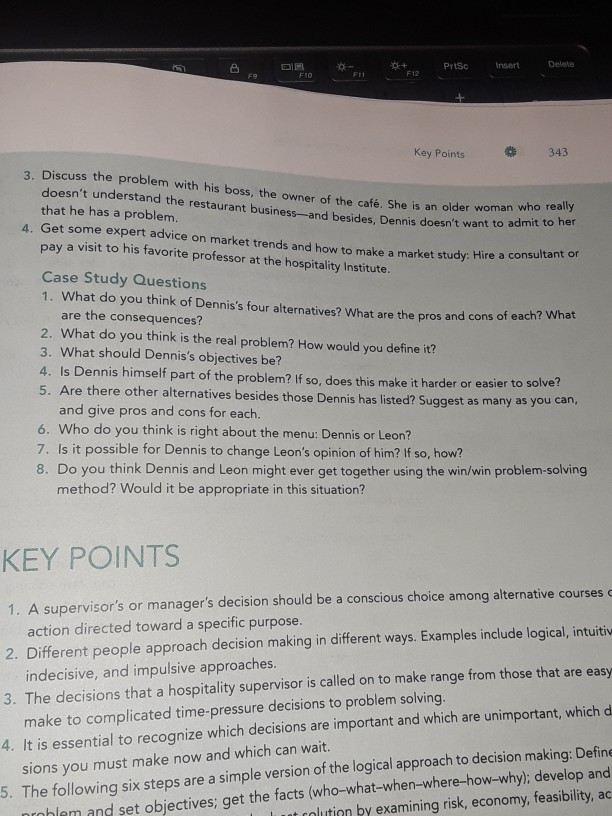
CASE STUDY: Who's the Boss? Leon has been head chef at the Elite Caf since it opened 25 years ago. The little restaurant has been customers who came back to enjoy the same fresh seafood dishes they remembered from years before. a landmark in a small seaside resort town and up to a year or so ago had always been crowded with from several new restaurants that feature nouvelle cuisine, gluten-free offerings, and ethnic cuisines In the past year, however, there has been a noticeable drop in its business, owing to competition Leon's boss, Dennis, the restaurant manager, is an eager young man fresh out of a college hospi tality program. He sees what is happening and wants Leon to change the menu, but Leon Tatly refuses. He says that the food is as good as it ever was the best food in town and that Dennis Leon makes it clear that he has no respect for college graduates who haven't paid their dues and "-a figure of speech that is all too appropriate for Leon, whose sanitation "gotten their hands dirty"- practices are old-fashioned, too. simply isn't promoting it properly and is probably making a lot of other mistakes, too. The other employees are aware of this ongoing situation between Leon and Dennis and are beginning to take sides. Dennis is aware that he must do something quickly. But what? Dennis sees his main problem as regaining the caf's share of the market and putting it out front, where it has always been. He can see only the following alternatives: 1. Fire Leon for insubordination. This is what he would like to do. But Leon is an excellent cook and no one on his staff can duplicate his chowder, his lobster bisque, and some of the other classics and there are no recipes to follow. 2. Try it Leon's waya marketing program emphasizing an old-timey image and ambience-the good old days, tradition. Dennis's heart is not in this approachhe does not believe that Leon is right and knows the other employees will protest. 3. Discuss the problem with his boss, the owner of the caf. She is an older woman who really DP + F12 Prisc Insert Delete F9 FIO F11 + Key Points 343 doesn't understand the restaurant business--and besides, Dennis doesn't want to admit to her that he has a problem. 4. Get some expert advice on market trends and how to make a market study: Hire a consultant or pay a visit to his favorite professor at the hospitality Institute. Case Study Questions 1. What do you think of Dennis's four alternatives? What are the pros and cons of each? What are the consequences? 2. What do you think is the real problem? How would you define it? 3. What should Dennis's objectives be? 4. Is Dennis himself part of the problem? If so, does this make it harder or easier to solve? 5. Are there other alternatives besides those Dennis has listed? Suggest as many as you can, and give pros and cons for each. 6. Who do you think is right about the menu: Dennis or Leon? 7. Is it possible for Dennis to change Leon's opinion of him? If so, how? 8. Do you think Dennis and Leon might ever get together using the win/win problem-solving method? Would it be appropriate in this situation? KEY POINTS 1. A supervisor's or manager's decision should be a conscious choice among alternative courses action directed toward a specific purpose. 2. Different people approach decision making in different ways. Examples include logical, intuitiv indecisive, and impulsive approaches. 3. The decisions that a hospitality supervisor is called on to make range from those that are easy make to complicated time-pressure decisions to problem solving. 4. It is essential to recognize which decisions are important and which are unimportant, which d sions you must make now and which can wait. 5. The following six steps are a simple version of the logical approach to decision making: Define nroblem and set objectives: get the facts (who-what-when-where-how-why); develop and ut calutinn by examining risk, economy, feasibility, ac









 Study Help