







Question: Answer all questions. Show all your work you must explain how you arrived at your answer. Partial credit may be awarded if a substantial part
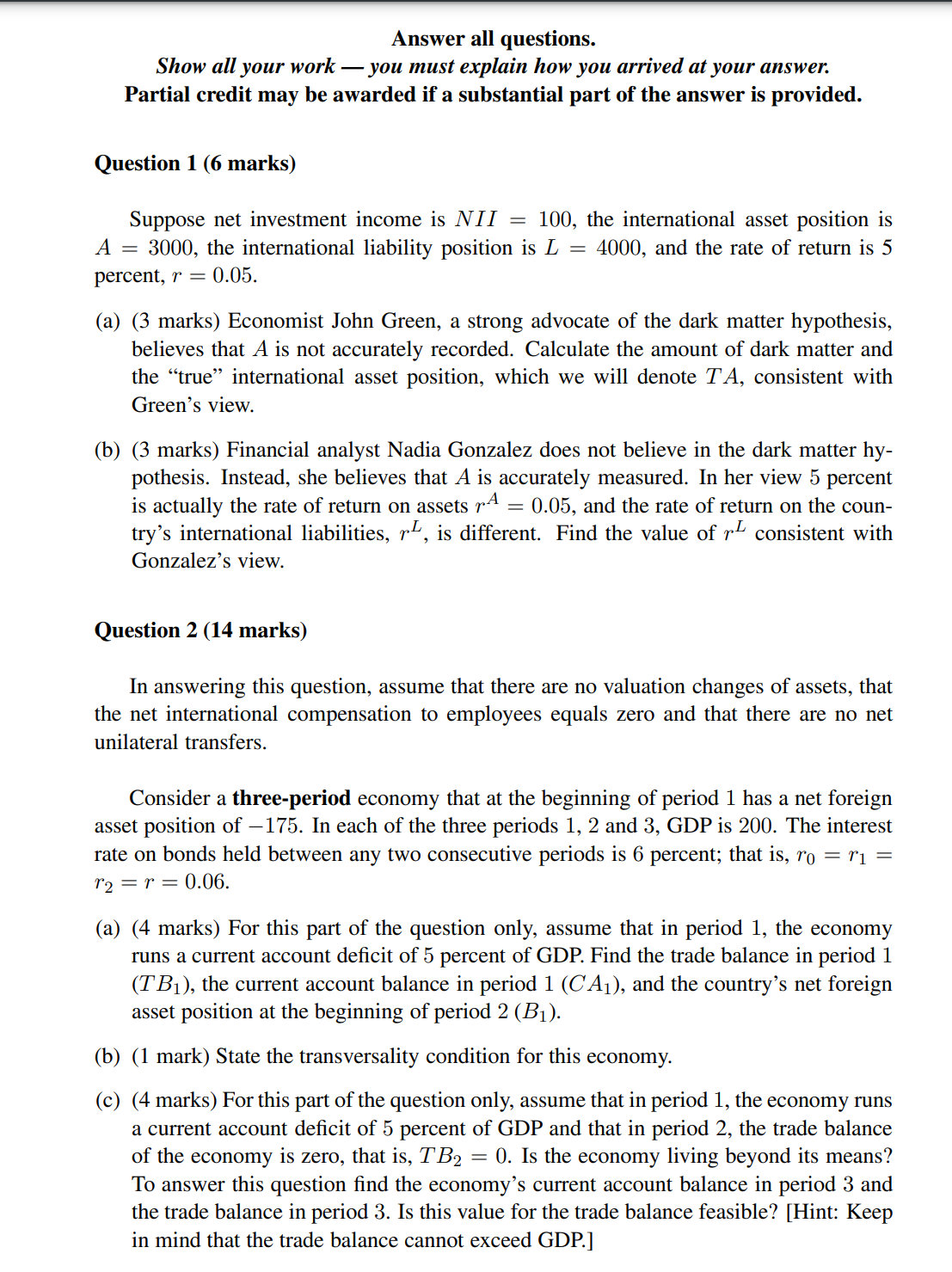
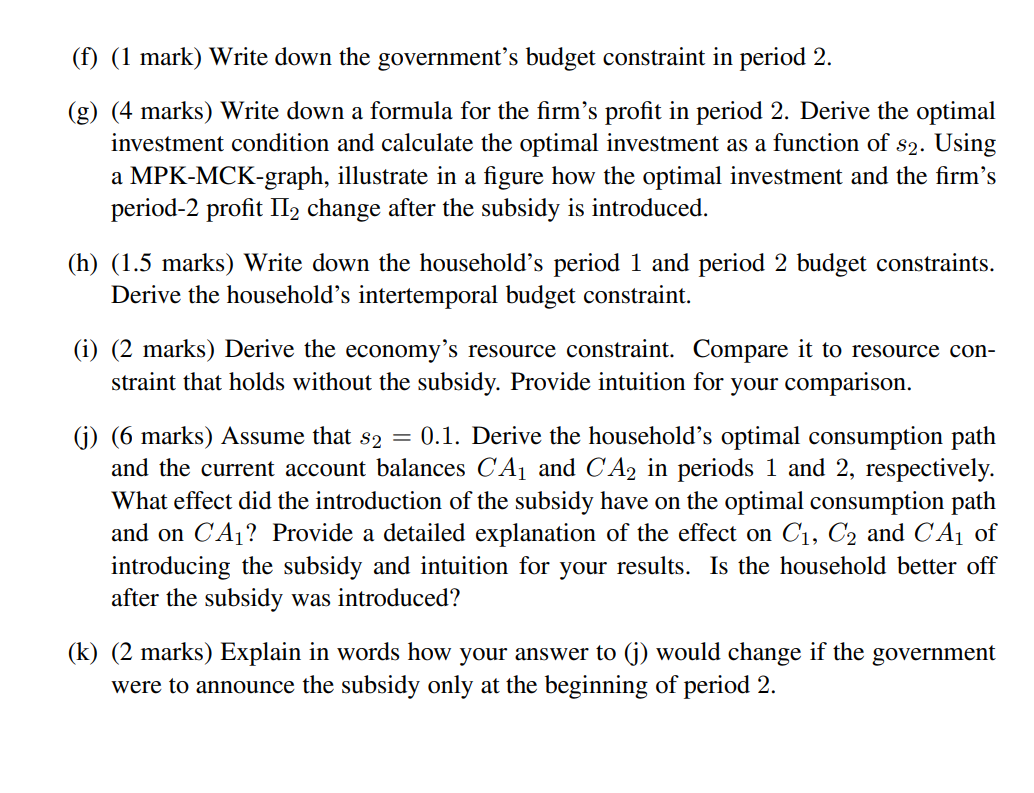
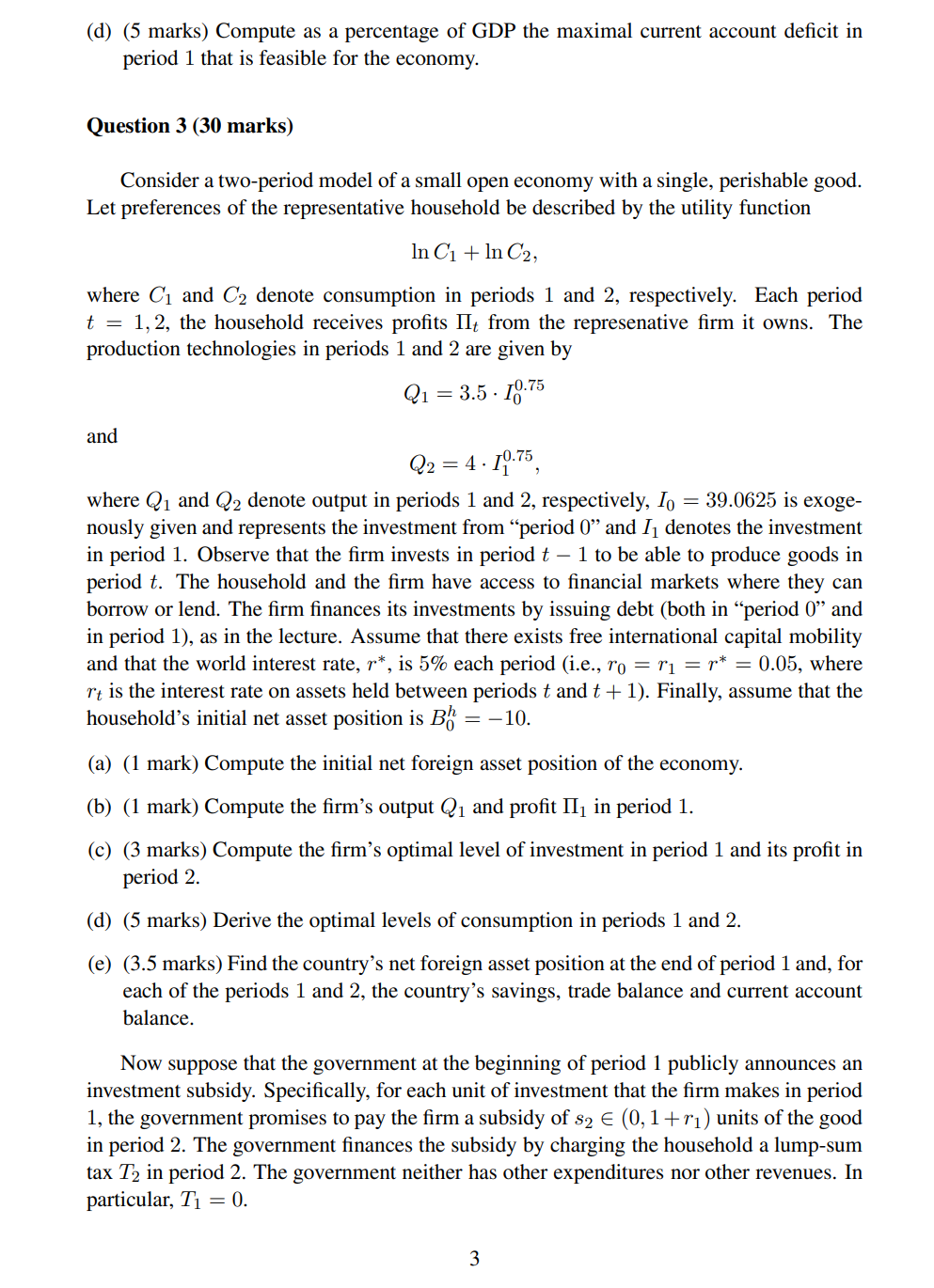
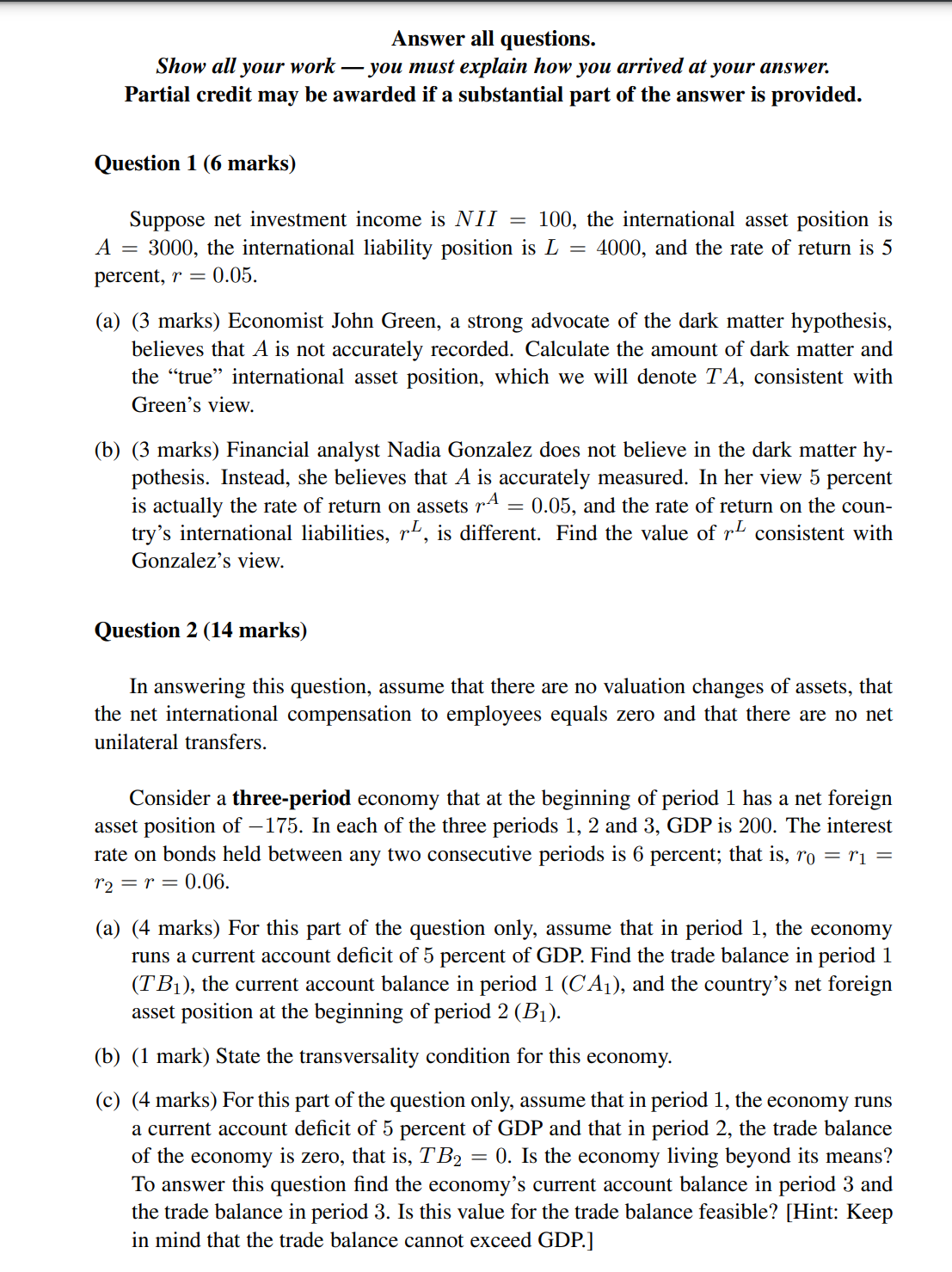
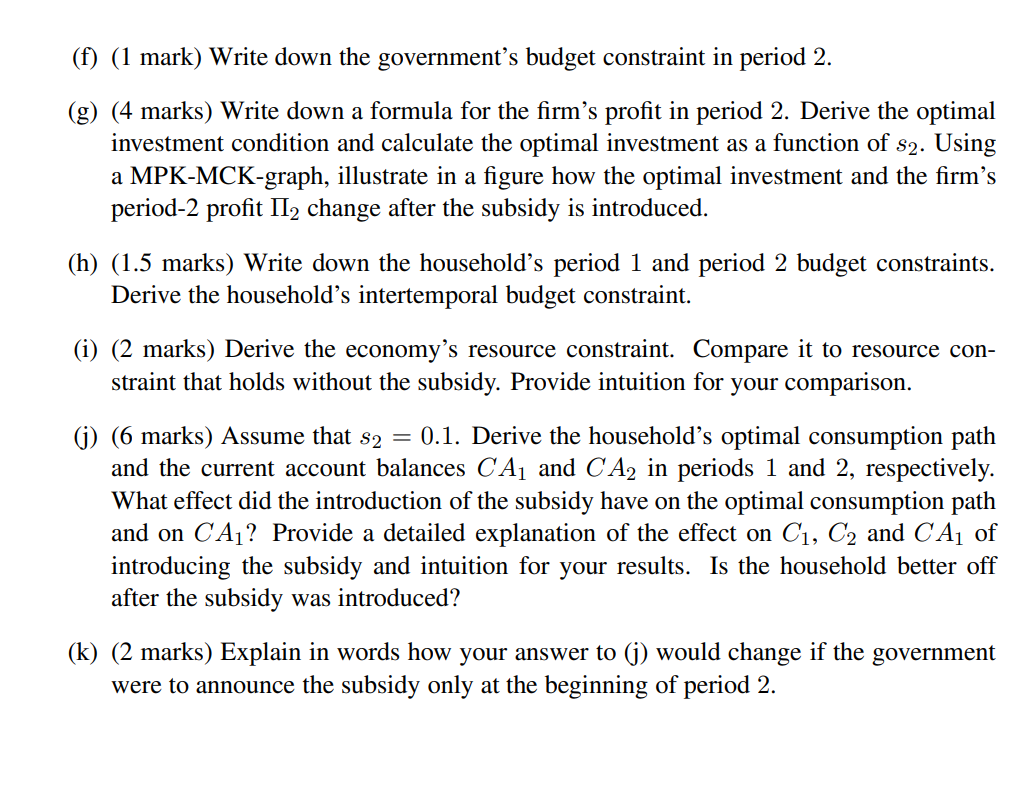
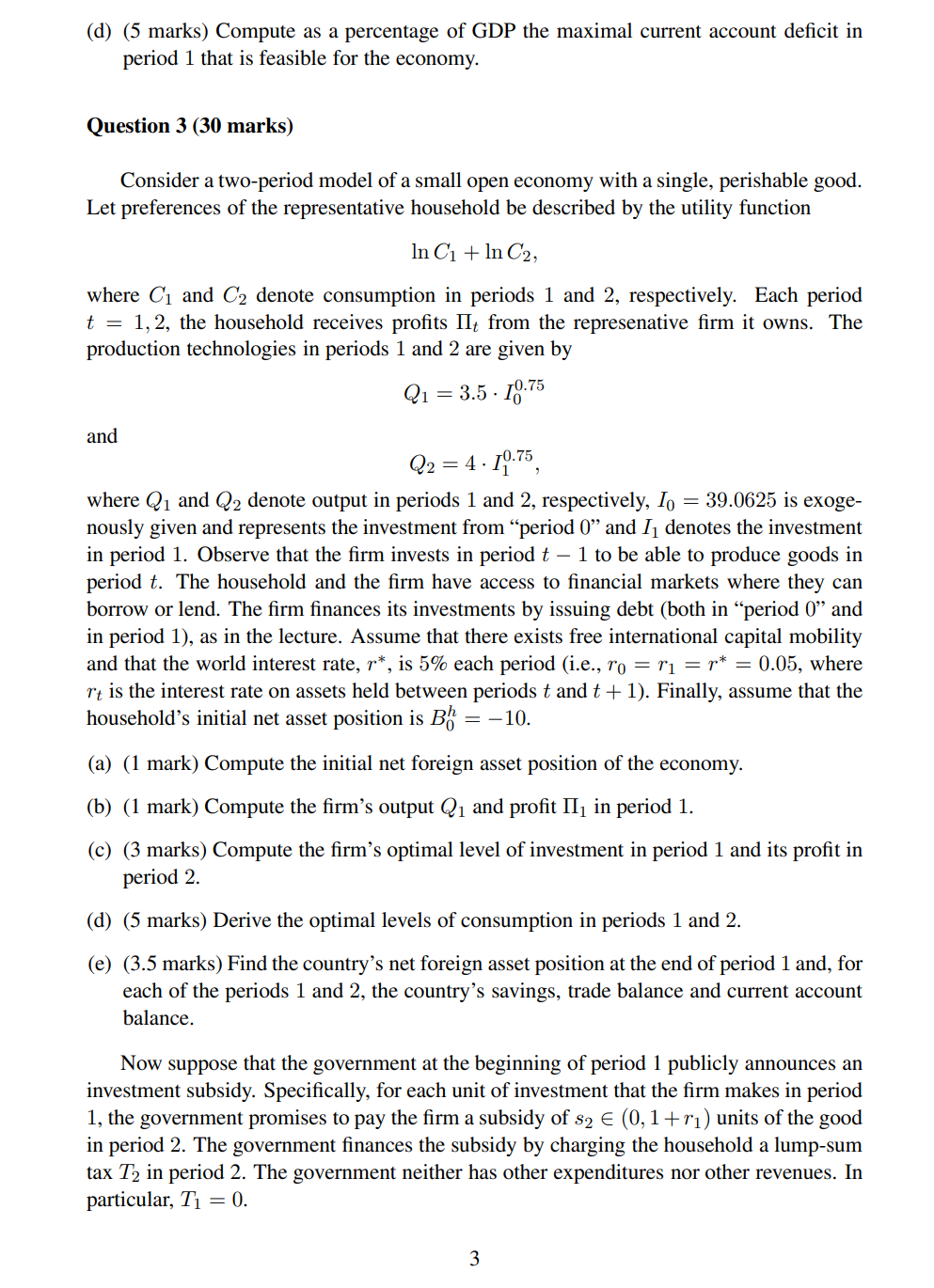
Answer all questions. Show all your work you must explain how you arrived at your answer. Partial credit may be awarded if a substantial part of the answer is provided. Question 1 (6 marks) Suppose net investment income is N II = 100, the international asset position is A = 3000, the international liability position is L = 4000, and the rate of return is 5 percent, r = 0.05. (a) (3 marks) Economist John Green, a strong advocate of the dark matter hypothesis, believes that A is not accurately recorded. Calculate the amount of dark matter and the \"true\" international asset position, which we will denote TA, consistent with Green's view. (b) (3 marks) Financial analyst Nadia Gonzalez does not believe in the dark matter hy- pothesis. Instead, she believes that A is accurately measured. In her view 5 percent is actually the rate of return on assets rA = 0.05, and the rate of return on the coun- try's international liabilities, r1\(f) (1 mark) Write down the government's budget constraint in period 2. (g) (4 marks) Write down a formula for the rm's prot in period 2. Derive the optimal investment condition and calculate the optimal investment as a function of 52. Using a MPK-MCK-graph, illustrate in a gure how the optimal investment and the rm's period-2 prot H2 change after the subsidy is introduced. (h) (1.5 marks) Write down the household's period 1 and period 2 budget constraints. Derive the household's intertemporal budget constraint. (i) (2 marks) Derive the economy's resource constraint. Compare it to resource con- straint that holds without the subsidy. Provide intuition for your comparison. (j) (6 marks) Assume that .92 = 0.1. Derive the household's optimal consumption path and the current account balances CA1 and CA2 in periods 1 and 2, respectively. What effect did the introduction of the subsidy have on the optimal consumption path and on CA1? Provide a detailed explanation of the effect on Cl, C2 and CA1 of introducing the subsidy and intuition for your results. ls the household better off after the subsidy was introduced? (k) (2 marks) Explain in words how your answer to (j) would change if the government were to announce the subsidy only at the beginning of period 2. (d) (5 marks) Compute as a percentage of GDP the maximal current account decit in period 1 that is feasible for the economy. Question 3 (30 marks) Consider a two-period model of a small open economy with a single, perishable good. Let preferences of the representative household be described by the utility function 11101 + 11102, where Cl and C2 denote consumption in periods 1 and 2, respectively. Each period t = 1. 2, the household receives prots 111 from the represenative rm it owns. The production technologies in periods 1 and 2 are given by (21 = 3.51875 and (22 : 4 _ [(11.751 where Q] and C22 denote output in periods 1 and 2, respectively, I\" = 39.0625 is exoge- nously given and represents the investment from \"period 0\" and I 1 denotes the investment in period 1. Observe that the rm invests in period t 7 1 to be able to produce goods in period t. The household and the rm have access to nancial markets where they can borrow or lend. The rm nances its investments by issuing debt (both in \"period 0" and in period 1), as in the lecture. Assume that there exists free international capital mobility and that the world interest rate, r\
Step by Step Solution
There are 3 Steps involved in it

Get step-by-step solutions from verified subject matter experts
 Study Help