Question: Answer all questions using your own words. Any answer that has been copied from the article, or insufficiently changed, will receive a grade of zero.
Answer all questions using your own words. Any answer that has been copied from the article, or insufficiently changed, will receive a grade of zero.
Do not answer in point form; answer in paragraphs.
For full marks, elaborate your answers and provide evidence when possible.
Pls help me answer question 3. Thank you.

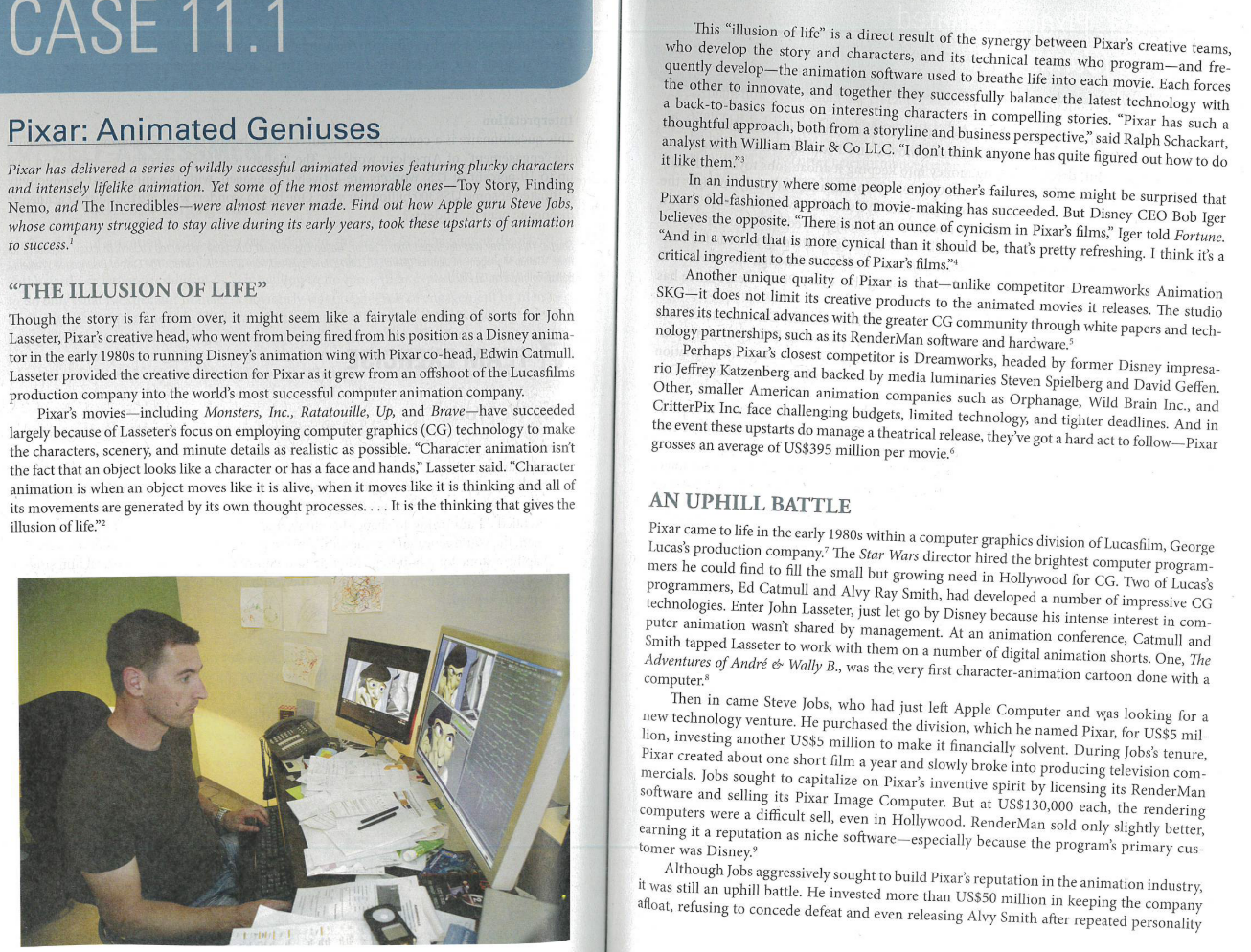
CASE 11.1 Pixar: Animated Geniuses Pixar has delivered a series of wildly successful animated movies featuring plucky characters and intensely lifelike animation. Yet some of the most memorable ones-Toy Story, Finding Nemo, and The Incredibles-were almost never made. Find out how Apple guru Steve Jobs, whose company struggled to stay alive during its early years, took these upstarts of animation to success. "THE ILLUSION OF LIFE" Though the story is far from over, it might seem like a fairytale ending of sorts for John Lasseter, Pixar's creative head, who went from being fired from his position as a Disney anima- tor in the early 1980s to running Disney's animation wing with Pixar co-head, Edwin Catmull. Lasseter provided the creative direction for Pixar as it grew from an offshoot of the Lucasfilms production company into the world's most successful computer animation company. Pixar's movies including Monsters, Inc., Ratatouille, Up, and Brave-have succeeded largely because of Lasseter's focus on employing computer graphics (CG) technology to make the characters, scenery, and minute details as realistic as possible. "Character animation isn't. the fact that an object looks like a character or has a face and hands," Lasseter said. "Character animation is when an object moves like it is alive, when it moves like it is thinking and all of its movements are generated by its own thought processes.... It is the thinking that gives the illusion of life."2 15 This "illusion of life" is a direct result of the synergy between Pixar's creative teams, who develop the story and characters, and its technical teams who program-and fre- quently develop the animation software used to breathe life into each movie. Each forces the other to innovate, and together they successfully balance the latest technology with a back-to-basics focus on interesting characters in compelling stories. "Pixar has such a thoughtful approach, both from a storyline and business perspective," said Ralph Schackart, analyst with William Blair & Co LLC. "I don't think anyone has quite figured out how to do it like them.""3 In an industry where some people enjoy other's failures, some might be surprised that Pixar's old-fashioned approach to movie-making has succeeded. But Disney CEO Bob Iger believes the opposite. "There is not an ounce of cynicism in Pixar's films," Iger told Fortune. "And in a world that is more cynical than it should be, that's pretty refreshing. I think it's a critical ingredient to the success of Pixar's films." Another unique quality of Pixar is that-unlike competitor Dreamworks Animation. SKG-it does not limit its creative products to the animated movies it releases. The studio shares its technical advances with the greater CG community through white papers and tech- nology partnerships, such as its RenderMan software and hardware.5 noi Perhaps Pixar's closest competitor is Dreamworks, headed by former Disney impresa- rio Jeffrey Katzenberg and backed by media luminaries Steven Spielberg and David Geffen. Other, smaller American animation companies such as Orphanage, Wild Brain Inc., and CritterPix Inc. face challenging budgets, limited technology, and tighter deadlines. And in the event these upstarts do manage a theatrical release, they've got a hard act to follow-Pixar grosses an average of US$395 million per movie. AN UPHILL BATTLE Pixar came to life in the early 1980s within a computer graphics division of Lucasfilm, George Lucas's production company. The Star Wars director hired the brightest computer program- mers he could find to fill the small but growing need in Hollywood for CG. Two of Lucas's programmers, Ed Catmull and Alvy Ray Smith, had developed a number of impressive CG technologies. Enter John Lasseter, just let go by Disney because his intense interest in com- puter animation wasn't shared by management. At an animation conference, Catmull and Smith tapped Lasseter to work with them on a number of digital animation shorts. One, The Adventures of Andr & Wally B., was the very first character-animation cartoon done with a computer. Then in came Steve Jobs, who had just left Apple Computer and was looking for a new technology venture. He purchased the division, which he named Pixar, for US$5 mil- lion, investing another US$5 million to make it financially solvent. During Jobs's tenure, Pixar created about one short film a year and slowly broke into producing television com- mercials. Jobs sought to capitalize on Pixar's inventive spirit by licensing its RenderMan software and selling its Pixar Image Computer. But at US$130,000 each, the rendering computers were a difficult sell, even in Hollywood. RenderMan sold only slightly better, earning it a reputation as niche software-especially because the program's primary cus- tomer was Disney." Although Jobs aggressively sought to build Pixar's reputation in the animation industry, it was still an uphill battle. He invested more than US$50 million in keeping the company afloat, refusing to concede defeat and even releasing Alvy Smith after repeated personality CASE 11.1: Pixar: Animated Geniuses (Continued) ahola guillequios conflicts. Slowly, Hollywood began to take notice of Pixar. Disney expressed interest in having Pixar develop a feature-length animated movie, and Pixar agreed to animate and produce Toy Story. But, tired of pouring money into keeping it afloat, Jobs toyed with sell- ing the company. He entertained offers from Oracle, Microsoft, and, curiously enough, the greeting-card company Hallmark." But Jobs held out. "We should have failed," says Smith. "Steve just would not suffer a defeat." The release of Toy Story proved his instincts right- the groundbreaking movie earned US$362 million worldwide, shattering records for box- office earnings by animated movies.2 A Bug's Life followed, and although the movie did well, especially for an animated feature, it's worth noting that every Pixar release since has done even better. Acutely aware of a string of failures for its own animated movies, Disney entered into talks to buy Pixar. Lasseter and Catmull were pleasantly surprised when Disney not only pur- chased Pixar, but also placed the Pixar honchos at the top of Disney's stagnant animation department. The sale went through for US$7.4 billion, and suddenly Steve Jobs became Dis- ney's single largest shareholder.3 Pixar's future looks bright. Never one to rest on its laurels, the company continues to actively invest in software and technology, the tools that have made possible the lifelike ren- dering that is the hallmark of Pixar movies. But Pixar will have to stay sharp to stave off competition from the junior animation firms that are quickly forging alliances with major production companies to put out feature-length films of their own. Wild Brain, for instance, inked a five-picture deal with Dimension Films, a unit of Miramax (owned by, of all compa- nies, Disney).4 Questions also remain about Pixar's future within the corporate umbrella of Disney. Business Week notes: "Many industry insiders wonder if the company will be able to maintain its string of hits now that it's part of the Magic Kingdom."5 On April 20, 2010, Pixar Animation Studios undertook their first international ven- ture by opening a new studio in Vancouver, British Columbia. In their new 2,000-square- metre studio, Pixar Canada designs and produces TV specials based on characters from their feature films. The studio's first production was Air Mater based on a Cars' character.16 A good part of Pixar's success stems from its ability to generate intriguing stories that warm the hearts of audiences. According to analyst Ralph Schackart, that's where Pixar has it made: "It all starts with the story. You or I can go buy off-the-shelf software and make an animated film. The barrier to entry for this industry is the story." Use paragraph style writing to answer each questions below: (1) Apply the elements of Maslow's hierarchy of needs theory to working at PIXAR? (K/U) (C) (2) PIXAR heavily relies on creative people who are motivated to do their best under production schedules that can sometimes be highly stressful. Explain how team works is motivating the people at PIXAR? (T/I) (C) (3) With all the wealth and success already achieved, how can the needs theories explain Steve Jobs' motivation to keep Pixar running in the 1990'? (A) (C)









 Study Help