







Question: Answer all sub questions and number them do not copy and paste an answer from another question like someone did last time. Consider the following
Answer all sub questions and number them do not copy and paste an answer from another question like someone did last time.
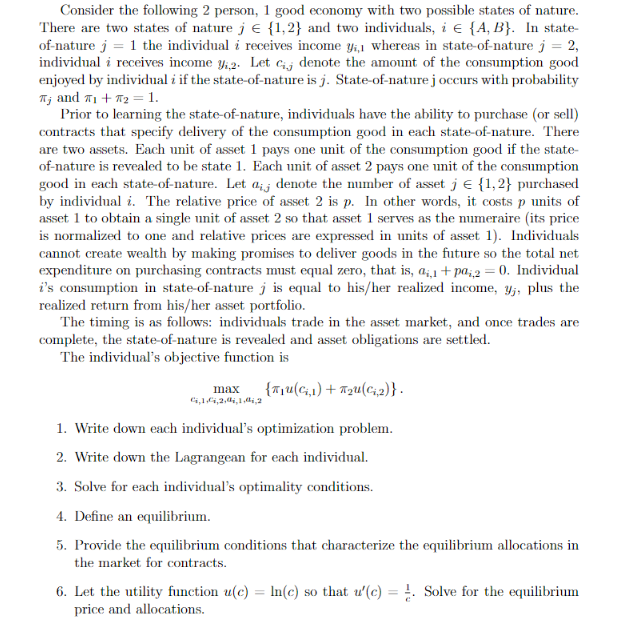
Consider the following 2 person, 1 good economy with two possible states of nature. There are two states of nature j {1,2} and two individuals, i E {A, B}. In state- of-nature j = 1 the individual i receives income Yi, whereas in state-of-nature j = 2, individual i receives income y,2. Let Gij denote the amount of the consumption good enjoyed by individual i if the state-of-nature is j. State-of-nature j occurs with probability Tt; and 11 + 12 = 1. Prior to learning the state-of-nature, individuals have the ability to purchase or sell) contracts that specify delivery of the consumption good in each state-of-nature. There are two assets. Each unit of asset 1 pays one unit of the consumption good if the state- of-nature is revealed to be state 1. Each unit of asset 2 pays one unit of the consumption good in each state-of-nature. Let dij denote the number of asset j {1,2} purchased by individual i. The relative price of asset 2 is p. In other words, it costs p units of asset 1 to obtain a single unit of asset 2 so that asset 1 serves as the numeraire (its price is normalized to one and relative prices are expressed in units of asset 1). Individuals cannot create wealth by making promises to deliver goods in the future so the total net expenditure on purchasing contracts must equal zero, that is, 0,,1 + po 2 = 0. Individual i's consumption in state-of-nature j is equal to his/her realized income, yj, plus the realized return from his/her asset portfolio. The timing is as follows: individuals trade in the asset market, and once trades are complete, the state-of-nature is revealed and asset obligations are settled. The individual's objective function is max {714(G,1)+12u(6,2)}. 1. Write down each individual's optimization problem. 2. Write down the Lagrangean for each individual. 3. Solve for each individual's optimality conditions. 4. Define an equilibrium. 5. Provide the equilibrium conditions that characterize the equilibrium allocations in the market for contracts. 6. Let the utility function u(e) = ln(c) so that u'(c) = . Solve for the equilibrium price and allocations. Consider the following 2 person, 1 good economy with two possible states of nature. There are two states of nature j {1,2} and two individuals, i E {A, B}. In state- of-nature j = 1 the individual i receives income Yi, whereas in state-of-nature j = 2, individual i receives income y,2. Let Gij denote the amount of the consumption good enjoyed by individual i if the state-of-nature is j. State-of-nature j occurs with probability Tt; and 11 + 12 = 1. Prior to learning the state-of-nature, individuals have the ability to purchase or sell) contracts that specify delivery of the consumption good in each state-of-nature. There are two assets. Each unit of asset 1 pays one unit of the consumption good if the state- of-nature is revealed to be state 1. Each unit of asset 2 pays one unit of the consumption good in each state-of-nature. Let dij denote the number of asset j {1,2} purchased by individual i. The relative price of asset 2 is p. In other words, it costs p units of asset 1 to obtain a single unit of asset 2 so that asset 1 serves as the numeraire (its price is normalized to one and relative prices are expressed in units of asset 1). Individuals cannot create wealth by making promises to deliver goods in the future so the total net expenditure on purchasing contracts must equal zero, that is, 0,,1 + po 2 = 0. Individual i's consumption in state-of-nature j is equal to his/her realized income, yj, plus the realized return from his/her asset portfolio. The timing is as follows: individuals trade in the asset market, and once trades are complete, the state-of-nature is revealed and asset obligations are settled. The individual's objective function is max {714(G,1)+12u(6,2)}. 1. Write down each individual's optimization problem. 2. Write down the Lagrangean for each individual. 3. Solve for each individual's optimality conditions. 4. Define an equilibrium. 5. Provide the equilibrium conditions that characterize the equilibrium allocations in the market for contracts. 6. Let the utility function u(e) = ln(c) so that u'(c) = . Solve for the equilibrium price and allocations
Step by Step Solution
There are 3 Steps involved in it

Get step-by-step solutions from verified subject matter experts
 Study Help