



Question: Answer all the parts..Do not copy from chegg as this ques was posted previously on chegg.. PLEASE ANSWER IT CORRECTLY I WILL SURELY UPVOTE.. THANKS
 Answer all the parts..Do not copy from chegg as this ques was posted previously on chegg.. PLEASE ANSWER IT CORRECTLY I WILL SURELY UPVOTE.. THANKS
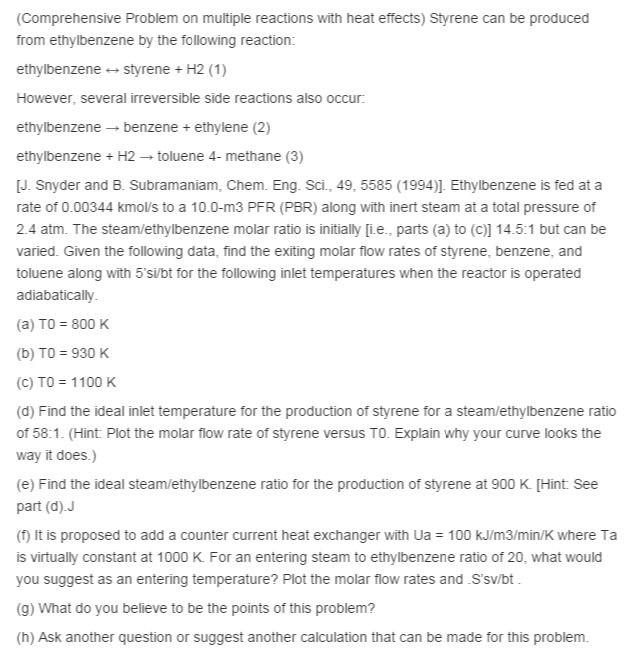
(Comprehensive Problem on multiple reactions with heat effects) Styrene can be produced from ethylbenzene by the following reaction: ethylbenzene-styrene + H2 (1) However, several irreversible side reactions also occur ethylbenzene- benzene + ethylene (2) ethylbenzene + H2 toluene 4-methane (3) [J. Snyder and B. Subramaniam, Chem. Eng. Sci. 49.5585 (1994)] Ethylbenzene is fed at a rate of 0.00344 kmols to a 10.0-m3 PFR (PBR) along with inert steam at a total pressure of 2.4 atm. The steam/ethylbenzene molar ratio is initially [i.e. parts (a) to (C)] 14.5:1 but can be varied. Given the following data, find the exiting molar flow rates of styrene, benzene, and toluene along with 5'sibt for the following inlet temperatures when the reactor is operated adiabatically (a) TO = 800 K (b) TO = 930 K (C) TO = 1100 K (d) Find the ideal inlet temperature for the production of styrene for a steam ethylbenzene ratio of 58:1. (Hint Plot the molar flow rate of styrene versus TO. Explain why your curve looks the way it does.) (e) Find the ideal steamethylbenzene ratio for the production of styrene at 900 K [Hint See part (d).J (1) it is proposed to add a counter current heat exchanger with Ua = 100 kJ/m3/min/K where Ta is virtually constant at 1000 K For an entering steam to ethylbenzene ratio of 20. what would you suggest as an entering temperature? Plot the molar flow rates and S'sv/bt. (9) What do you believe to be the points of this problem? (h) Ask another question or suggest another calculation that can be made for this
Step by Step Solution
There are 3 Steps involved in it

Get step-by-step solutions from verified subject matter experts