







Question: Answer any ten questions: (a) If we throw two fair dice, which is more likely: a sum of 11 or a sum of 12?
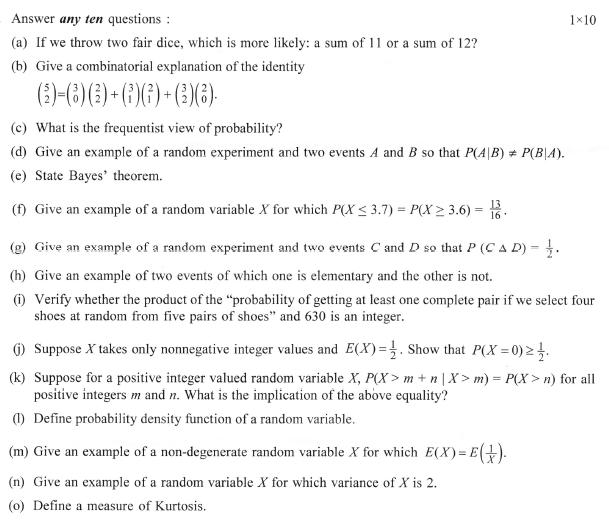
Answer any ten questions: (a) If we throw two fair dice, which is more likely: a sum of 11 or a sum of 12? (b) Give a combinatorial explanation of the identity (3)-(8) (E) + (8)(7) + (2)(6). (c) What is the frequentist view of probability? (d) Give an example of a random experiment and two events A and B so that P(A|B) = P(B|A). (e) State Bayes' theorem. (f) Give an example of a random variable X for which P(X 3.7) = P(X 3.6) = 13 16' (g) Give an example of a random experiment and two events C and D so that P (CAD) = . (h) Give an example of two events of which one is elementary and the other is not. 110 (i) Verify whether the product of the "probability of getting at least one complete pair if we select four shoes at random from five pairs of shoes" and 630 is an integer. (j) Suppose X takes only nonnegative integer values and E(X)=1. Show that P(X=0)> (k) Suppose for a positive integer valued random variable X, P(X>mn | X>m) = P(X>n) for all positive integers m and n. What is the implication of the above equality? (1) Define probability density function of a random variable. (m) Give an example of a non-degenerate random variable X for which E(X)=E(+) (n) Give an example of a random variable X for which variance of X is 2. (0) Define a measure of Kurtosis.
Step by Step Solution
There are 3 Steps involved in it
Sure lets tackle these questions one by one a Both outcomes are equally likely because each die has six sides so theres one combination for each sum T... View full answer

Get step-by-step solutions from verified subject matter experts
 Study Help