Question: Answer below 2 questions based on the case study, you are allowed to give 2 answers as per Chegg norms Questions: What recommendation would you
Answer below 2 questions based on the case study, you are allowed to give 2 answers as per Chegg norms
Questions:
- What recommendation would you make if you were Mr. Mirchandani? Why?
- Suggest a suitable organizational structure for TMC for effective materials management.
.
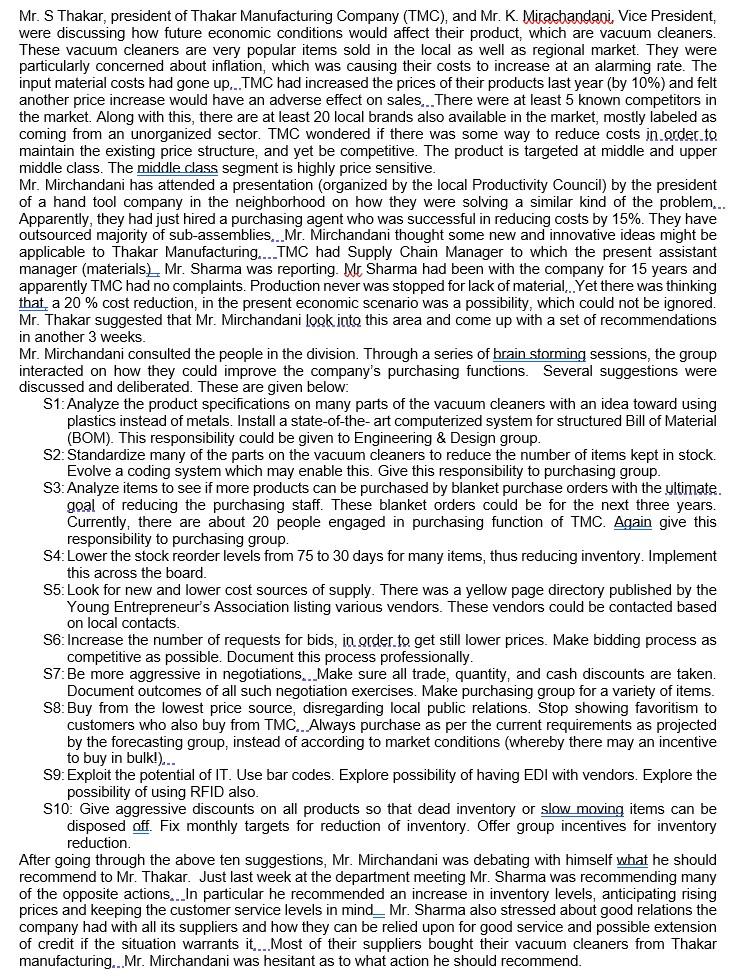
Mr. S Thakar, president of Thakar Manufacturing Company (TMC), and Mr. K. Mirachandani, Vice President, were discussing how future economic conditions would affect their product, which are vacuum cleaners. These vacuum cleaners are very popular items sold in the local as well as regional market. They were particularly concerned about inflation, which was causing their costs to increase at an alarming rate. The input material costs had gone up...TMC had increased the prices of their products last year (by 10%) and felt another price increase would have an adverse effect on sales... There were at least 5 known competitors in the market. Along with this, there are at least 20 local brands also available in the market, mostly labeled as coming from an unorganized sector. TMC wondered if there was some way to reduce costs in order to maintain the existing price structure, and yet be competitive. The product is targeted at middle and upper middle class. The middle class segment is highly price sensitive. Mr. Mirchandani has attended a presentation (organized by the local Productivity Council) by the president of a hand tool company in the neighborhood on how they were solving a similar kind of the problem... Apparently, they had just hired a purchasing agent who was successful in reducing costs by 15%. They have outsourced majority of sub-assemblies...Mr. Mirchandani thought some new and innovative ideas might be applicable to Thakar Manufacturing... TMC had Supply Chain Manager to which the present assistant manager (materials. Mr. Sharma was reporting. Mr Sharma had been with the company for 15 years and apparently TMC had no complaints. Production never was stopped for lack of material. Yet there was thinking that a 20 % cost reduction, in the present economic scenario was a possibility, which could not be ignored. Mr. Thakar suggested that Mr. Mirchandani look into this area and come up with a set of recommendations in another 3 weeks. Mr. Mirchandani consulted the people in the division. Through a series of brain storming sessions, the group interacted on how they could improve the company's purchasing functions. Several suggestions were discussed and deliberated. These are given below: S1: Analyze the product specifications on many parts of the vacuum cleaners with an idea toward using plastics instead of metals. Install a state-of-the-art computerized system for structured Bill of Material (BOM). This responsibility could be given to Engineering & Design group. S2: Standardize many of the parts on the vacuum cleaners to reduce the number of items kept in stock. Evolve a coding system which may enable this. Give this responsibility to purchasing group. S3: Analyze items to see if more products can be purchased by blanket purchase orders with the ultimate. goal of reducing the purchasing staff. These blanket orders could be for the next three years. Currently, there are about 20 people engaged in purchasing function of TMC. Again give this responsibility to purchasing group. S4: Lower the stock reorder levels from 75 to 30 days for many items, thus reducing inventory. Implement this across the board. S5: Look for new and lower cost sources of supply. There was a yellow page directory published by the Young Entrepreneur's Association listing various vendors. These vendors could be contacted based on local contacts. S6: Increase the number of requests for bids, in order to get still lower prices. Make bidding process as competitive as possible. Document this process professionally. S7: Be more aggressive in negotiations...Make sure all trade, quantity, and cash discounts are taken. Document outcomes of all such negotiation exercises. Make purchasing group for a variety of items. S8: Buy from the lowest price source, disregarding local public relations. Stop showing favoritism to customers who also buy from TMC.. Always purchase as per the current requirements as projected by the forecasting group, instead of according to market conditions (whereby there may an incentive to buy in bulk!)... S9: Exploit the potential of IT. Use bar codes. Explore possibility of having EDI with vendors. Explore the possibility of using RFID also. S10: Give aggressive discounts on all products so that dead inventory or slow moving items can be disposed off. Fix monthly targets for reduction of inventory. Offer group incentives for inventory reduction After going through the above ten suggestions, Mr. Mirchandani was debating with himself what he should recommend to Mr. Thakar. Just last week at the department meeting Mr. Sharma was recommending many of the opposite actions. In particular he recommended an increase in inventory levels, anticipating rising prices and keeping the customer service levels in mind_ Mr. Sharma also stressed about good relations the company had with all its suppliers and how they can be relied upon for good service and possible extension of credit if the situation warrants it...Most of their suppliers bought their vacuum cleaners from Thakar manufacturing...Mr. Mirchandani was hesitant as to what action he should recommend









 Study Help