







Question: Answer Below Multiple Choice from Case Study Below 1. Which one is the key aspect of program termination? A. All programs are completed and handed
Answer Below Multiple Choice from Case Study Below
1. Which one is the key aspect of program termination?
A. All programs are completed and handed over
B. A Project requirement is met and accepted
C. Project has initiated closing process
D. All projects with in a program are completed and handed over
2. Staff demobilization should be included in the:
A. Closing process initiation
B. Closing acceptance criteria
C. Closing checklist
D. Project Plan
3. This case is about
A. Project initiation and planning
B. Project lessons learned
C. Project closure checklist and expectations
D. Project Management and Planning
4.Who should be involved in the project closing process?
A. Project Management and CEO
B. Project manager, team leaders, client, and sponsor
C. Suppliers and customers
D. Non of them
5.Project postmortem is necessary.
A. To ensure profitability
B. To keep project on track
C. For system closing of the project
D. To prevent mistakes in the future
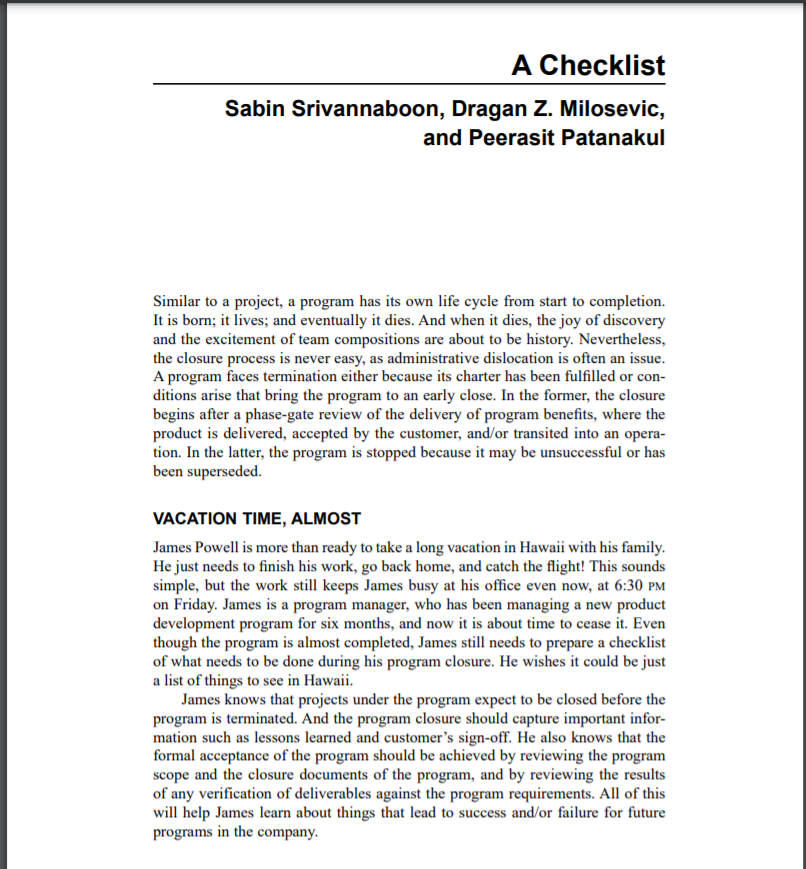
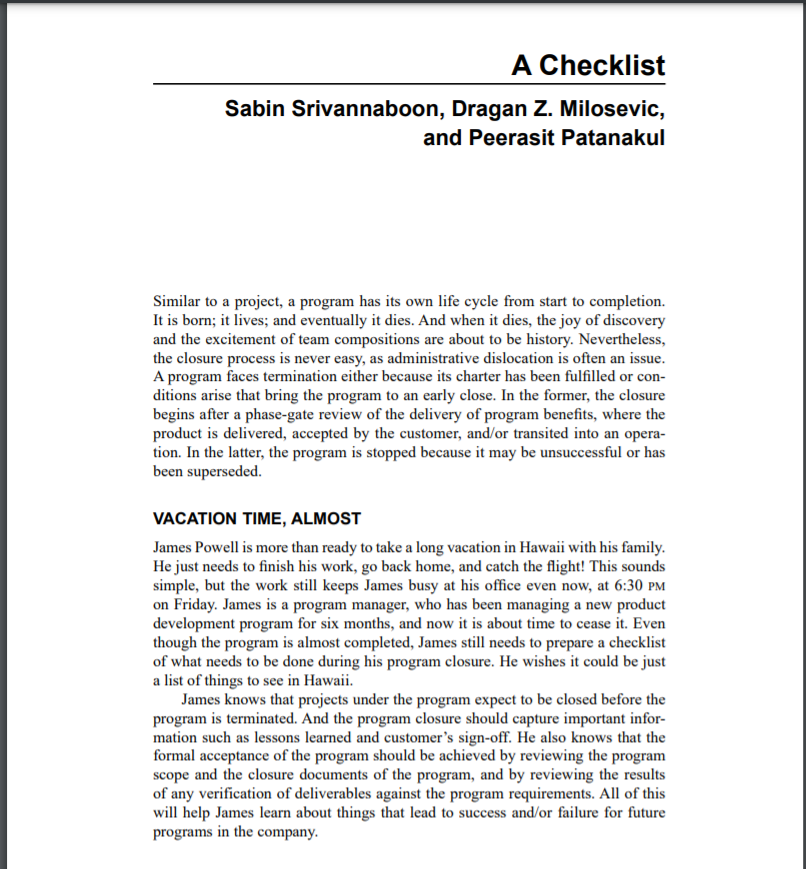
A Checklist Sabin Srivannaboon, Dragan Z. Milosevic, and Peerasit Patanakul Similar to a project, a program has its own life cycle from start to completion. It is born; it lives, and eventually it dies. And when it dies, the joy of discovery and the excitement of team compositions are about to be history. Nevertheless, the closure process is never easy, as administrative dislocation is often an issue. A program faces termination either because its charter has been fulfilled or con- ditions arise that bring the program to an early close. In the former, the closure begins after a phase-gate review of the delivery of program benefits, where the product is delivered, accepted by the customer, and/or transited into an opera- tion. In the latter, the program is stopped because it may be unsuccessful or has been superseded. VACATION TIME, ALMOST James Powell is more than ready to take a long vacation in Hawaii with his family. He just needs to finish his work, go back home, and catch the flight! This sounds simple, but the work still keeps James busy at his office even now, at 6:30 PM on Friday. James is a program manager, who has been managing a new product development program for six months, and now it is about time to cease it. Even though the program is almost completed, James still needs to prepare a checklist of what needs to be done during his program closure. He wishes it could be just a list of things to see in Hawaii. James knows that projects under the program expect to be closed before the program is terminated. And the program closure should capture important infor- mation such as lessons learned and customer's sign-off. He also knows that the formal acceptance of the program should be achieved by reviewing the program scope and the closure documents of the program, and by reviewing the results of any verification of deliverables against the program requirements. All of this will help James learn about things that lead to success and/or failure for future programs in the company. A Checklist Sabin Srivannaboon, Dragan Z. Milosevic, and Peerasit Patanakul Similar to a project, a program has its own life cycle from start to completion. It is born; it lives, and eventually it dies. And when it dies, the joy of discovery and the excitement of team compositions are about to be history. Nevertheless, the closure process is never easy, as administrative dislocation is often an issue. A program faces termination either because its charter has been fulfilled or con- ditions arise that bring the program to an early close. In the former, the closure begins after a phase-gate review of the delivery of program benefits, where the product is delivered, accepted by the customer, and/or transited into an opera- tion. In the latter, the program is stopped because it may be unsuccessful or has been superseded. VACATION TIME, ALMOST James Powell is more than ready to take a long vacation in Hawaii with his family. He just needs to finish his work, go back home, and catch the flight! This sounds simple, but the work still keeps James busy at his office even now, at 6:30 PM on Friday. James is a program manager, who has been managing a new product development program for six months, and now it is about time to cease it. Even though the program is almost completed, James still needs to prepare a checklist of what needs to be done during his program closure. He wishes it could be just a list of things to see in Hawaii. James knows that projects under the program expect to be closed before the program is terminated. And the program closure should capture important infor- mation such as lessons learned and customer's sign-off. He also knows that the formal acceptance of the program should be achieved by reviewing the program scope and the closure documents of the program, and by reviewing the results of any verification of deliverables against the program requirements. All of this will help James learn about things that lead to success and/or failure for future programs in the companyStep by Step Solution
There are 3 Steps involved in it

Get step-by-step solutions from verified subject matter experts
 Study Help