







Question: Answer both questions completely please Question 1: Consider the following two assets: Asset Expected Return Standard Deviation S&P 500 ETF (U.S. Stocks) 8.0% 18% Treasury
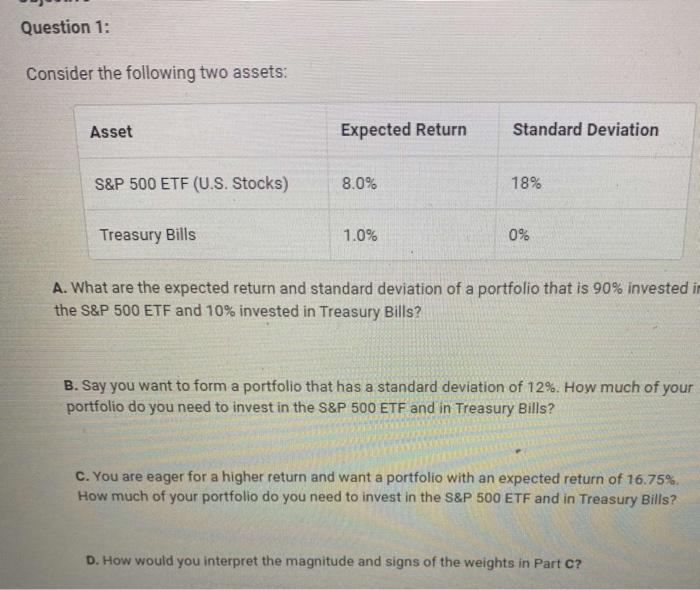
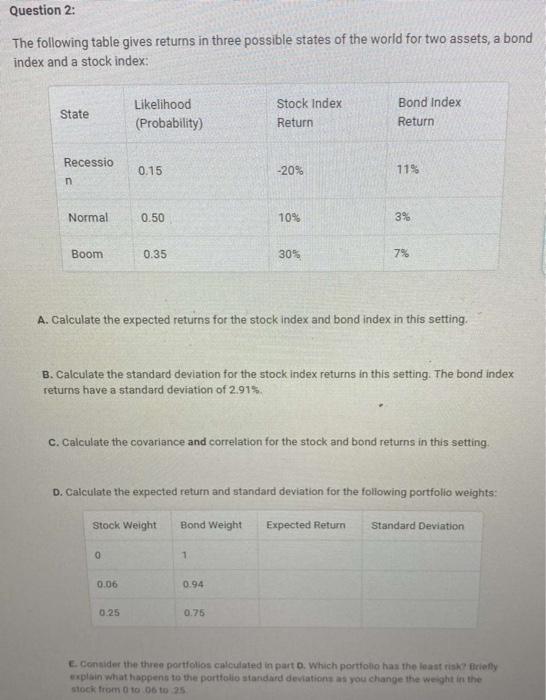
Question 1: Consider the following two assets: Asset Expected Return Standard Deviation S&P 500 ETF (U.S. Stocks) 8.0% 18% Treasury Bills 1.0% 0% A. What are the expected return and standard deviation of a portfolio that is 90% invested in the S&P 500 ETF and 10% invested in Treasury Bills? B. Say you want to form a portfolio that has a standard deviation of 12%. How much of your portfolio do you need to invest in the S&P 500 ETF and in Treasury Bills? C. You are eager for a higher return and want a portfolio with an expected return of 16.75%. How much of your portfolio do you need to invest in the S&P 500 ETF and in Treasury Bills? D. How would you interpret the magnitude and signs of the weights in Part C? Question 2: The following table gives returns in three possible states of the world for two assets, a bond index and a stock index: State Likelihood (Probability) Stock Index Return Bond Index Return Recessio 0.15 -20% 11% Normal 0.50 10% 3% Boom 0.35 30% 7% A. Calculate the expected returns for the stock index and bond index in this setting. B. Calculate the standard deviation for the stock index returns in this setting. The bond index returns have a standard deviation of 2.91%. C. Calculate the covariance and correlation for the stock and bond returns in this setting D. Calculate the expected return and standard deviation for the following portfolio weights: Stock Weight Bond Weight Expected Return Standard Deviation 0 1 0.06 0.94 0.25 0.75 E. Consider the three portfolios calculated in parto. Which portfolio has the least risk? Briefly explain what happens to the portfolio standard deviations as you change the weight in the stock from 0 to 06 to 25
Step by Step Solution
There are 3 Steps involved in it

Get step-by-step solutions from verified subject matter experts
 Study Help