







Question: Answer by True or False 1. A collective bargaining representative is legally barred by the duty of fair representation from making agreements that have unfavorable
Answer by True or False
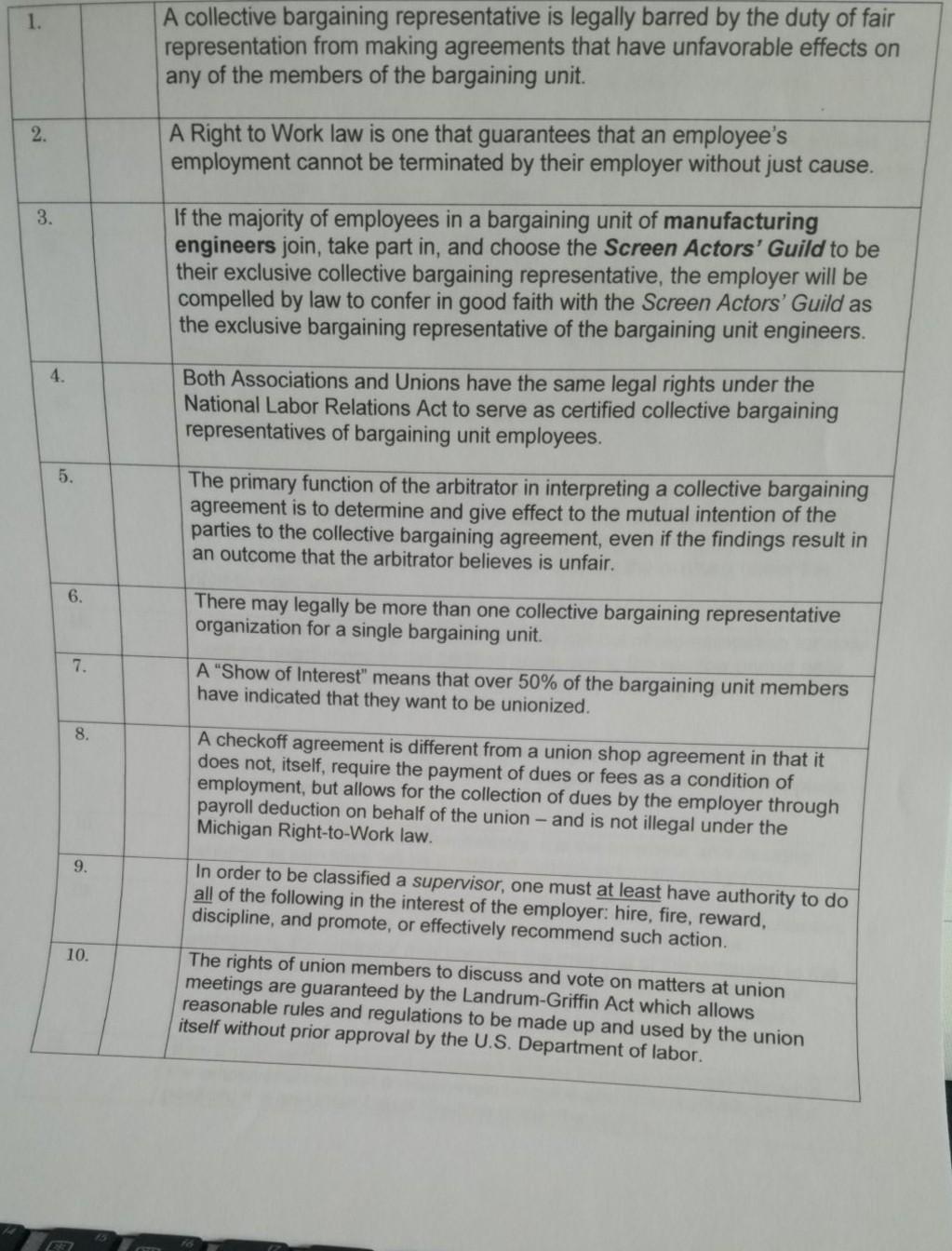
1. A collective bargaining representative is legally barred by the duty of fair representation from making agreements that have unfavorable effects on any of the members of the bargaining unit. 2. A Right to Work law is one that guarantees that an employee's employment cannot be terminated by their employer without just cause. 3. If the majority of employees in a bargaining unit of manufacturing engineers join, take part in, and choose the Screen Actors' Guild to be their exclusive collective bargaining representative, the employer will be compelled by law to confer in good faith with the Screen Actors' Guild as the exclusive bargaining representative of the bargaining unit engineers. 4. Both Associations and Unions have the same legal rights under the National Labor Relations Act to serve as certified collective bargaining representatives of bargaining unit employees. 5. The primary function of the arbitrator in interpreting a collective bargaining agreement is to determine and give effect to the mutual intention of the parties to the collective bargaining agreement, even if the findings result in an outcome that the arbitrator believes is unfair. 6. There may legally be more than one collective bargaining representative organization for a single bargaining unit. 7. A "Show of Interest" means that over 50% of the bargaining unit members have indicated that they want to be unionized. 8. A checkoff agreement is different from a union shop agreement in that it does not, itself, require the payment of dues or fees as a condition of employment, but allows for the collection of dues by the employer through payroll deduction on behalf of the union - and is not illegal under the Michigan Right-to-Work law. 9. In order to be classified a supervisor, one must at least have authority to do all of the following in the interest of the employer: hire, fire, reward, discipline, and promote, or effectively recommend such action. 10. The rights of union members to discuss and vote on matters at union meetings are guaranteed by the Landrum-Griffin Act which allows reasonable rules and regulations to be made up and used by the union itself without prior approval by the U.S. Department of labor. 337Step by Step Solution
There are 3 Steps involved in it
1 Expert Approved Answer
Step: 1 Unlock

Question Has Been Solved by an Expert!
Get step-by-step solutions from verified subject matter experts
Step: 2 Unlock
Step: 3 Unlock
 Study Help