







Question: Answer: (d) [3 marks] Is the trapezoidal approximation T larger than, smaller than, or equal to the true value /? Explain your answer carefully. A
![Answer: (d) [3 marks] Is the trapezoidal approximation T larger than,](https://s3.amazonaws.com/si.experts.images/answers/2024/06/6661fc7b29283_6586661fc7a94305.jpg)
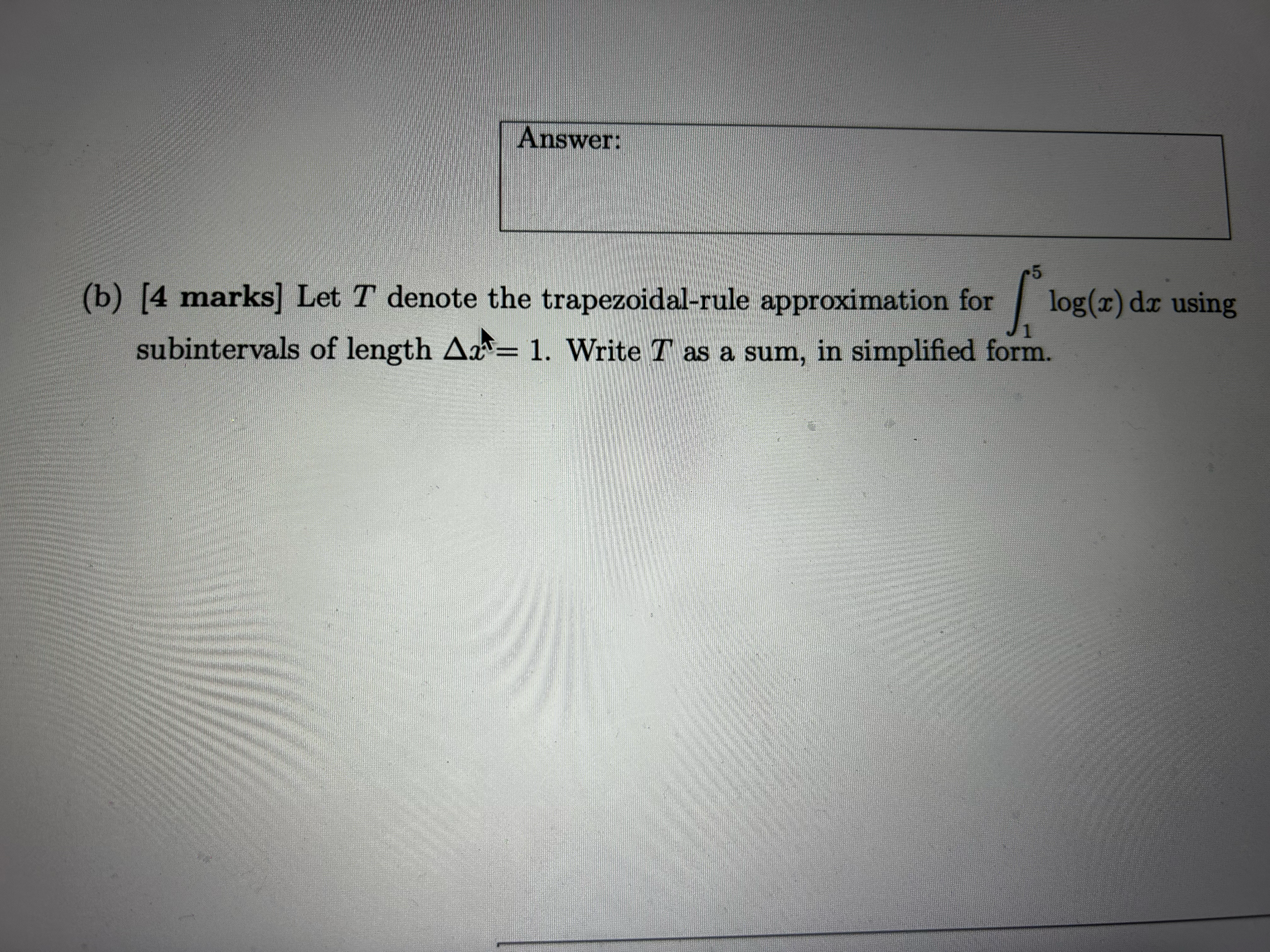
![carefully. A newer.Answer: (b) [4 marks] Let T denote the trapezoidal-rule approximation](https://s3.amazonaws.com/si.experts.images/answers/2024/06/6661fc860b626_6696661fc8584be7.jpg)
![a sum, in simplified form.12. (a) [4 marks] Calculate I = (](https://s3.amazonaws.com/si.experts.images/answers/2024/06/6661fc88290c5_6716661fc87aa30d.jpg)
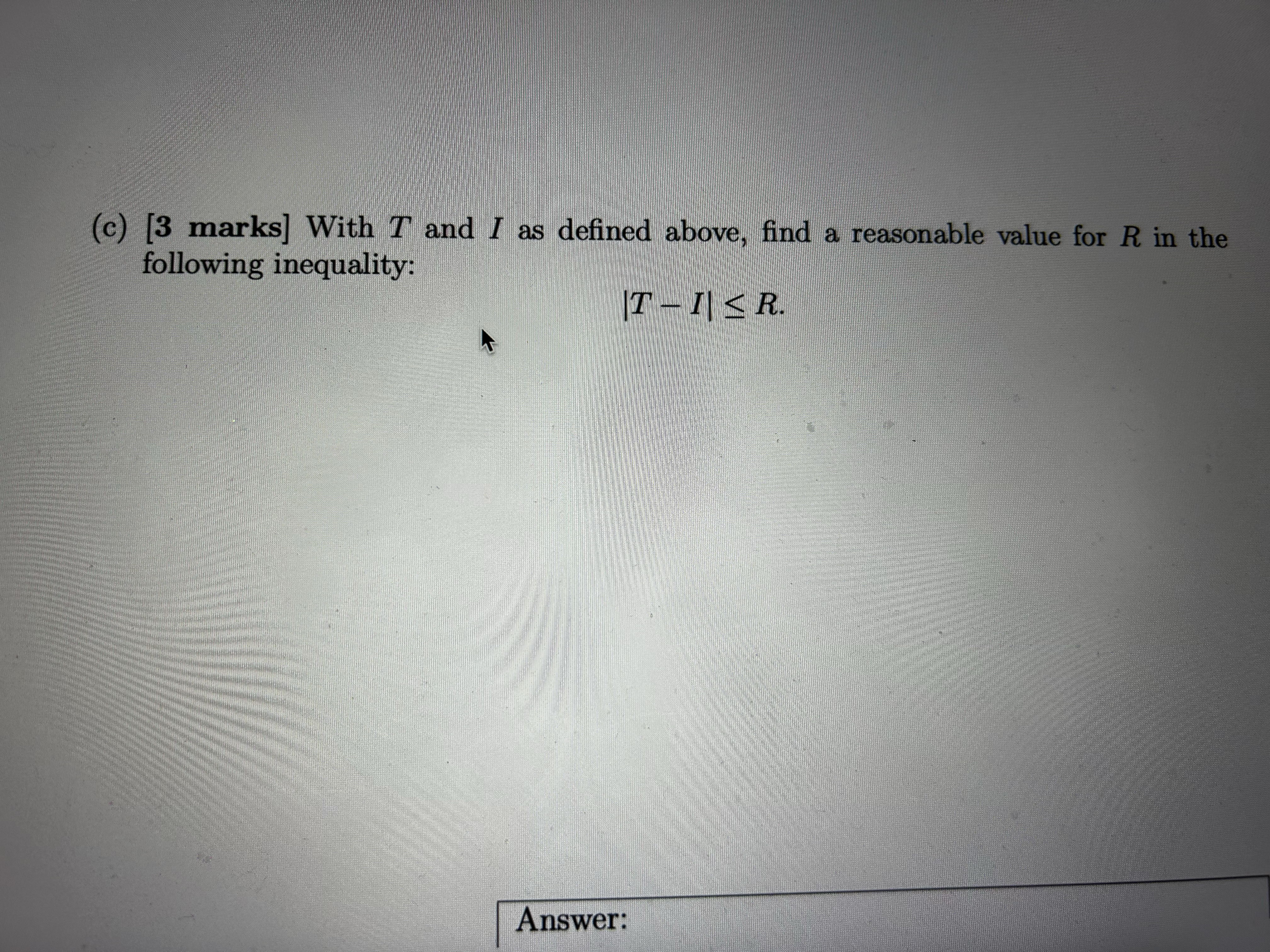
![log(x) dr. Answer:(c) [3 marks] With T and I as defined above,](https://s3.amazonaws.com/si.experts.images/answers/2024/06/6661fc892ac7d_6726661fc88a9bec.jpg)


Answer: (d) [3 marks] Is the trapezoidal approximation T larger than, smaller than, or equal to the true value /? Explain your answer carefully. A newer.Answer: (b) [4 marks] Let T denote the trapezoidal-rule approximation for log(x) dx using subintervals of length Am= 1. Write T as a sum, in simplified form.12. (a) [4 marks] Calculate I = ( log(x) dr. Answer:(c) [3 marks] With T and I as defined above, find a reasonable value for R in the following inequality: T - I
Step by Step Solution
There are 3 Steps involved in it
1 Expert Approved Answer
Step: 1 Unlock

Question Has Been Solved by an Expert!
Get step-by-step solutions from verified subject matter experts
Step: 2 Unlock
Step: 3 Unlock
 Study Help