







Question: answer each component PLEASE. Last year Carson Industries issued a 10-year, 15% semiannual coupon bond at its par value of $1,000. Currently, the bond can
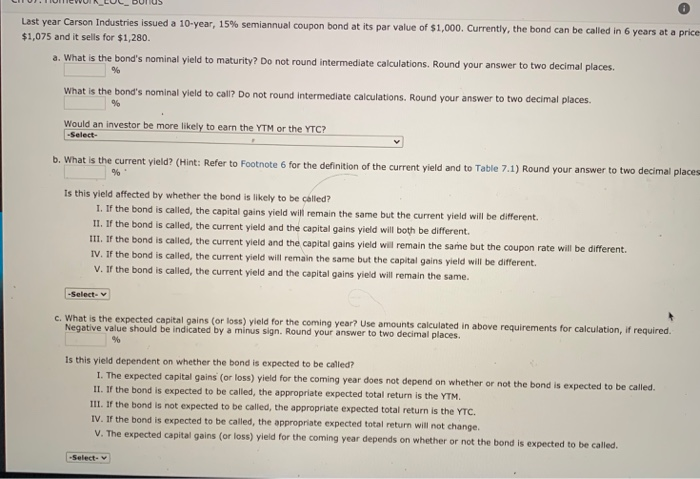
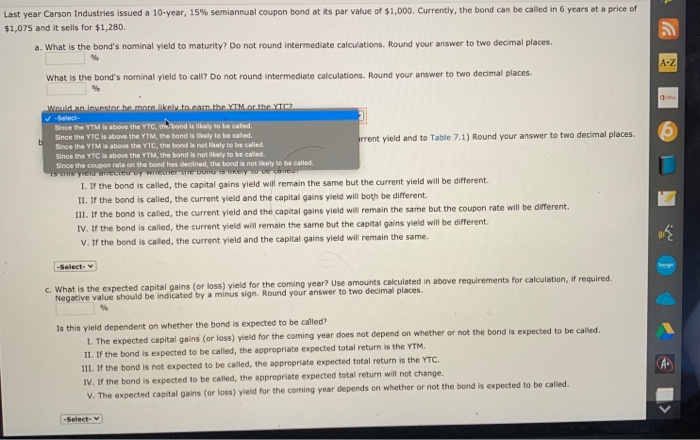
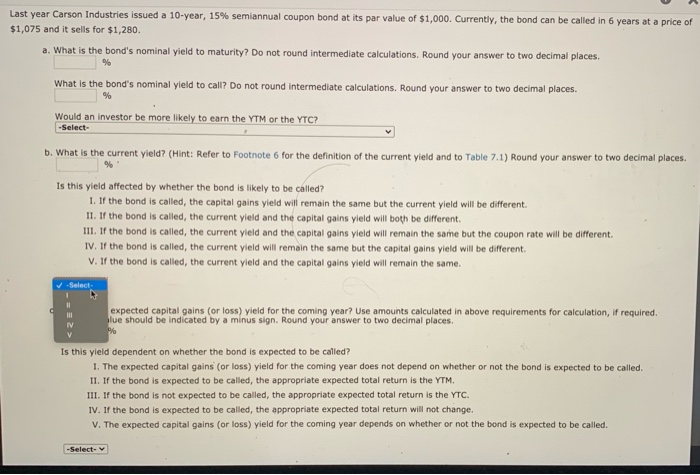
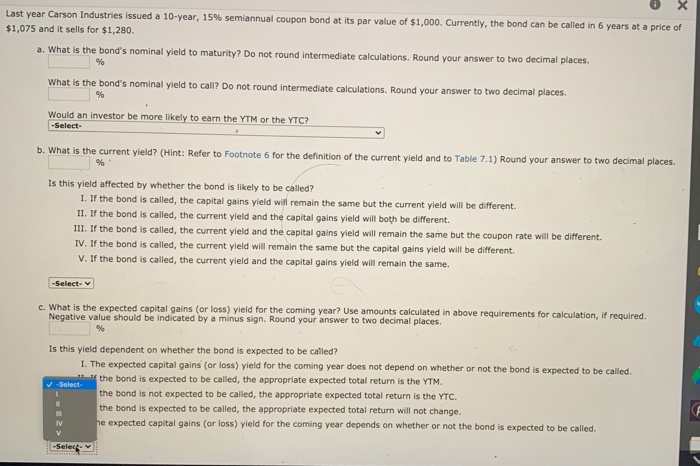
Last year Carson Industries issued a 10-year, 15% semiannual coupon bond at its par value of $1,000. Currently, the bond can be called in 6 years at a price $1,075 and it sells for $1,280. a. What is the bond's nominal yield to maturity? Do not round intermediate calculations. Round your answer to two decimal places. % What is the bond's nominal yield to call? Do not round Intermediate calculations. Round your answer to two decimal places. % Would an investor be more likely to earn the YTM or the YTC? -Select- b. What is the current yield? (Hint: Refer to Footnote 6 for the definition of the current yield and to Table 7.1) Round your answer to two decimal places % Is this yield affected by whether the bond is likely to be called? I. If the bond is called, the capital gains yield will remain the same but the current yield will be different II. If the bond is called, the current yield and the capital gains yield will both be different III. If the bond is called, the current yield and the capital gains yield will remain the same but the coupon rate will be different. IV. If the bond is called, the current yield will remain the same but the capital gains yield will be different. V. If the bond is called, the current yield and the capital gains yield will remain the same. -Select- c. What is the expected capital gains (or loss) yield for the coming year? Use amounts calculated in above requirements for calculation, if required. Negative value should be indicated by a minus sign. Round your answer to two decimal places. % Is this yield dependent on whether the bond is expected to be called? 1. The expected capital gains (or loss) yield for the coming year does not depend on whether or not the bond is expected to be called. II. If the bond is expected to be called, the appropriate expected total return is the YTM. III. If the bond is not expected to be called, the appropriate expected total return is the YTC. IV. If the bond is expected to be called, the appropriate expected total return will not change. V. The expected capital gains (or loss) yield for the coming year depends on whether or not the bond is expected to be called -Select- Last year Carson Industries issued a 10-year, 15% semiannual coupon bond at its par value of $1,000. Currently, the bond can be called in 6 years at a price of $1,075 and it sells for $1,280 a. What is the bond's nominal yield to maturity? Do not round intermediate calculations. Round your answer to two decimal places % What is the bond's nominal yield to call? Do not round Intermediate calculations. Round your answer to two decimal places A-Z Wouldan investor bo more likely to earn the YTM ottho. YT2 -Select- Since the YTM is above the YTC, the hond is likely to be cated, Since the YTC is above the YTM, the bond is licely to be called Since the YIM is above the YTC, the bond is rely to be called Irrent yield and to Table 7.1) Round your answer to two decimal places. Since the YTC is above the YTM, the bond is not likely to be called Since the coupon rate on the band has declined, the bond is not kely to be called 19THS y necitu uy WIELE CULTURE CUT 1. If the bond is called, the capital gains yield will remain the same but the current yield will be different. IL. If the bond is called, the current yield and the capital gains yield will both be different. III. If the bond is called, the current yield and the capital gains yield will remain the same but the coupon rate will be different. IV. If the bond is called, the current yield will remain the same but the capital gains yield will be different V. If the bond is called the current yield and the capital gains yield will remain the same. -Select c. What is the expected capital gains (or loss) yield for the coming year? Use amounts calculated in above requirements for calculation, if required. Negative value should be indicated by a minus sign. Round your answer to two decimal places. % Is this yield dependent on whether the bond is expected to be called? 1. The expected capital gains (or loss) yield for the coming year does not depend on whether or not the bond is expected to be called 11. If the bond is expected to be called, the appropriate expected total return is the YTM III. If the bond is not expected to be called, the appropriate expected total return is the YTC. IV. If the bond is expected to be called, the appropriate expected total return will not change. V. The expected capital gains (or loss) yield for the coming year depends on whether or not the bond is expected to be called -Select- Last year Carson Industries issued a 10-year, 15% semiannual coupon bond at its par value of $1,000. Currently, the bond can be called in 6 years at a price of $1,075 and it sells for $1,280. a. What is the bond's nominal yield to maturity? Do not round intermediate calculations. Round your answer to two decimal places. % What is the bond's nominal yield to call? Do not round intermediate calculations. Round your answer to two decimal places. % Would an investor be more likely to earn the YTM or the YTC? -Select- b. What is the current yield? (Hint: Refer to Footnote 6 for the definition of the current yield and to Table 7.1) Round your answer to two decimal places. Is this yield affected by whether the bond is likely to be called? 1. If the bond is called, the capital gains yield will remain the same but the current yield will be different. 11. If the bond is called, the current yield and the capital gains yield will both be different. III. If the bond is called, the current yield and the capital gains yield will remain the same but the coupon rate will be different IV. If the bond is called, the current yield will remain the same but the capital gains yield will be different V. If the bond is called, the current yield and the capital gains yield will remain the same. Select expected capital gains (or loss) yield for the coming year? Use amounts calculated in above requirements for calculation, if required. lue should be indicated by a minus sign. Round your answer to two decimal places. IV v % Is this yield dependent on whether the bond is expected to be called? 1. The expected capital gains (or loss) yield for the coming year does not depend on whether or not the bond is expected to be called. 11. If the bond is expected to be called, the appropriate expected total return is the YTM. III. If the bond is not expected to be called, the appropriate expected total return is the YTC. IV. If the bond is expected to be called, the appropriate expected total return will not change. V. The expected capital gains (or loss) yield for the coming year depends on whether or not the bond is expected to be called. -Select
Step by Step Solution
There are 3 Steps involved in it

Get step-by-step solutions from verified subject matter experts
 Study Help