



Question: i need help on a-c Last year Carson Industries issued a 10-year, 15% semiannual coupon bond at its par value of $1,000. Currently, the bond
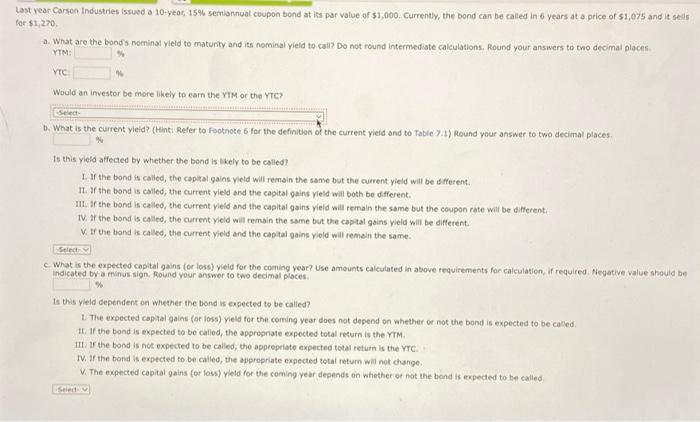
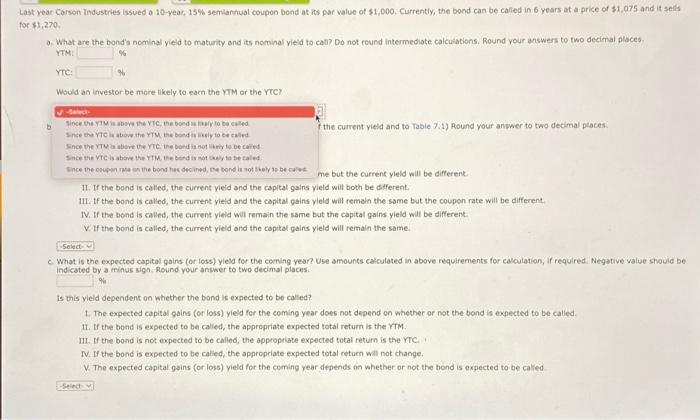
Last year Carson Industries issued a 10-year, 15% semiannual coupon bond at its par value of $1,000. Currently, the bond can be called in 6 years at a price of $1,075 and it selis for $1,270. a. What are the boods nominal vield to maturity and its nominal yield to call? Do not round intermediate calculations. Round your answers to two decimal places VTM: rec Would an investor be more likely to earn the rIM or the ric? b. What is the current yield? (Hinti Refer to footnote 6 for the definition of the current yield and to Table 7.1) Round your answer to two decimal places. Is this yield affected by whether the bond is tikely to be called? 1. If the bond is called, the captal gains yeld will remsin the same but the current yield will be ifferent. II. If the bond is called, the current yield and the capital gains vield will both be different. III. If the bond is called, the current yieid and the capital gains yield will remain the same but the coupon rate will be different. IV. If the bond is called, the current yield will remain the same but the captal gains yield will be different. V. tf the bond is called, the current yield and the captal gains yiold will remein the same. c. What is the expected capital gains (or loss) vield for the coming vear? Use amounts calcutated in above requirements for calculation, if required. Niegative value should be indicated by a minus sign, Round your answer to two decimal places. ts this yeld dependent on whether the bond is expected to be called? 1. The expected captal gains (or loss) yield for the ceming year does not depend on whether or not the bond is expected to be called. II. If the bond is expected to be called, the appropriate expected total return is the YTM. III. If the bond is not expected to be called, the appropriato expected total return is the VrC. IV. If the bond is expected to be called, the appropriate expected total return wal not change. . The expected capital gains (or loss) yeld for the coming year depends on whether of not the bond is expected to be called. ast year Carson Industries issued a 10 year, 15% semiannual coupon bond at its par value of $1,000. Currently, the bond can be called in 6 years at a price of $1,075 and it selis or $1,270. a. What are the bond's nominal yieid to maturity and its nominal yieid to call? Do not round intermediate calculations, Round your answers to two decimal places. rTM: \%. YTC: Would an investor be more tikely to eacn the YTM or the YTC? b Since the Yru is abeve the rre, the boed a bair to be ealed snce the rTC in above the FTM be boed is kikely to se caled the current yield and to rable 7.1) Round vour anwwer to two decimal places. since the Vic is above the FTM, the bend is not cowy ta se tal ed II. If the bond is called; the current yield and the capital gains yield will both be different. 111. If the bond is called, the current yield and the copital gains yield will remain the same but the coupon rate will be different. IV. If the bond is called, the current yield will remain the same but the capital gains yield will be different. . If the bond is called, the current yield and the copital gains yield will remain the same. c. What is the expected capital gains (or loss) yleld for the coming year? Use omounts calculated in above requirements for calculation, if required. Negative value should be indicated by a minus sign. Round your answer to two decimal places. is this yieid dependent on whether the bond is expected to be called? 1. The expected capital gains (or loss) yied for the coming year does not depend on whether or not the band is expected to be called. II. If the bond is expected to be calied, the appropriate expected total return is the YTM. III. If the bond is not expected to be called, the appropriate expected total return is the VTC. N. If the bond is expected to be calied, the appropriate expected total return will not change. . The expected capital gains (or loss) yield for the coming year depends on whether or not the bond is expected to be called
Step by Step Solution
There are 3 Steps involved in it

Get step-by-step solutions from verified subject matter experts