





Question: Answer each question separately RECRUITMENT AND SELECTION TODAY 1.3 ETHICAL DILEMMAS 1. Situation. You are a management consultant who is asked by a large employer
Answer each question separately RECRUITMENT ANDAnswer each question separately

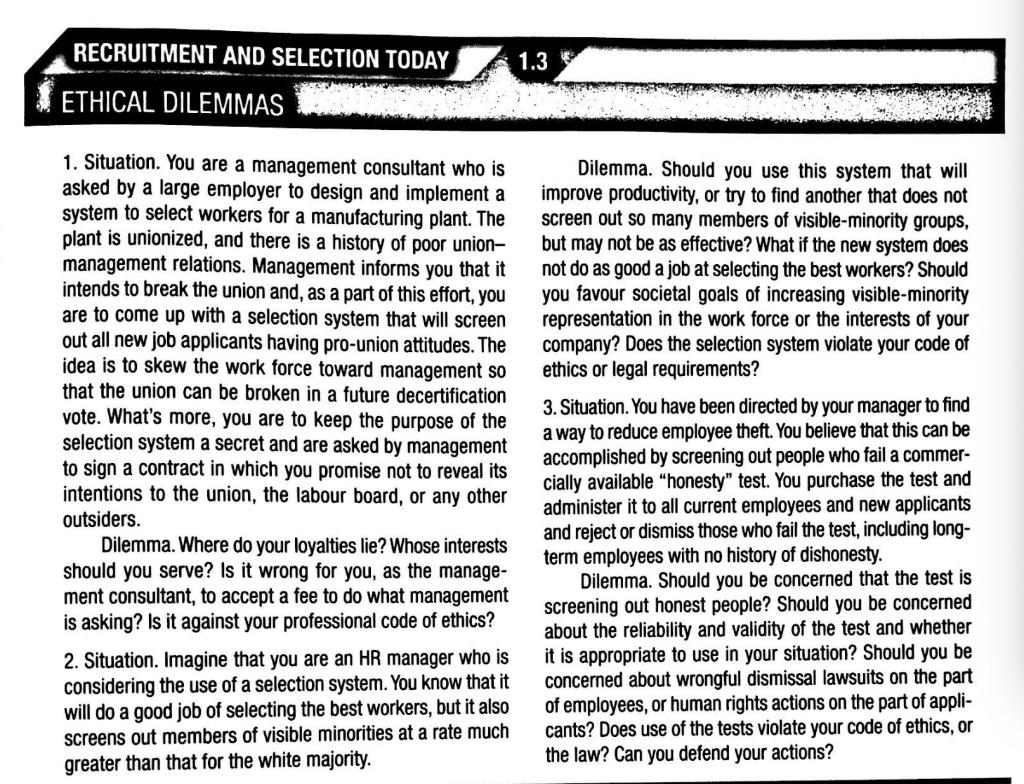
RECRUITMENT AND SELECTION TODAY 1.3 ETHICAL DILEMMAS 1. Situation. You are a management consultant who is asked by a large employer to design and implement a system to select workers for a manufacturing plant. The plant is unionized, and there is a history of poor union- management relations. Management informs you that it intends to break the union and, as a part of this effort, you are to come up with a selection system that will screen out all new job applicants having pro-union attitudes. The idea is to skew the work force toward management so that the union can be broken in a future decertification vote. What's more, you are to keep the purpose of the selection system a secret and are asked by management to sign a contract in which you promise not to reveal its intentions to the union, the labour board, or any other outsiders. Dilemma. Where do your loyalties lie? Whose interests should you serve? Is it wrong for you, as the manage- ment consultant, to accept a fee to do what management is asking? Is it against your professional code of ethics? 2. Situation. Imagine that you are an HR manager who is considering the use of a selection system. You know that it will do a good job of selecting the best workers, but it also screens out members of visible minorities at a rate much greater than that for the white majority. Dilemma. Should you use this system that will improve productivity, or try to find another that does not screen out so many members of visible-minority groups, but may not be as effective? What if the new system does not do as good a job at selecting the best workers? Should you favour societal goals of increasing visible-minority representation in the work force or the interests of your company? Does the selection system violate your code of ethics or legal requirements? 3. Situation. You have been directed by your manager to find a way to reduce employee theft. You believe that this can be accomplished by screening out people who fail a commer- cially available "honesty" test. You purchase the test and administer it to all current employees and new applicants and reject or dismiss those who fail the test, including long- term employees with no history of dishonesty. Dilemma. Should you be concerned that the test is screening out honest people? Should you be concerned about the reliability and validity of the test and whether it is appropriate to use in your situation? Should you be concerned about wrongful dismissal lawsuits on the part of employees, or human rights actions on the part of appli- cants? Does use of the tests violate your code of ethics, or the law? Can you defend your actions

Step by Step Solution

There are 3 Steps involved in it

1 Expert Approved Answer
Step: 1 Unlock blur-text-image

Question Has Been Solved by an Expert!

Get step-by-step solutions from verified subject matter experts

Step: 2 Unlock
Step: 3 Unlock

Students Have Also Explored These Related General Management Questions!