







Question: ANSWER EVERY QUESTION OR NONE AT ALL THANKS The theoretical yield of a reaction is the amount of product obtained if the limiting reactant is
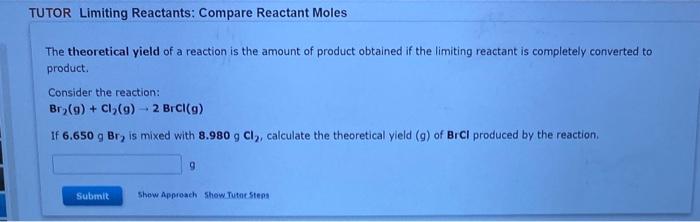
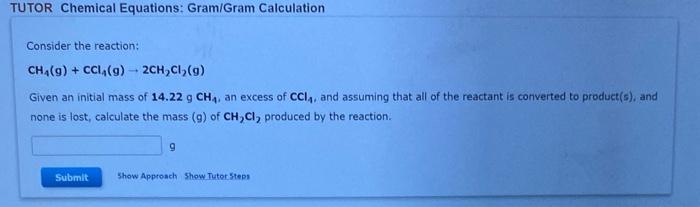
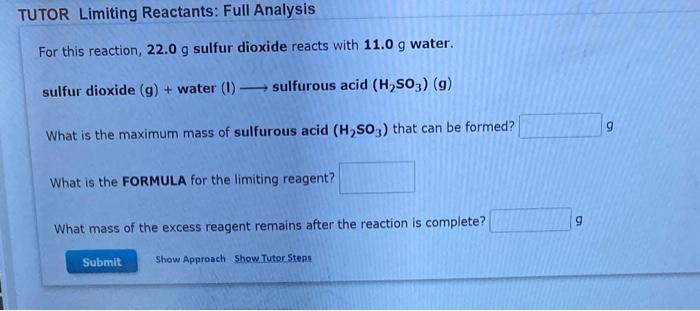
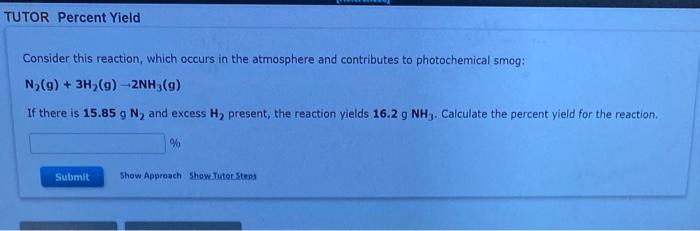
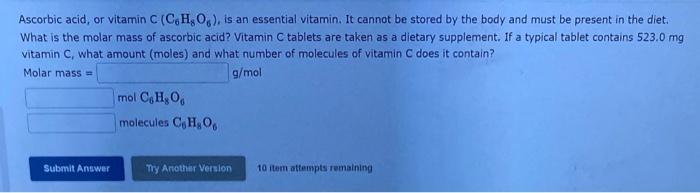
The theoretical yield of a reaction is the amount of product obtained if the limiting reactant is completely converted to product. Consider the reaction: Br2(g)+Cl2(g)2BrCl(g) If 6.650gBrr2 is mixed with 8.980gCl2, calculate the theoretical yield (g) of BrCl produced by the reaction. 9 TUTOR Chemical Equations: Gram/Gram Calculation Consider the reaction: CH4(g)+CCl4(g)2CH2Cl2(g) Given an initial mass of 14.22gCH4, an excess of CCl4, and assuming that all of the reactant is converted to product(s), and none is lost, calculate the mass (g) of CH2Cl2 produced by the reaction. 9 sulfur dioxide (g)+ water (I) sulfurous acid (H2SO3)(g) What is the maximum mass of sulfurous acid (H2SO3) that can be formed? 9 What is the FORMULA for the limiting reagent? What mass of the excess reagent remains after the reaction is complete? Show Tutor Stept Consider this reaction, which occurs in the atmosphere and contributes to photochemical smog: N2(g)+3H2(g)2NH3(g) If there is 15.85gN, and excess H2 present, the reaction yields 16.2gNH3. Calculate the percent yield for the reaction. Ascorbic acid, or vitamin C(C6H8O6), is an essential vitamin. It cannot be stored by the body and must be present in the diet. What is the molar mass of ascorbic acid? Vitamin C tablets are taken as a dietary supplement. If a typical tablet contains 523.0 mg vitamin C, what amount (moles) and what number of molecules of vitamin C does it contain? Molar mass = g/mol molC6H8O6 molecules C6H8O6
Step by Step Solution
There are 3 Steps involved in it

Get step-by-step solutions from verified subject matter experts
 Study Help