







Question: Answer following questions based o this case study above #1 With the rise in purchasing power in India, online shopping (including grocery shopping) has seen
Answer following questions based o this case study above
#1 With the rise in purchasing power in India, online shopping (including grocery shopping) has seen an increase in popularity. Many of the major population centers are dispersed in the country but lucrative online markets for Fresh Buy. If these population areas are to be serviced by Fresh Buy, what are the most important Logistical challenges that are present and will need to be addressed in India? (Ensure you support your statements with concepts/references). As you list these challenges, elaborate on mitigation and solutions that can affect the performance for Fresh Buy and allow it to become competitive.
#2 The primary goal of logistics is to achieve consistent service at the lowest possible total cost. What are the current issues that Fresh Buy is facing that is affecting its growth? What do you suggest they should do to increase market share, reduce distribution/transportation cost, and improve customer serviceability? Elaborate and connect with Supply Chain Concepts and your positions must be supported with concepts/references.
#3 Logistics involves several functions/categories (Integrated Logistics Management). Please discuss these functions/categories and how they might affect Fresh Buy. In addition, what areas of these logistical functions/categories has Fresh Buy concentrated on in order to gain a competitive advantage, and what do you suggest they do, in order to gain further advantage and market share?
#4 What are the Supply chain Risk factors and Complexity that this market segment is associated with? Discuss how these Risks affect Fresh Buy? (Ensure you support your statements with supply chain concepts/references) In addition, what can Fresh Buy do to mitigate these Risks, and ensure that they are addressed and allow Fresh Buy to be successful?
#5 Talent is critical for the success of Fresh Buy. What can the company do to attract, develop and retain talent that will enhance the capability of the company. (Ensure you support your statements with supply chain concepts/references). In addition, what challenges will be faced with this talent in the field that Fresh Buy is in, meaning what core concepts and competency development will need to be enhanced with employees that will benefit the company with the work that is done by these employees?
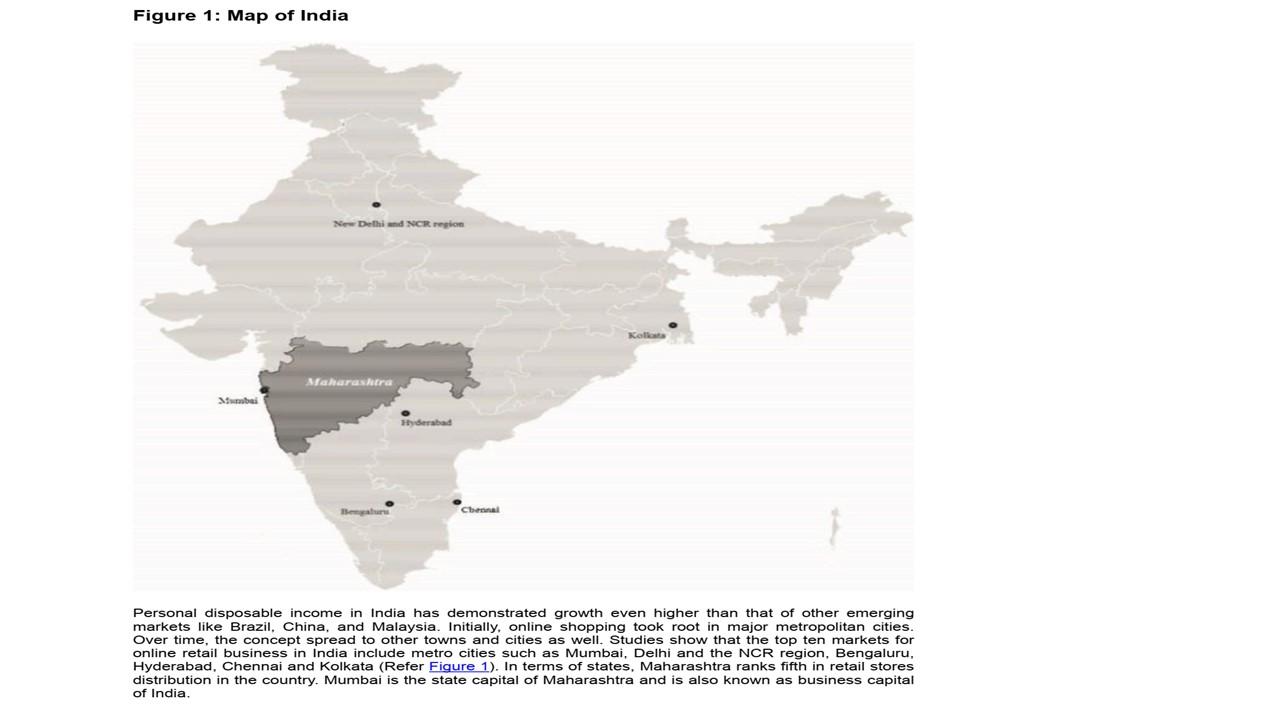
Case Keywords: e-grocery, India, logistics cost, delays, vehicle routing. On a bright Friday afternoon Prateek Juneja, an MBA intern at Fresh Buy (FB), reflected on the events of the last few weeks in the company. Since 2013, FB had been operating in Mumbai, the capital of Maharashtra state. Prateek was hired from a premier b-school in India to identify appropriate solutions for FB. He was a little stressed as his internship was ending on Tuesday and his proposal for improving logistics practices at FB had not been well received. Prateek had prepared a logistics design recommending the deployment of additional vehicles on existing routes to cope with the increasing demand for FB products. His mentor, Mr. Nikhil Kapoor, Head of the Logistics Department, had expressed his dissatisfaction with Prateek's proposal during the previous meeting and asked Prateek to revise it with a focus on cost reduction - specifically he asked Prateek to improve delivery performance but only utilizing existing assets. 1. Online Groceries Market The increasing penetration of the Internet and the widespread availability of smartphones has been a major impetus to the growth of online shopping. A strong economy and full employment has left people time- constrained, a major factor contributing to a growing preference for shopping from the comfort of their own space, anytime, anywhere, on online stores that are open 24 x 7 x 365. Thus, more and more consumers are turning to online stores to make purchases including for groceries. The rise in online shopping can also be attributed to the rise in the purchasing power of the Indian population. As online shopping (including "grocery shopping") gains popularity more people do their shopping at these virtual stores. This enables them to avoid driving to physical stores, navigating often heavy traffic and paying expensive parking fees to bring in their monthly groceries or make more urgent purchases. They can do so from the comfort of their own space, anytime, anywhere. Food 1 has emerged as a prominent category in online retail business in India. Though the gross margin for this market is between 1215% 2, the size of traditional grocery retailers is larger than that of modern grocery retailers. Figure 1: Map of India New Delhi NCR region Ko Maharashtra Sumbai dersbad Cena Personal disposable income in India has demonstrated growth even higher than that of other emerging markets like Brazil, China, and Malaysia. Initially, online shopping took root in major metropolitan cities. Over time, the concept spread to other towns and cities as well. Studies show that the top ten markets for online retail business in India include metro cities such as Mumbai, Delhi and the NCR region, Bengaluru, Hyderabad, Chennai and Kolkata (Refer Figure 1). In terms of states, Maharashtra ranks fifth in retail stores distribution in the country. Mumbai is the state capital of Maharashtra and is also known as business capital of India 2. Journey of Fresh Buy (FB) Fresh Buy (FB) was one of the major players in the e-grocery market, serving customers in Mumbai and its suburban areas. Established in May 2013, the company soon registered growth and began to compete with the established players such as Bigbasket 3 and Groffers 4. FB soon built its reputation of supplying fresh fruits and vegetables to its customers, which it sourced directly from farmers, and stored in its collection centers in Othur, Sinnar and Nashik. At these collection centers, the fruits and vegetables underwent sorting and inspection, after which they were transported to the Distribution Center (DC) at Navi Mumbai. Orders placed by both B2B & B2C customers were aggregated at the DC and delivered to the respective customers in Mumbai. FB provided deliveries to 79 pin codes 5 across Mumbai and its suburban areas from DC, of which 59 pin codes had relatively higher demand. Some of its prominent B2B customers included REDCARPET, Superfresh, Bigbasket, Thyrocare, and Groffers (Exhibit 1a). 3. Current Logistics Network Mr. Kapoor was concerned about the logistics cost that FB had incurred for its operations during the last financial year. This cost included the transportation cost for all vehicles in the region. It is in this context, that he asked Juneja, an intern in the company, to recommend a solution to reduce the cost. As per the current logistics network, the company delivered fresh fruits and vegetables to its customers over two time-slots - one in the morning and the other in the evening. Both the morning and evening delivery options were available in the high demand areas, while for the others, the company only made deliveries in the evening. The B2B customers preferred their orders to be delivered during the mornings, to fulfil the demand of their customers throughout the day. To ensure smooth delivery to its B2C segment, FB divided the pin codes of its customers into four different routes - Central, Western, Thane and Navi Mumbai (See Exhibit 1b). 4. The Challenge FB had witnessed an impressive growth in business over the previous few months, leading to a rise in its customer base, and consequently giving rise to the need for the company to revisit its logistics approach, to reach the new customers and provide them with timely deliveries. Mr. Kapoor was comfortable with the existing logistics to deliver to its B2B customers since the high volume of demand offset the cost of dedicated full truck loads. It was the increase in B2C customers and serving them through the existing model that was the cause of worry and so he asked Juneja to propose a solution that focused on reducing the transport cost, while at the same time, ensuring delivery in a nine-hour window. Juneja first gathered data of the order details for all routes (Exhibit 2a; 2b) and zone-wise travel distance (Exhibit 3) for the month of February 2016. He studied the route plan and found that it had been created on a trial and error basis to meet the current requirements. He further noted that FB rented four vehicles from a third-party logistics (3PL) service provider (Exhibit 4) and the cost for the month (Exhibit 5) indicated a significant amount of overtime. Juneja recalled the previous day's meeting with Mr. Kapoor where his mentor had shared his worries about late deliveries, given that the company had built up a reputation for quality and timely deliv of its products. Mr. had also pointed out to Juneja that during his last meeting with the 3PL service provider, he had expressed concerns about renewing the contract with the company as they would not be able to provide vehicles to FB with a larger capacity (e.g., the Mahindra (5025)) because these vehicles were already contracted out elsewhere. However, Mr Kapoor also told Juneja that the current 3PL service provider had served FB during difficult times and was a loyal client, such that FB's CEO had instructed them to maintain the partnership in the long term. In addition to this, FB's market research division had submitted a report the previous Monday detailing the possibility of a 25% increase in sales across all pin codes during the following financial year. Mr. Kapoor was duly concerned as to whether the existing vehicles were being optimally used and asked Juneja to keep all these aforementioned facts in mind while designing his proposal. 5. The Proposal To revisit the current logistics, Juneja first identified the list of active customers at respective pin codes (Exhibit 6). He was not very clear about the current zone-wise route plan and wondered if point-to-point, i.e., pin code to pin code would give a better picture of the distances (Exhibit 7). He recalled that during his MBA program, he had encountered a similar situation which had been solved using the Clark and Write's algorithm (Exhibit 8). He thought that the algorithm could be applied to find a solution to the case in hand. While designing a new route, he had to keep in mind that the load of any route should not exceed the vehicle capacity and that delivery had to be made in a nine-hour window. He assumed on a regular day, vehicles would be able to run at an average speed of 40 kms per hour. But also he knew that this assumption would not be applicable during peak traffic periods. He needed to ponder on this assumption to incorporate possible delays into the calculations. Finally, he had to consider the average delivery time per customer. He found that in cases of high density of order areas, for example, at pin code 400706, delivery time would be one minute on average while for others it could go up to 5 minutesStep by Step Solution
There are 3 Steps involved in it

Get step-by-step solutions from verified subject matter experts
 Study Help