Question: Answer the question after reading the case study. Question: 1. Discuss the Desifirangi e-commerce business model. Case study: ELECTRONIC RETAILING IN INDIA Electronic retailing (e-retail),
Answer the question after reading the case study. Question:
1. Discuss the Desifirangi e-commerce business model.
Case study:
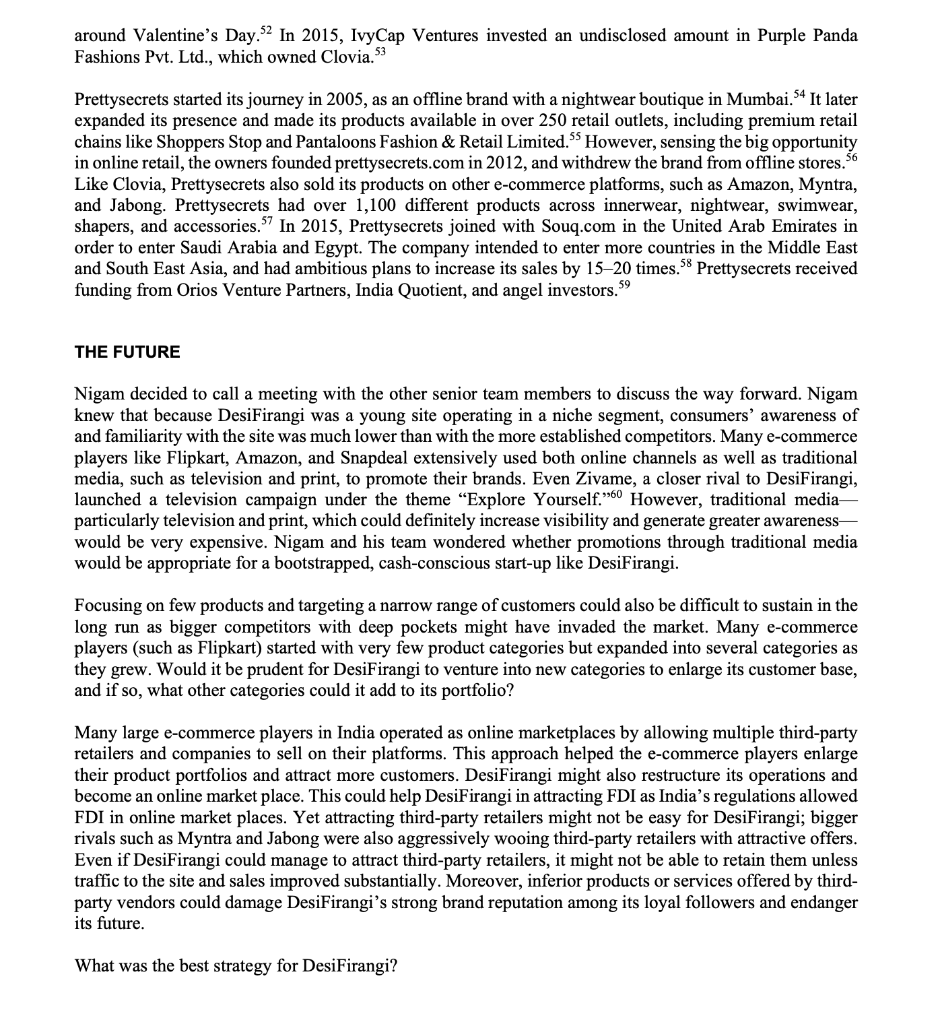
ELECTRONIC RETAILING IN INDIA Electronic retailing (e-retail), or business-to-consumer e-commerce, was growing at a brisk pace in India. The Indian e-retail market size, which was estimated at US$2 billion in 2013, was projected to grow at a compound annual growth rate (CAGR) of 60-65 per cent and reach $4555 billion by 2020. Though only 0.3 per cent of overall retail sales took place through online retail in 2013, e-retail was expected to account for over 5 per cent of total retail sales in India by 2020. Other reports indicated that the market might reach "$220 billion in terms of value of goods sold by 2025.94 There were many reasons for this rapid growth, including convenience, saving of time and effort, and access 24 hours a day, seven days a week. In the Indian context, the deals and discounts offered by online retailers were other important factors contributing to the growth of consumer e-commerce. It was also believed that increasing availability of smartphones and Internet broadband was fuelling the e-commerce boom in India. The bulk of online retail sales came from books, electronics, and apparel and accessories. In spite of its boom, the e-retail industry had its share of problems. Cost of customer acquisition was very high for e-retailers because these firms were engaged in deep discounting in order to acquire customers in the fledgling and evolving market. The firms also spent heavily on other promotions and marketing activities to attract many first-time online shoppers. E-retailers intended to recover these costs through repeat purchases by customers. However, the deep discounting led to huge losses among online retailers. For instance, online fashion retailer Jabong.com was reported to have lost 57 per cent of ever every rupee earned because of discounts and other marketing expenses. Further, customers had become habituated to heavy discounts, and shopped on multiple sites looking for the best deals without having any loyalty to any particular seller. This challenged e-commerce firms to retain customers and generate repeat orders. Mo companies offered free shipping for many purchases, resulting in additional costs for the e-retailers. The industry was also plagued by a high rate of product returns. One of the main constraints of online shopping was the lack of opportunity for customers to touch and feel the products, which made evaluation of alternatives on e-retail sites difficult. Therefore, many first-time buyers felt online shopping was risky. In order to alleviate the fears of such customers, e-retailers promised easy return policies with no questions asked, but this resulted in a massive number of returns. Though the estimates varied, some reports indicated that the return rate could be around 15-20 per cent in the industry, and might be as high as 40 per cent in the case of cash on delivery. The cost of goods returned was estimated to be close to $1 billion. Given the rapid growth the industry was witnessing, this problem might intensify further. Many sellers that sold on popular e-commerce sitessuch as those run by Amazon.com, Inc. and Flipkart Online Services Pvt. Ltd. complained that the return rate had increased in many categories by as much as 50 per cent since the beginning of July 2015." Some consumers themselves admitted that they returned as much as 30 per cent of their online purchases, and many non-serious buyers might window shop for fun by placing orders on e-retail sites. The returned goods were sent back into inventory and re-listed on the website. On some occasions, the returned goods had to be written off altogether. Because most of the online retailers offered free shipping to attract customers, the retailers were also forced to incur shipping costs both for delivery and return in many instances. Therefore, the high rate of returns further contributed to the financial burden of the industry. Another challenge that was typical in the Indian market was low penetration of credit cards and a consumer preference for cash transactions. Online retailers had begun offering options to pay cash on delivery to overcome this difficulty-widely believed to be an option that was one of the critical factors in the success of e-retail in India. The payment option allowed consumers to pay for a purchase in cash when they received the goods instead of paying with a credit or debit card at the time of placing the order. Notably, this option On a sunny day in the first week of March 2016, Shailesh Nigam, co-founder and director at DesiFirangi.com (DesiFirangi), an online women's fashion apparel retailer, was going through the sales reports of last quarter. DesiFirangi, which started its operations in November 2014, had been able to establish itself as a niche lingerie, nightwear, and clubwear retailer within the short span of its operations. The company was averaging about 8,000 customer visits to the site daily, with a conversion ratio that was at par with the industry standards. The fledging company, however, was facing intense competition because the market was extremely competitive, with a number of established and upcoming players. According to some reports, 32 foreign fashion retailers had ventured into the Indian market through online sales since the beginning of financial year 2015/16 alone. DesiFirangi was also facing a number of other challenges. Many Indian e-commerce players used heavy discounts and sold merchandise below the cost price in order to attract customers. Nigam and his team had resisted the urge to follow the crowd on deep-discounting, and focused on product quality and service to attract and retain customers instead; this strategy resulted in fewer, but highly satisfied, customers. Moreover, unlike many other e-commerce players, which followed the marketplace model and sold a variety of product categories and brands through a number of third-party retailers on their sites, DesiFirangi largely focused on developing and marketing its own brand through curated designs sourced directly from manufacturers, along with a few other high-quality, yet reasonably priced brands. The focus on a few brands and a narrow range of categories also led to fewer customer visits to the site and high customer acquisition costs. Given the intense competition and the inherent challenges associated with being a new entrant, Nigam knew that it was imperative to increase the customer base and enhance customer loyalty to grow the business. DesiFirangi was decently profitable at the gross level, but the marketing costs were pulling the business into the red; hence, it was important to increase both site visits and conversions within the existing marketing spends. Nigam took a deep breath and decided to put his more than two decades of advertising and marketing experience to work. led to added costs for online retailers because they had to pay courier companies to collect the cash from customers and transfer it to the company." Indian e-retailers also had to overcome hurdles related to logistics and last-mile connectivity. The online retailers had to depend on third-party courier companies to deliver products to consumers. Many of these courier firms were small and unreliable, which often led to delays in delivery and damage to the goods.15 In some instances, products such as mobile phones were stolen in transit, and replaced with items like soap bars. To overcome these challenges, large e-commerce companies like Flipkart and Amazon invested in their own infrastructure for shipping. Smaller e-commerce companies, however, had to rely on third-party service providers. Indian e-retailers also had to cope with India's under-developed and inefficient rail and road networks. Some retailers complained that up to 90 per cent of goods purchased online were shipped by air, which substantially increased the delivery costs. Given the high rate of product returns, reverse logistics represented another difficulty for e- retailers. The industry faced regulatory challenges as well. States like Uttarakhand and West Bengal had imposed entry taxes on goods sold by e-commerce companies, which put e-retailers at a disadvantage compared to brick-and-mortar retailers; the additional tax made products purchased online more expensive for end-users. Flipkart filed cases challenging the entry tax against the respective state governments, and the same issue had also been contested in the Supreme Court of India. Moreover, the recently announced government regulations for e-commerce elicited mixed reactions from the industry. Though foreign direct investment (FDI) was not permitted in the retail sector in India, the new regulations permitted 100 per cent FDI in online marketplacesthe method followed by large online retailers such as Flipkart, Snapdeal.com, and Amazon. While the new regulations were a welcome step, they largely took away freedom in pricing by prohibiting marketplaces from offering discounts. The new regulations also capped the total sales by a single vendor on a site at 25 per cent. Some experts considered these policies to be ill-conceived, and expressed the concern that they might hamper the growth of the industry." FASHION AND APPAREL E-RETAIL Apparel and accessories was one of the fastest growing categories in the e-commerce industry. It was estimated that 35 per cent of online retail revenue would come from apparel and fashion accessories by 2020.20 Reports also indicated that almost 40 per cent of funding received by e-commerce companies from private equity and venture capital firms was garnered by firms operating in the online apparel retail space.21 At the outset, apparel was seen as a difficult category to sell online because many consumers might want to touch and feel the fabric and try the garment before making the purchase. Therefore, it was thought that making consumers buy apparel online was a mammoth and challenging task. However, online apparel retailers were able to break this barrier using a variety of means. Technology played a vital role in the success of online apparel retail in India. High-resolution pictures and videos of models, 360-degree viewing and zooming tools, and virtual dressing and three-dimensional trial rooms in which buyers could try the garments before purchasing made product selection easier for buyers.22 It was also possible for consumers to find the right fit on some sites by keying in their measurements. Deft marketing and heavy promotions by some online retailers, as well as availability of a multitude of choices, also played important roles. To promote apparel sales, for example, Amazon India sponsored India Fashion Week and carried out a variety of activities such as live-streaming of fashion shows, chats with designers, and attractive offers to lure customers. The company tied up with fashion bloggers and 23 designers, and ran events and contests to promote the fashion week. As well, the company advertised heavily on television, in print, and on social media to promote Amazon Fashion.24 Easy product return policies also gave confidence to buyers that they could return the garments without any hassles if they had problems with size and fitting or didn't like the fabric. An increase in women online shoppers was another factor that fuelled online apparel sales. Small-town shoppers who did not have access to malls and high fashion streets (as did their metropolitan counterparts) also played a critical role in the success of online apparel sales. Reports indicated that Tier 2 and Tier 3 cities and towns accounted for more than half of online apparel sales.25 Innerwear and Lingerie Among all products in the apparel category, innerwear was considered to be a category with high potential for growth. Innerwear, which was rarely openly discussed in India, was witnessing a slow evolution and gradual association with fashion. The innerwear market was estimated at approximately $3 billion in 2014, and was projected to cross $10 billion by 2024.26 A larger number of women in the workforce, a rise in disposable incomes, and increasing consciousness about fashion and the latest trends were some of the factors that were expected to lead to growth in the innerwear segment. Though the innerwear market in India was traditionally fragmented and dominated by local and unorganized players, it was believed that the organized innerwear segment in both men's and women's categories had witnessed promising growth over the previous few years. Women's innerwear and lingerie accounted for about 60 per cent of the market and was growing at a CAGR of 15 per cent, largely due to the increase in the number of working women and the growing share of Western wear in their wardrobe.27 The bulk of lingerie, however, was bought from brick-and-mortar stores where men often acted as sales assistants.28 Because India was a traditional and conservative society, the presence of male sales assistants and other men in the shops made lingerie purchases awkward and uncomfortable for many women.9 Availability of lingerie online took this discomfort away for most women. Some online lingerie retailers noted that they were using technology to solve a cultural problem. Many women said that online lingerie retailers gave them an alternative to physical stores, and they could shop on those sites with more comfort, privacy, and discretion. Availability of a much larger variety of products and attractive pricing by e-retailers also boosted online lingerie sales. The online lingerie market was estimated to be $1.4 billion with a projected CAGR of 14 per cent. 32 Challenges with Apparel E-retail Though online apparel retail was growing at a brisk pace, online apparel retailers were confronted with similar regulatory, logistical, and related challenges faced by other e-commerce players. The product return rates could be much higher in the apparel category because buyers sometimes felt that the look of the actual product was different from its appearance on the website. After trying the product, consumers might also be dissatisfied with its touch and feel, which was very critical in this category. Lack of standardized sizes in the Indian market could be another problem. Many customers had a tendency to return products after single use and cite size as an issue for the return.33 DESIFIRANGI.COM DesiFirangi catered "to the fashion needs of the modern Indian women" by offering lingerie, swimwear, nightwear, clubwear, leisurewear, and resortwear through their e-commerce site.34 The firm was part of eMAGINe Ventures Retail Pvt. Ltd, an organization that was started by seven people, including Nigam, who came together with a vision to provide international fashion at Indian prices to the modern Indian woman with "an Indian soul and an international style."35 The seven founders had over 100 years of combined experience in a wide variety of different sectors, such as manufacturing, distribution and logistics, marketing and brand management, customer care, analytics, finance, and engineering. Nigam, having worked in the advertising and marketing industry previously, was very passionate about the venture. DesiFirangi is the lovemark' of our keen focus on understanding what women want, and what men want [to buy for the women in their lives), and going all out to ensure that they get that at a quality and price that is just perfect," noted Nigam. Befitting their business and its consumers, five of the seven founders were women. DesiFirangi started its operations in November 2014. Nigam, who did not come from a business-oriented family and was taking his first steps towards entrepreneurship, had driven the strategy, development, and marketing of the e-commerce stores of two leading multinational corporate giants in India in his previous organization. Nigam had witnessed first-hand how e-commerce could solve availability and distribution challenges and make otherwise inaccessible products available to consumers in far-flung areas at affordable prices. Eager to do something of his own in the same domain, Nigam decided to focus on the needs and aspirations of consumers beyond metropolitan cities and state capitals, and zeroed in on women's apparel as the category for his venture. However, he decided to stay away from traditional Indian wear, because this segment was highly crowded with a large number of players; instead, he decided focus solely upon lingerie, nightwear, and Western wear. Nigam was clear that he did not want to compete with established players like Myntra or Jabong?" by offering a wide range of sub-categories, at least not in the initial years of operations. Through initial research, the founders of DesiFirangi learned that there was a strong need for quality women's lingerie at affordable prices, not only in urban centres but also in smaller towns. There were a number of other reasons the founders chose lingerie over formal wear. Over the previous few years, the lingerie market in India had undergone a transformation. There had been a lot of innovation in manufacturing, styling, and adoption of lingerie. The entry of a large number of high-quality products had given the industry a new fillip, as had the growing number of working women, a rising level of media exposure, changing fashion trends, and a greater craving for and awareness about fit, brands, colours, quality, and designs. Indian women were also becoming choosy with lingerie. The result was that the lingerie industry was growing in double digits and offered good margins, and had already attracted the attention of quite a few players. The high-quality segment, though, was still dominated by just a few leading Indian and international brands, with availability limited to very few stores and prices that were still out of reach for most consumers. Despite availability and price issues, growing independence, fashion-consciousness, and rising income levels of Indian women were manifesting in their rapidly changing lifestyles, Western fashion sense, and pride in dressing up just for themselves. This shift had changed lingerie pieces from just unmentionable undergarments to flaunt-worthy fashion items. However, according to Nigam, there were four key issues that interfered with purchasing quality lingerie from brick-and-mortar stores: range and quality (the absence of a good range and international-quality products at a single location, and the inability to check out all designs available at the store); affordability issues (prohibitively high pricesthe starting prices for quality lingerie began upward of 1,00038 or about $15 per itemwhich prevented many women from indulging); emotional resistance (women were reluctant to discuss product details, ask for slinky, transparent designs and deal with male sales personnel in stores); and male reluctance (men found it embarrassing to purchase lingerie in India). The nightwear market faced exactly the same issues, with just basic, everyday nighties being available in stores and the delightfully flimsy items being off-shelf at most places. DesiFirangi's founders were convinced that this was something that needed change for the good of consumers. Quality lingerie and nightwear should be easily available and affordable. Hence, DesiFirangi started its operations with lingerie and nightwear lines first. The founders had already identified through prior research that honeymooners and vacationing couples were a big market, so targeted this segment by later adding clubwear, resort wear, and beach wear to the company's portfolio. Right from the beginning, the founders wanted to offer quality products. "A female should feel happy and comfortable seeing and wearing our products, said Nigam. As a result, sourcing the right products with good quality was imperative. Consequently, Nigam and his team did not restrict their sourcing options within the country, but decided to go beyond India to other countries such as China, Sri Lanka, Indonesia, the United States, and European nations. This enabled them to source quality products from multiple manufacturers at competitive prices. DesiFirangi also decided to carry some of the upcoming high-quality, affordably priced Indian lingerie brands on its site. Because of its very strong focus on quality, DesiFirangi did not witness a single product return in the most recent year. This was a remarkable feat given that the industry was plagued by high rates of product return. The flip side of offering superior quality was that the product had to be priced higher than some competing "me-too" products available online, but that was a trade-off that Nigam and his team were happy to make. "We might be losing some customers to competition due to our slightly higher prices, but we are happy with the knowledge that all the people who made a purchase on our site are satisfied with the clothes; not a single product return over the last ... year and quite a few returning customers show that customers are, in fact, delighted with our products, noted Nigam. He added, We are building a niche for ourselves through superior product quality, unique designs, and great service; most of the designs that are available on our site are not available on any other site." DesiFirangi further differentiated itself by offering a wide variety of sizes, including exciting styles for plus-sized women, so its products suited the needs of different customers. To increase its customer loyalty and brand preference, DesiFirangi regularly provided a preview of its new designs to regular customers and gave them an opportunity to buy these products before they were offered to other customers. DesiFirangi also offered bonus points equivalent to 10 per cent of the cost of the products bought by the customer. Customers could redeem these points when they made their next purchase. DesiFirangi was based in Faridabad, a suburb of Delhi, and had its own warehouse for product storage. It used third-party logistics partners for product delivery. Being highly customer oriented, DesiFirangi took immense pride in its products, processes, and response times. Even if we receive an order at 4:00 p.m., we mostly ship the product on the same day, said Nigam. He added, For customers in Tier 1 and Tier 2 cities, our product is delivered within a day or two. Even for customers in the remotest corners of India, we ensure that our product reaches [them] within four to five days. Like other e-commerce firms, DesiFirangi offered easy return policies. Customers could also email or call DesiFirangi's helpline to resolve any issues related to product or delivery. PROMOTION Nigam delved into his entire past experience and expertise in advertising and marketing to devise and drive a market entry strategy, and to create a strong brand presence and niche for DesiFirangi. The core target audience for the company was males and females, aged 2535 years, who had already been shopping online. "Existing online shoppers were the obvious low-hanging fruit, and we decided to target them initially; it would be easier to convince them to shop with us than those who never shopped online," noted Nigam. Moreover, as an online brand, DesiFirangi mainly relied on online channels to promote itself. As we are an e-commerce firm, we primarily wanted to focus on online channels [because) they allow faster and easier reach to our already-online audience," said Nigam. To support the company's online marketing strategy, the marketing team at DesiFirangi first focused on search engine optimization (SEO) and search engine marketing to draw customers to its site. The team members initially identified 50 keywords relevant to DesiFirangi by observing consumer searches and industry practices. They narrowed this list down to 24 keywords after carefully analyzing the results in terms of search engine rankings, and the number of hits and conversions for each keyword over a period of three months. The team focused on those 24 keywords to strengthen DesiFirangi's positioning. In conjunction with this, the team used off-page SEO activitiessuch as blogs, directory listings, fashion bloggers' reviews of products, and multi-channel social media presence and engagementto develop a greater presence and relevance for the brand. The DesiFirangi team also procured sharply segmented email addresses from e-mail marketing and database companies and sent e-mails and promotional offers to prospects. It tied up with online travel portals and, through its email campaigns, targeted honeymooners and young international travellers who were travelling as couples. DesiFirangi used Facebook extensively for its advertising and promotions. It used the demographic and social profiles available within Facebook to identify extremely relevant target audiences, and customized its offers and promotional campaigns for them. Using Facebooks custom audiences" feature, the team used profiles of existing customers to target potential customers matching those profiles. Most of these campaigns worked extremely well for DesiFirangi. The site traffic went up by 40-100 per cent, and conversion rates went up by 2030 per cent during these campaigns. "While SEO has laid the foundation for our brand presence, both Facebook and e-mail marketing campaigns have helped us substantially to gain consumers," said Nigam. Though they mainly relied on online campaigns, the DesiFirangi team also used offline platforms selectively to generate awareness and visibility for the fledgling company. DesiFirangi was the official swimwear partner for Miss North India 2015, a beauty pageant that had been conducted for over nine years. In addition, the company sponsored Mrs. India Worldwide 2015, in which women of Indian origin from 42 countries participated. In addition, DesiFirangi sponsored various college festivals, sponsored prizes for many events, and distributed discount coupons to all festival attendees. College students are young, willing to experiment, and already buy[ing] online. We promoted Western wear and [the] clubwear range in college festivals, and were delighted by the response and feedback we got from them," affirmed Nigam. In the early days, DesiFirangi advertised and sponsored programs on FM radio channels in Delhi and Mumbai for six weeks. Our radio campaign was designed to catch the wedding season and Valentine's Day purchases; we had just started operations, and it definitely had [a] good impact on sales," noted Nigam. COMPETITION The online apparel, fashion, and accessories market was highly fragmented and competitive. The market primarily consisted of four types of players. The first type included firms like Amazon and Snapdeal, which sold multiple categories and brands but had a considerable interest in the apparel category because of its huge potential. Amazon actively promoted apparel and fashion on its site by organizing events like India Fashion Week, and spending heavily on promotions. Amazon was also planning to create its own private label in the fashion and lifestyle category, making India the first country where Amazon had its own private label in this category. In 2015, Snapdeal, one of the largest e-commerce players in India, acquired Exclusively.com, founded in 2010 and focused on premium fashion. The site targeted sales of $2 billion worth of apparel and fashion accessories.40 The second type of players comprised e-retailers like Myntra and Jabong, which focused on only apparel and fashion accessories, but were structured as online marketplaces and sold multiple products and brands, catering to different needs of consumers in this segment. The third type included large apparel firms like Madura Fashion & Lifestyle, Fabindia Overseas Pvt. Ltd., and Zodiac Clothing Co. Ltd., which traditionally sold their products offline but made their own brands or brands licensed to them available online through their websites. The fourth type of competitor was pure play e-retailers that catered to a niche segment, such as DesiFirangi. In India's booming apparel e-commerce sector, a number of start-ups had taken this niche route. Among this plethora of firms, keeping their product portfolios in mind, Nigam considered DesiFirangi's main competitors to be Zivame.com, Clovia.com, and PrettySecrets.com. Zivame was one of the early entrants in India's online lingerie market and emerged as one of the leading lingerie e-retailers. Zivame was founded by Richakar and Kapil Karekar in 2011, with $600,000 seed funding. 41 Over the previous four years, Zivame had raised over $48 million from investors such as IDG Ventures, Kalaari Capital, Unilazer Ventures, Zodius Technology Fund, and Khazanah Nasional, the Malaysian sovereign fund. Zivame had more than 2.5 million unique visitors per month and shipped 200,000 items every month with estimated revenues of over $15 million by the end of March 2016.42 It offered over 5,000 styles, 50 brands, and 100 sizes to cater to the growing number of customers." Zivame also designed and developed its own brands; 60 per cent of its revenues were derived from in-house products.44 In order to enlarge its customer base and enable online sales, Zivame planned to open at least 100 fitting lounges across different cities in India to assist customers in understanding the company's sizes. The first lounge was opened in Indiranagar, a neighbourhood in Bengaluru.46 Zivame also aimed to offer superior service to its customers by leveraging technology, for example, in 2015, it was the first Indian company to launch a lingerie application that would help customers with product discovery and quick checkout in just two clicks.*Zivame offered online tools and guidelines for size selection as well. Zivame was growing 10-15 per cent per month and had ambitious plans for the future: the company intended to earn $150 million in sales over the next 35 years.48 Clovia, which was initially known as Moods of Cloe, was founded in 2012 by a team of four people: serial entrepreneur Pankaj Vermani, e-commerce professional Neha Kant, lingerie designer Suman Chowdhury, and start-up specialist Aditya Chaturvedi." Clovia sold lingerie, beach wear, and nightwear through its own website, clovia.com, as well as on other e-commerce sites, such as Jabong and Amazon. The company sold its products in over 1,000 cities, and witnessed robust growth, growing over 100 per cent quarter on quarter. Buoyed by strong growth, Clovia planned to double its production capacityClovia, like Zivame, leveraged technology to serve customers better. Clovia offered a two-minute fit test on its website to enable buyers to find their best fits. Clovia also boasted a number of male customers, with one-fourth of its buyers being men. The percentage of male shoppers could go as high as 40 per cent during wedding season and around Valentine's Day.52 In 2015, IvyCap Ventures invested an undisclosed amount in Purple Panda Fashions Pvt. Ltd., which owned Clovia. 53 56 Prettysecrets started its journey in 2005, as an offline brand with a nightwear boutique in Mumbai. 54 It later expanded its presence and made its products available in over 250 retail outlets, including premium retail chains like Shoppers Stop and Pantaloons Fashion & Retail Limited. However, sensing the big opportunity in online retail, the owners founded prettysecrets.com in 2012, and withdrew the brand from offline stores. Like Clovia, Prettysecrets also sold its products on other e-commerce platforms, such as Amazon, Myntra, and Jabong. Prettysecrets had over 1,100 different products across innerwear, nightwear, swimwear, shapers, and accessories."7 In 2015, Prettysecrets joined with Souq.com in the United Arab Emirates in order to enter Saudi Arabia and Egypt. The company intended to enter more countries in the Middle East and South East Asia, and had ambitious plans to increase its sales by 1520 times. Prettysecrets received funding from Orios Venture Partners, India Quotient, and angel investors. 59 THE FUTURE Nigam decided to call a meeting with the other senior team members to discuss the way forward. Nigam knew that because DesiFirangi was a young site operating in a niche segment, consumers' awareness of and familiarity with the site was much lower than with the more established competitors. Many e-commerce players like Flipkart, Amazon, and Snapdeal extensively used both online channels as well as traditional media, such as television and print, to promote their brands. Even Zivame, a closer rival to DesiFirangi, launched a television campaign under the theme Explore Yourself.960 However, traditional media particularly television and print, which could definitely increase visibility and generate greater awareness- would be very expensive. Nigam and his team wondered whether promotions through traditional media would be appropriate for a bootstrapped, cash-conscious start-up like DesiFirangi. Focusing on few products and targeting a narrow range of customers could also be difficult to sustain in the long run as bigger competitors with deep pockets might have invaded the market. Many e-commerce players (such as Flipkart) started with very few product categories but expanded into several categories as they grew. Would it be prudent for DesiFirangi to venture into new categories to enlarge its customer base, and if so, what other categories could it add to its portfolio? Many large e-commerce players in India operated as online marketplaces by allowing multiple third-party retailers and companies to sell on their platforms. This approach helped the e-commerce players enlarge their product portfolios and attract more customers. DesiFirangi might also restructure its operations and become an online market place. This could help DesiFirangi in attracting FDI as India's regulations allowed FDI in online market places. Yet attracting third-party retailers might not be easy for DesiFirangi; bigger rivals such as Myntra and Jabong were also aggressively wooing third-party retailers with attractive offers. Even if DesiFirangi could manage to attract third-party retailers, it might not be able to retain them unless traffic to the site and sales improved substantially. Moreover, inferior products or services offered by third- party vendors could damage DesiFirangi's strong brand reputation among its loyal followers and endanger its future. What was the best strategy for DesiFirangi









 Study Help