







Question: Answer for this problem is needed (2) Now the goal is find the best q, r, s to fit approximately the data t g(t) 3
Answer for this problem is needed
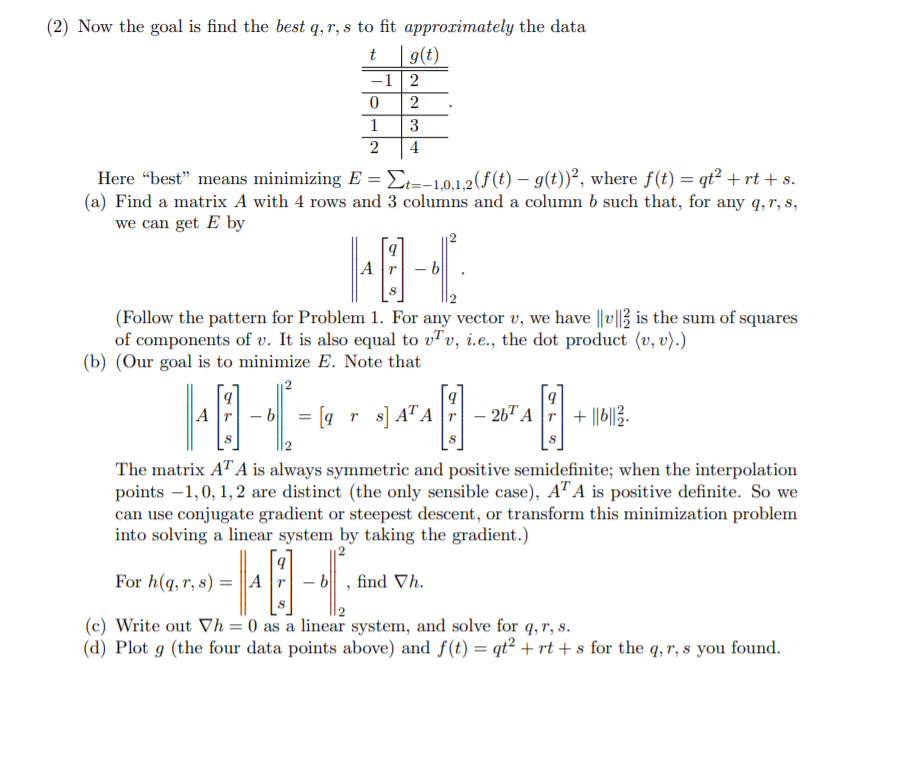
(2) Now the goal is find the best q, r, s to fit approximately the data t g(t) 3 Here "best" means minimizing E = Et=-1,0,1,2(f(t) - g(t))?, where f(t) = qt2 + rt + s. (a) Find a matrix A with 4 rows and 3 columns and a column b such that, for any q, r, s, we can get E by (Follow the pattern for Problem 1. For any vector v, we have ||v|? is the sum of squares of components of v. It is also equal to v v, i.e., the dot product (v, v).) (b) (Our goal is to minimize E. Note that The matrix A'A is always symmetric and positive semidefinite; when the interpolation points -1, 0, 1, 2 are distinct (the only sensible case), A'A is positive definite. So we can use conjugate gradient or steepest descent, or transform this minimization problem into solving a linear system by taking the gradient.) For h(q, r, s) = (c) Write out Vh = 0 as a linear system, and solve for q, r, s. (d) Plot g (the four data points above) and f (t) = qt2 + rt + s for the q, r, s you found
Step by Step Solution
There are 3 Steps involved in it

Get step-by-step solutions from verified subject matter experts
 Study Help