Question: answer from the case 1. Can you explain Ahsans, Owaiss, and Alis motivations based on Expectancy theory of Motivation? III. Solve the attached case study.
answer from the case
1. Can you explain Ahsans, Owaiss, and Alis motivations based on Expectancy theory of Motivation?
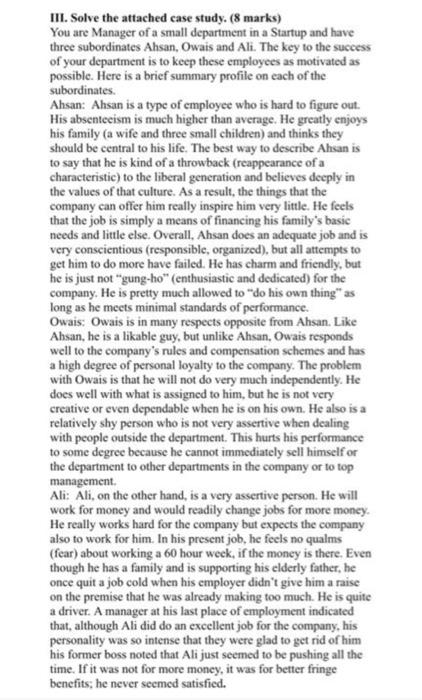
III. Solve the attached case study. (8 marks) You are Manager of a small department in a Startup and have three subordinates Ahsan, Owais and Ali . The key to the success of your department is to keep these employees as motivated as possible. Here is a brief summary profile on each of the subordinates. Ahsan: Ahsan is a type of employee who is hard to figure out His absenteeism is much higher than average. He greatly enjoys his family (a wife and three small children) and thinks they should be central to his life. The best way to describe Ahsan is to say that he is kind of a throwback (reappearance of a characteristic) to the liberal generation and believes deeply in the values of that culture. As a result, the things that the company can offer him really inspire him very little. He feels that the job is simply a means of financing his family's basic needs and little else. Overall, Ahsan does an adequate job and is very conscientious (responsible, organized), but all attempts to get him to do more have failed. He has charm and friendly, but he is just not gung-ho" (enthusiastic and dedicated) for the company. He is pretty much allowed to do his own thing" as long as he meets minimal standards of performance. Owais: Owais is in many respects opposite from Ahsan. Like Ahsan, he is a likable guy, but unlike Ahsan. Owais responds well to the company's rules and compensation schemes and has a high degree of personal loyalty to the company. The problem with Owais is that he will not do very much independently. He does well with what is assigned to him, but he is not very creative or even dependable when he is on his own. He also is a relatively shy person who is not very assertive when dealing with people outside the department. This hurts his performance to some degree because he cannot immediately sell himself or the department to other departments in the company or to top management Ali: Ali, on the other hand, is a very assertive person. He will work for money and would readily change jobs for more money He really works hard for the company but expects the company also to work for him. In his present job, he feels no qualms (fear) about working a 60 hour week, if the money is there. Even though he has a family and is supporting his elderly father, he once quit a job cold when his employer didn't give him a raise on the premise that he was already making too much. He is quite a driver. A manager at his last place of employment indicated that, although Ali did do an excellent job for the company, his personality was so intense that they were glad to get rid of him his former boss noted that Ali just seemed to be pushing all the time. If it was not for more money, it was for better fringe benefits; he never seemed satisfied









 Study Help